VC Reporting Software vs AI Workflow Tools
Use reporting software for audit-ready LP records and AI workflow tools to automate sourcing, outreach and scheduling.
If my team needs audit-ready LP reports, I’d use reporting software. If my team is stuck doing sourcing, follow-ups, and meeting admin by hand, I’d use AI workflow tools.
That’s the short answer.
Here’s the split in plain English:
- Reporting software is for records, valuations, partner packs, portfolio dashboards, and LP updates
- AI workflow tools are for sourcing, email outreach, follow-ups, scheduling, and pipeline tracking
- Reporting software looks back
- AI workflow tools help move work forward
- Many UK VC teams need both, because one handles formal outputs and the other cuts admin before reporting starts
A simple way I’d think about it:
- If your pain is quarterly reporting, board materials, or audit trails, start with reporting software
- If your pain is missed outreach, slow sourcing, or too much calendar admin, start with AI workflow tools
- If your data is messy at the start, your reports will often be messy at the end too
One point stands out: a lot of work in UK deal teams still happens outside the final reporting stack. Emails, calls, meeting notes, and founder follow-ups can sit in inboxes and calendars unless someone logs them. That gap is often where time gets lost.
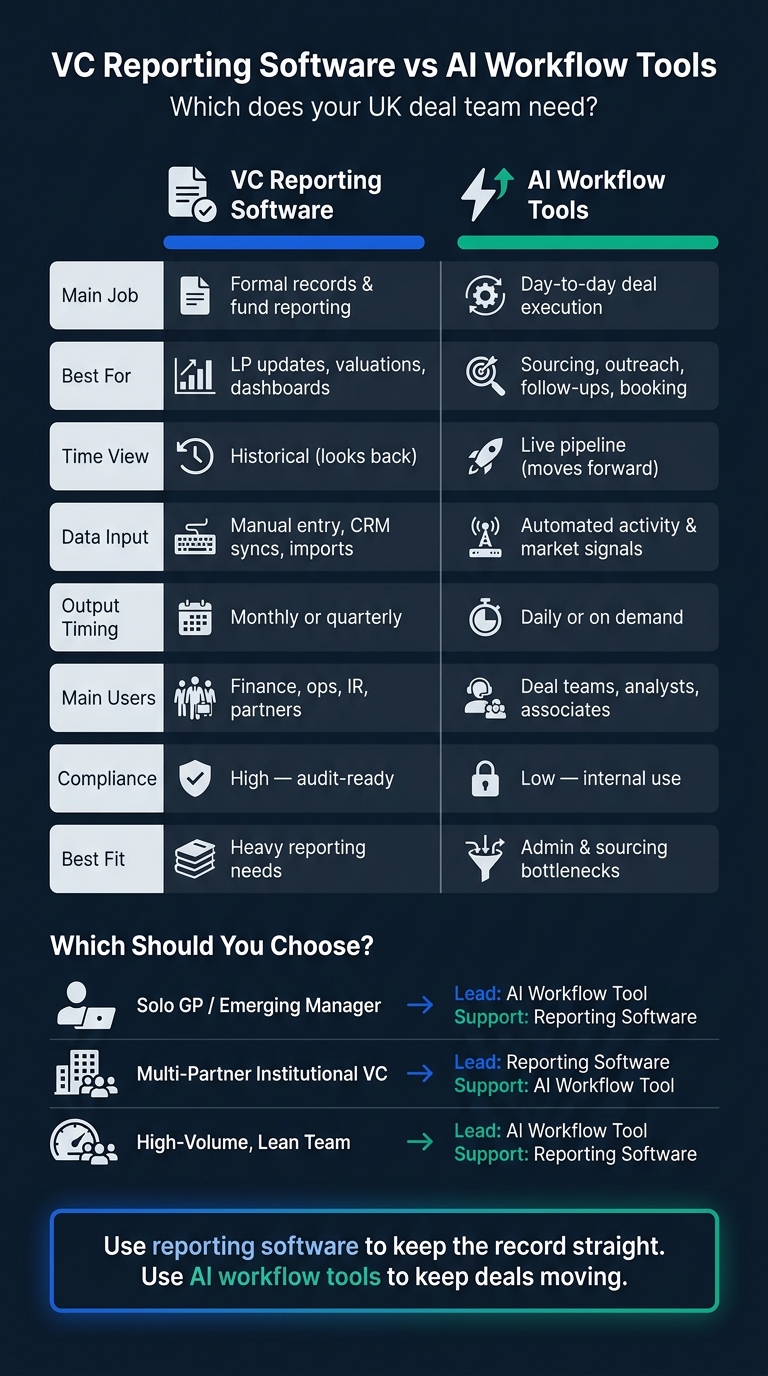
VC Reporting Software vs AI Workflow Tools: Side-by-Side Comparison
Quick Comparison
| Area | VC Reporting Software | AI Workflow Tools |
|---|---|---|
| Main job | Formal records and fund reporting | Day-to-day deal execution |
| Best for | LP updates, valuation records, dashboards | Sourcing, outreach, follow-ups, booking |
| View | Historical | Live pipeline activity |
| Data input | Manual entry, CRM syncs, imports | Automated activity and market signals |
| Output timing | Monthly or quarterly | Daily or on demand |
| Main users | Finance, ops, IR, partners | Deal teams, analysts, associates |
| Best fit | Teams with heavy reporting needs | Teams with admin and sourcing bottlenecks |
In short: I’d use reporting software to keep the record straight and AI workflow tools to keep deals moving.
sbb-itb-c96cd03
Where VC reporting software fits best
Reporting software comes in after the work has already happened. It’s used when data needs to be checked, locked, and shared with LPs and other stakeholders. In that sense, reporting software sits downstream. It’s not the tool you use to run day-to-day execution.
LP reporting, partner packs, and portfolio dashboards
Reporting software handles the formal outputs: LP updates, partner packs, capital call notices, and valuation summaries. Those documents need to be exact.
Portfolio dashboards play a similar role. Reporting systems give GPs a structured view of what the fund owns, what has been deployed, and how each company is performing against benchmarks. That historical record matters when LPs ask tough questions or when an investment committee wants context before a follow-on decision.
Those outputs only work if the inputs are clean. That’s why upstream activity capture matters so much.
What reporting software does well and where it falls short for activity logging
Reporting software works best with structured, verified inputs. Data usually comes in through manual entry, CRM syncs, or formatted imports. That discipline helps keep outputs reliable. But it also means the system is limited to data that has already been logged.
It can’t capture live activity. It can only summarise what’s already there. For formal reporting, that delay is fine. For tracking live sourcing, outreach, and meeting activity, it turns into a bottleneck.
Put simply, reporting tools validate history. They don’t capture live sourcing or outreach. That gap is where AI workflow tools step in.
Where AI workflow tools fit best
Reporting software records what has already happened. AI workflow tools deal with the work that happens before that record exists.
That’s the key split.
These tools sit in the busy middle of the process: sourcing, outreach, scheduling, and moving deals through the pipeline. In plain terms, they help with the day-to-day activity that teams usually end up handling by hand.
Activity logging, sourcing reports, and outreach tracking
The main difference comes down to capture. AI tools can capture calls, emails, and calendar activity on their own, which helps keep records up to date without constant manual logging.
Sourcing changes too. Instead of leaning only on static database filters, AI tools can track live signals like:
- hiring spikes
- GitHub activity
- founder moves
- new domains
That makes it easier to spot companies earlier, often before they show up in standard databases.
Avyn fits into this layer. It helps private market investors source companies, draft outreach, manage follow-ups, book meetings, and track pipeline activity against the fund's thesis.
Meeting booking and internal partner updates
Scheduling eats time. AI tools can handle booking and rescheduling automatically, so analysts aren’t burning hours on logistics that add no analytical value.
They can also produce weekly partner digests covering new targets, founder interactions, and pipeline shifts. Those digests then feed cleaner data into formal reporting later.
The next comparison shows which tasks belong in each layer.
Workflow-by-workflow comparison: which tool handles what
The comparison below shows how the work tends to split in practice.
Activity logging and sourcing reports
Reporting software leans on historical records, like closed rounds and filings. The catch is timing: by the time that data shows up in a database, the first window on a deal may already be gone.
AI workflow tools come at it from the other side. They pull live signals from hiring activity, GitHub commits, and domain activations to spot companies before they turn up in older databases.
| Feature | Reporting Software | AI Workflow Tools |
|---|---|---|
| Data source | Lagging databases and manual entry | Live web signals such as hiring, GitHub activity, and patent filings |
| Update cadence | Batch-based and retrospective | Continuous and real-time |
| Manual input | High - data entry and extraction | Low - automated capture |
| Forward usefulness | Backward-looking (historical comps and validation) | Forward-looking (thesis-driven discovery) |
What you catch early shapes what you can track later. That’s why AI is stronger for live sourcing, while reporting software is better for record-keeping.
Meeting booking and outreach tracking
This is where AI workflow tools start doing the heavy lifting. They can draft messages, chase replies, and handle booking or rescheduling, with manual sign-off only when needed.
| Feature | Reporting Software | AI Workflow Tools |
|---|---|---|
| Automation level | Low - manual logging | High - agentic drafting and scheduling |
| Calendar integration | Basic - syncing history only | Active - managing availability and booking |
| Response handling | Manual | Automated follow-ups and triage |
In day-to-day work, this is often the part that saves the most time. Less admin, fewer dropped threads, and fewer back-and-forth emails.
Partner updates and formal reporting outputs
AI workflow tools are good at frequent, informal digests for internal deal teams and partners. Reporting software handles the structured, auditable outputs that LPs and investment committees want to see.
| Feature | Reporting Software | AI Workflow Tools |
|---|---|---|
| Audience | LPs and investment committees | Internal deal teams and partners |
| Frequency | Quarterly or monthly | Daily or on demand |
| Compliance needs | High - auditable | Low - internal |
| Data provenance | Verified transaction records | Signals and AI summaries |
| Best use case | Formal disclosure and records | Execution and pipeline momentum |
That split is usually what drives the setup choice: one system keeps the official record straight, while the other keeps the pipeline moving.
How to choose the right setup for a UK deal team
That workflow split turns into a buying choice pretty fast. The right setup comes down to one simple point: where is your team still doing manual work?
In most UK deal teams, the decision tends to rest on three things:
- how heavy the reporting load is
- how much admin work still sits with the team
- how much visibility partners need between reporting cycles
Choose reporting software when formal outputs are the priority
If LP reports and partner packs matter most, start with reporting software. That makes even more sense when you need a checked source of truth for portfolio dashboards and audit-ready records.
This route fits teams that care most about polished, formal outputs. If the board pack has to be right every time, and if investors expect clean reporting on a set schedule, reporting software should lead the setup.
Choose AI workflow tools when execution speed is the bottleneck
If analysts are losing hours tracking signals by hand, drafting follow-ups, or chasing calendar confirmations, the problem isn’t reporting. It’s execution.
That’s where AI workflow tools come in. Avyn, for example, scans live signals, scores companies against your thesis, and automates outreach, follow-ups, and meeting booking - all with manual approval gates so nothing goes out without sign-off.
Put simply, if your team keeps saying, “We know what to do, we just don’t have time to do it,” this is probably the better fit.
Use both when you need clean upstream data and formal downstream reporting
Sometimes the issue sits at both ends. When activity is logged inconsistently, downstream reports end up reflecting that mess. Garbage in, garbage out.
AI workflow tools help by capturing pipeline activity automatically as it happens. That means the data moving into your reporting layer is cleaner and more complete. For UK deal teams, any AI tool that touches contact data or outreach should include manual approval gates and GDPR controls.
The right tool depends on which work is still manual today. This table makes the match a bit easier.
| Team Profile | Lead Tool | Support Tool |
|---|---|---|
| Solo GP / emerging manager | AI workflow tool | Reporting software |
| Seed or Series A fund | AI workflow tool | Reporting software |
| Multi-partner institutional VC | Reporting software | AI workflow tool |
| High-volume, lean team | AI workflow tool | Reporting software |
Conclusion: use reporting software for records and disclosure, AI workflow tools for execution
In day-to-day work, the split is pretty simple: reporting software keeps the official record, while AI workflow tools keep the pipeline moving.
AI capture improves the quality of the data that goes into reporting. These tools pass cleaner activity data into reporting systems, from sourcing and outreach to booking and activity logging, before anything reaches the formal record. That’s what helps keep partner updates and formal reporting accurate.
If manual logging and scheduling are slowing the team down, execution is the bottleneck. Sort that out first, and reporting becomes much easier after that.
FAQs
Can one tool do both jobs?
Yes. One platform can handle both deal sourcing and workflow management.
Avyn brings both into one automated workflow for private market investors. It helps teams source companies, draft personalised outreach, manage follow-ups, book meetings, and track pipeline activity in one place.
Which should a small UK VC team buy first?
For a small UK VC team, the first priority should be an AI-native analyst platform like Avyn that automates the origination lifecycle.
Instead of pouring money into disconnected legacy tools - sometimes around £30,000 a year without sourcing a single deal - a small team can get more from one platform that brings together company discovery, outreach, meeting co-ordination, and pipeline tracking.
How do AI workflow tools improve reporting quality?
AI workflow tools help improve reporting quality by automating the synthesis of complex market and company data. That cuts down on the gaps that manual research often misses.
By tracking market activity, funding updates, and hiring patterns, these tools help deal teams produce more consistent research briefs, pipeline updates, partner updates, and deal summaries that stay aligned with the fund’s investment thesis.