
Outbound Deal Flow: AI Workflow for VC Teams
AI-powered workflow for VC teams to source, prioritise, and convert outbound leads while logging every touchpoint.
If I want better outbound deal flow, I need a simple system: pick the right companies, rank them by fit and timing, send short signal-led emails, follow up on time, and log every touchpoint. That is the core point.
In this workflow, I do 5 things:
- build a target list from the fund thesis
- rank companies by fit, momentum, and timing
- draft outreach around a specific trigger
- manage follow-ups and book meetings
- log replies, meetings, and outcomes in the CRM
The article makes one thing clear: AI does the heavy lifting, but investors still decide. That matters because outbound often fails for boring reasons: missed follow-ups, stale lists, patchy CRM data, and slow response times. In many teams, even a 24-hour delay after a funding round or launch can mean missing the window.
A few points stood out to me:
- Funding rounds often need outreach within 24 hours
- Product launches and stealth-to-public moves often need action in 24–48 hours
- Key hires usually matter within 1 week
- The main metrics are response rate, meetings per 100 targets, and time to first contact
In short: I would not treat outbound as a batch of cold emails. I would run it as a tracked process with clear rules, human approval, and live ranking based on market signals.
What follows is a plain summary of how that workflow fits together for UK VC, growth equity, and venture debt teams.
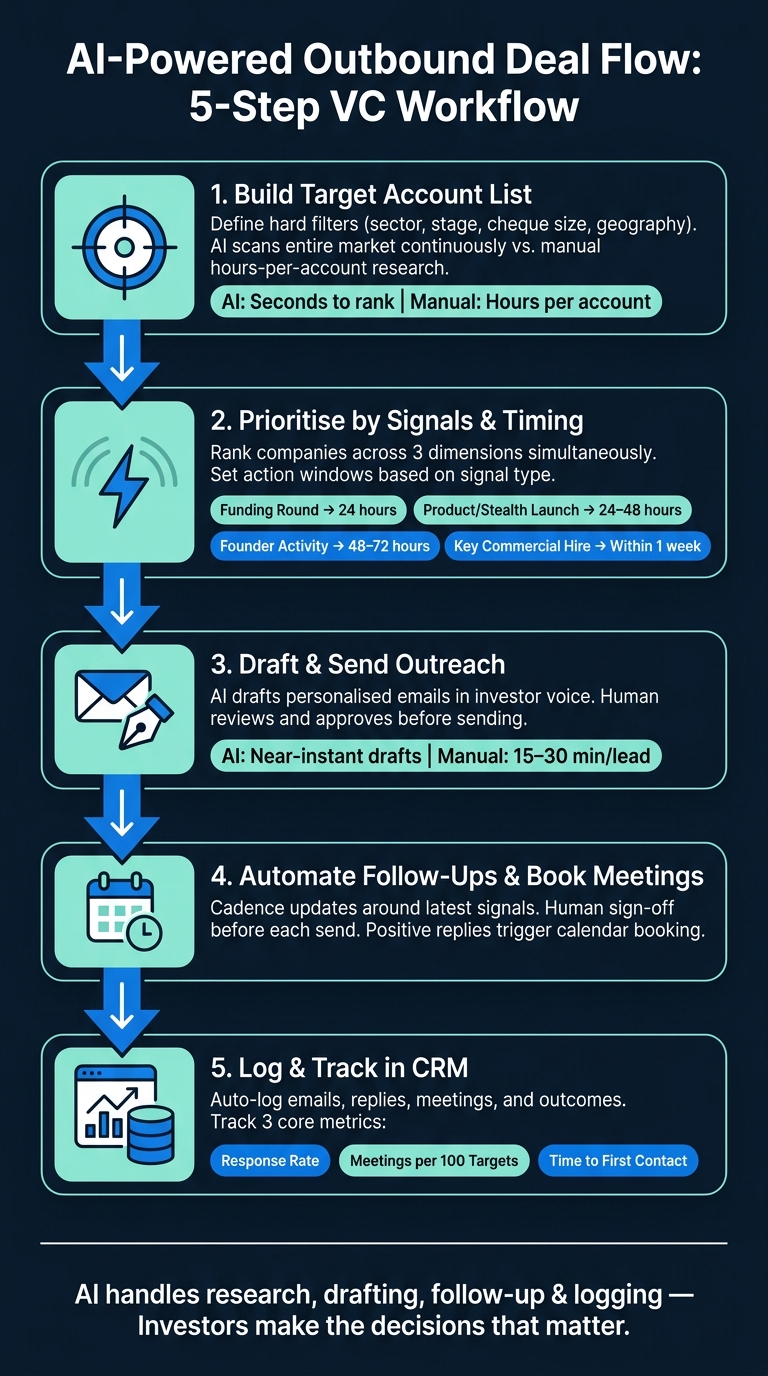
AI-Powered Outbound Deal Flow Workflow for VC Teams
1. Build the target account list from the fund's thesis
Define the company profile before any outreach starts
Before outreach starts, the fund needs a precise company profile. Not a broad sketch, but a set of hard filters that match the thesis exactly.
That means locking in sector focus, cheque size range, target geography, stage, and hiring profile. The geography could be UK-only, pan-European, or cross-border. The filters should reflect both the thesis and the market signals that matter most.
It also helps to add funding history and momentum signals. The more specific the filters, the better the list. In practical terms, the fund should be able to describe its target company in one tight paragraph. Write that profile as a single sourcing brief. That brief then becomes the scoring baseline for the next stage.
Use AI to expand and refresh the target universe
Manual lists go stale fast. AI helps keep the target list live as new signals appear.
The system can surface thesis-fit companies on its own and flag when those signals change. Avyn is built for this exact job: it reads the market on a continuous basis, ranks companies against a fund's investment thesis, and surfaces the matches that matter - including companies that would never show up on a manually curated shortlist.
So instead of building the list by hand, the team reviews AI-ranked matches. From there, the workflow moves into signal-based prioritisation.
Manual account selection vs AI-assisted selection
| Approach | Data coverage | Time per company | Refresh frequency | Common failure points |
|---|---|---|---|---|
| Manual selection | Limited to known shortlists and siloed data | Hours of research per account | Static or ad hoc | Missing high-fit companies; human fatigue; siloed data |
| AI-assisted selection | Entire market scanned continuously | Seconds to rank against thesis | Continuously refreshed | Noise if the thesis is poorly defined |
The trade-off is pretty clear. Manual selection isn't wrong. It reflects real investor judgement. But it doesn't scale across a full market without gaps creeping in.
AI-assisted selection covers far more ground. But it only works when the fund's thesis is defined with enough precision to give the system a useful ranking framework. Vague inputs create noisy outputs. A sharp thesis creates a sharp list.
A live target list only works if it feeds a clear prioritisation step. Once the list is built, the next move is to score each company for fit and timing.
sbb-itb-c96cd03
2. Prioritise companies using signals and timing
Score fit, momentum, and timing together
A big watchlist is only useful if the team knows who to contact now. That means scoring three things at the same time: thesis fit, momentum, and timing.
Only companies that already match the fund’s thesis should reach this step. Thesis fit is the starting point: does the company line up with the fund’s sector, stage, and cheque size? Momentum shows what’s changing right now, such as hiring velocity, product launches, founder activity, or a recent funding event. Timing is the short window when outreach is most likely to land well. Only companies that score highly across all three should move into outreach.
AI turns static scoring into a live ranking system. As new signals come in, priorities shift, so the team is always working from the current market picture. If a founder has just moved from stealth to public launch, that company should appear straight away. The same goes for a team that has suddenly started hiring at pace.
Avyn uses this approach in private market sourcing. It re-ranks companies against a fund’s thesis as new signals appear, so the team always sees the highest-priority targets at the top of the queue. From there, the workflow moves into outreach drafting and follow-up timing.
Set action windows for high-priority outreach
Not every signal needs the same response speed. A new funding round should prompt outreach within 24 hours. A key commercial hire will often justify contact within a week. A slow improvement in fit should sit in nurture rather than trigger instant outreach.
AI can assign high, medium, or low priority based on signal strength and recency. These priority bands help decide whether a target should get immediate outreach, move into nurture, or stay on the watchlist. That stops the team from treating every company the same and keeps attention on the names where timing looks strongest.
The ranked list then moves into the email and follow-up stage.
Signal table: what to track and when to act
| Signal | What it may indicate | Source type | Recommended outbound action window |
|---|---|---|---|
| Recent funding round | Capital infusion or upcoming bridge need | Databases, PR wires | Immediate (within 24 hours) |
| Stealth launch / public launch | Market readiness; AI-led product built from launch | LinkedIn, web scraping | Immediate (24–48 hours) |
| Regulatory licence acquisition | Aggressive time compression; de-risked business model | Regulatory filings | Immediate (24–48 hours) |
| Hiring velocity | Rapid scaling or new department formation | Job boards, LinkedIn | 1–2 weeks |
| Key commercial hire | Readiness to scale in complex B2B markets | LinkedIn, job boards | Within 1 week |
| Acqui-hire / small M&A | Closing technical gaps faster than organic hiring allows | News, press releases | Within 1 week |
| Founder activity | Major GitHub or social update | GitHub, social media | 48–72 hours |
| Product launch | Market entry and initial user validation | Product Hunt, tech press | 24–48 hours |
| Signal ageing | Decreasing relevance of previous momentum indicators | Internal CRM, AI logs | Re-score monthly |
Once priority bands are in place and action windows are set, the next job is turning that ranked list into outreach. That’s where drafting, follow-up timing, and meeting conversion start to matter.
3. Draft outreach, manage follow-ups, and convert interest into meetings
Draft thesis-aligned emails with specific signals
Use the action window from the scoring stage to turn each top-ranked account into a draft you can send. When a company moves to the top of the queue, send a short note built around a clear signal and aimed at the right founder at the right moment.
Open with the trigger in the first line: a launch, senior hire, funding event, or another plain sign that the company is moving. AI can put together a first pass from the thesis, the trigger, and the company profile, but the investor should still approve the final email. Keep the ask light: a brief call, not a big commitment. Avyn can draft the note in the fund's voice and point to warm intro paths when they exist.
If the founder replies, shift straight from drafting to booking the meeting.
Automate follow-up timing without spamming founders
Use a steady cadence and rewrite each follow-up around the latest signal. If a new signal shows up mid-sequence - a partnership announcement or a hiring update - the next note should mention it instead of sending a generic nudge. If the founder responds positively, send the thread straight into calendar booking.
Draft each follow-up, then send it only after human sign-off. That keeps the cadence in line with how the fund usually communicates.
Manual outreach vs AI-assisted outreach
The day-to-day difference comes down to consistency at scale. Manual outreach can still feel personal, but it gets harder to keep that same bar as volume goes up. AI keeps the standard steady across every draft, whether you're working through a short list or a long one.
| Workflow | Draft speed | Personalisation consistency | Signal response | Human review points |
|---|---|---|---|---|
| Manual outreach | 15–30 minutes per lead | Low - varies with analyst fatigue | Delayed - requires a manual re-check | Every stage, from research to sending |
| AI-assisted outreach | Near-instant (seconds) | High - thesis-aligned on every draft | Real-time - new signals trigger updated drafts | Final approval before sending |
Human review is the checkpoint; AI handles drafting, timing, and logging.
4. Log activity in CRM and run one connected outbound workflow
Capture every touchpoint automatically
Once outreach begins, this only works if every reply, meeting, and result flows back into the CRM.
Log every email, reply, warm intro, and meeting outcome against the company record, with the triggering signal attached. If logging is done by hand, teams end up chasing notes, rebuilding timelines, and making calls based on patchy data. The outreach trigger is what makes the record useful later. A CRM date on its own doesn't tell you much about what turns into a meeting. Avyn logs each touchpoint and ties it back to the signal that started the outreach.
When every touchpoint is captured, the team can see what actually turns into meetings.
Track pipeline conversion from sourced company to first meeting
Track three metrics:
- response rate
- meetings per 100 targets
- time to first contact
That last one matters a lot in competitive deals. If signal context, reply history, or outcomes are missing, the data stops being useful. Over time, clean records show which signal types lead to qualified meetings and which ones fall flat.
Process table: AI task, human task, and system of record
The table below shows each step in the outbound workflow: what AI handles, what the investor decides, and where the record sits. Avyn works as one layer across sourcing, outreach, follow-ups, meeting booking, and pipeline tracking, replacing the usual mix of disconnected tools.
| Step | AI Task | Human Task | System of Record |
|---|---|---|---|
| Company Added | Scans market and ranks against fund thesis | Defines and approves the target profile | Avyn / CRM |
| Priority Updated | Monitors signals (funding, hiring, momentum) and updates scores | Reviews high-priority alerts and sets action windows | Avyn / CRM |
| Outreach Sent | Drafts personalised email in investor's voice | Reviews and approves before sending | Avyn / Email |
| Follow-up Scheduled | Automates timing and updates drafts based on new signals | Monitors for direct founder interest | Avyn |
| Meeting Booked | Surfaces warm intro paths and logs meeting record | Conducts the meeting | Avyn / CRM |
| Stage Advanced | Updates pipeline stage based on touchpoints and outcomes | Makes go/no-go investment decision | Avyn / CRM |
Conclusion: How to roll out this workflow in a UK venture team
Start with one narrow use case and expand
Begin with the part of the workflow that causes the most friction: account selection or outreach drafting. Sort that first. Then bring in follow-up automation, meeting booking, and CRM logging.
From there, the flow is simple: select, score, draft, follow up, and log.
Each layer sits on the one before it. So if the first step is stable, you avoid bad inputs rippling through the rest of the workflow.
The rule for execution is straightforward: start small, keep the chain connected, and keep human approval at the decision points.
Key points to carry into execution
Start with precise filters and prioritise companies with both thesis fit and active momentum. AI can rank the right companies early on when the thesis is defined clearly enough. Timing signals then decide which of those companies should move to the top of the queue.
Log every touchpoint so pipeline metrics stay reliable. When the workflow is connected end to end, the team gets a clearer view of what is working and where the pipeline is slowing down.
Keep human approval on thesis, outreach, and go/no-go decisions. AI handles research, drafting, follow-up, and logging. Investors still make the calls that matter.
FAQs
How does AI improve outbound deal sourcing?
AI can improve outbound deal sourcing by helping firms keep an eye on far more of the market instead of working from a short, fixed target list.
Avyn works like an AI analyst for private market investors. It reads companies and ranks them against a fund’s investment thesis. It can also surface existing connections for warm introductions, draft outreach in the fund’s voice, manage follow-ups, book meetings, and track pipeline activity.
Which signals should trigger immediate outreach?
Immediate outreach should kick in when a company lines up closely with the fund’s investment thesis and there’s a warm intro to use.
In plain terms, the AI spots a high-fit target, shows who the investor already knows to open the door, and drafts the message in the team’s voice.
What should stay human-led in this workflow?
AI can take care of high-volume sourcing, first-pass drafting, and pipeline management. But the work that carries the most weight should still sit with people: shaping and sharpening the investment thesis, reading the nuance in a deal, making the final diligence calls, and building relationships with founders.
Used well, AI acts like an always-on analyst. Still, the conviction to back a founder comes down to human judgement and domain expertise.