
Manual vs. AI Outreach: What Works Better for VCs
Manual outreach builds trust for priority founders; AI scales sourcing, follow-ups and CRM—hybrid workflows suit most VC teams.
If I had to sum it up in one line: manual outreach wins on trust, AI wins on scale, and most VC teams should use both.
If I am trying to reach a small list of top founders, I would write those notes by hand. A person can pick up context, shape the tone, and refer to details that make the message feel earned. That matters when one email could lead to a meeting.
If I am trying to cover more of the market, AI does more of the heavy lifting. It can spot signals like funding rounds, key hires, and product launches, draft first messages, keep four-email sequences moving over six weeks, and log activity without extra admin. That shifts time away from spreadsheets and into founder chats.
Here is the short version:
- Manual outreach is best for high-priority founders
- AI outreach is best for volume, follow-ups, and pipeline logging
- Hybrid outreach is best for most firms: AI handles research and sequence work, while people approve and edit the parts that shape relationships
- One hand-written email can take 15–30 minutes
- A focused associate may send only around 50 tailored emails per week
- Trigger-led outreach can see reply rates of 5% to 18%
- Generic AI-led personalisation often lands closer to 1% to 3%
Quick Comparison
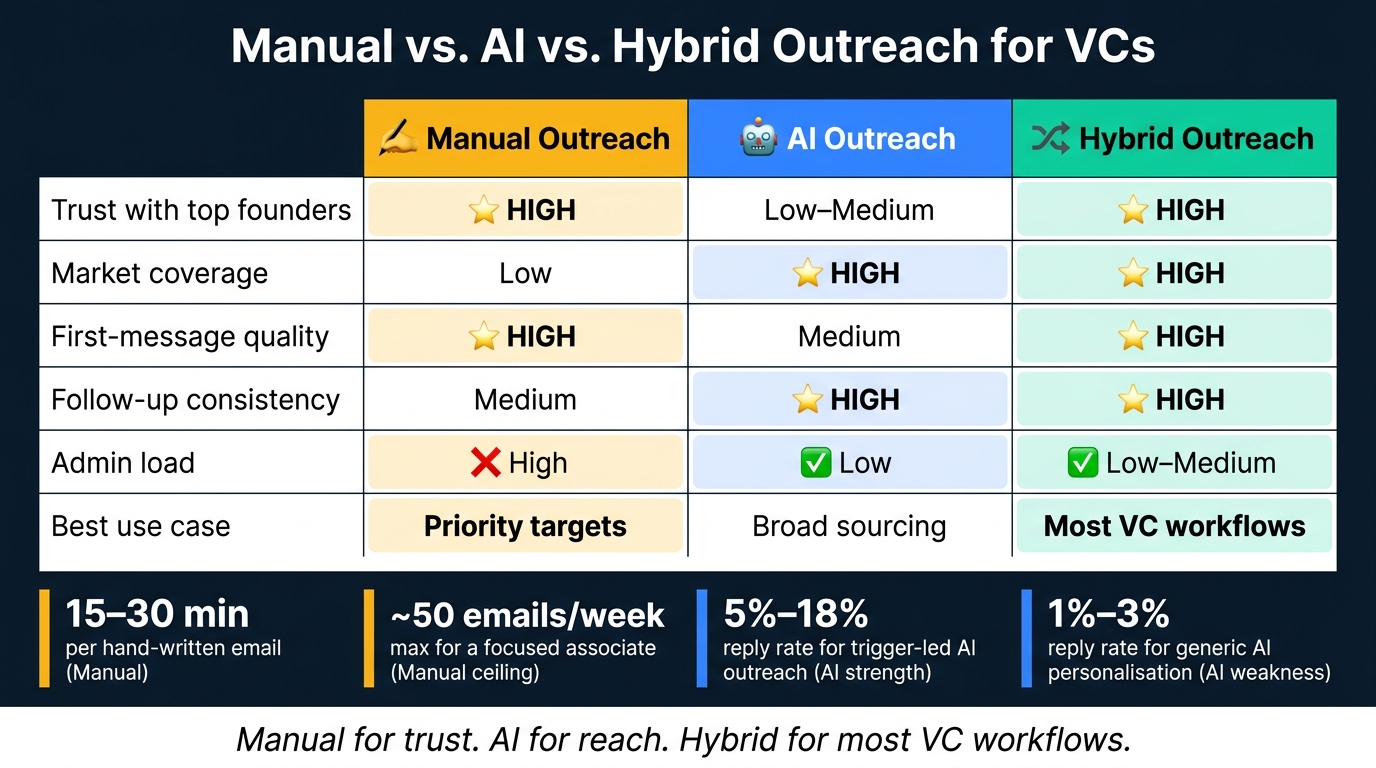
Manual vs. AI vs. Hybrid Outreach for VCs: Key Metrics & Comparison
| Area | Manual | AI | Hybrid |
|---|---|---|---|
| Trust with top founders | High | Low to medium | High |
| Market coverage | Low | High | High |
| First-message quality | High | Medium | High |
| Follow-up consistency | Medium | High | High |
| Admin load | High | Low | Low to medium |
| Best use case | Priority targets | Broad sourcing | Most VC workflows |
So, if I were setting this up, I would keep people on the first note and any nuanced reply, and let AI handle signal tracking, sequence timing, meeting booking, and CRM updates. That is usually the cleanest split between reach and judgement.
Where Manual Outreach Still Wins
Writing higher-trust notes for priority founders
For top-tier targets, a generic message can backfire. In those few conversations where trust and timing make the difference, manual outreach still wins.
More founders now use spam folders or secondary inboxes to catch messages that sound AI-written. And the tells are often obvious. Phrases like "quietly", "genuinely" and "rare" have become dead giveaways.
"The words 'quietly', 'genuinely' and 'rare' are in almost every single AI-generated email we get right now, and it just says that someone didn't spend the time to have a read about us." - Clare Jones, Founder, Polarsteps
What tends to land is something specific and believable: a podcast appearance, a mutual connection, or an event you both attended. That kind of detail shows effort. It gives the note more weight, and reply rates tend to improve. By contrast, generic AI personalisation often stops at the founder's name and company.
That’s why manual outreach makes the most sense for founders where trust matters more than scale.
Judging timing, tone, and fit
Even when AI spots a strong signal, such as a leadership change or an App Store download spike, someone still needs to judge the moment before sending anything. The signal is only part of the job. The harder part is choosing the right opener, the right tone, and the right timing.
Tone is one of the trickiest parts to automate in priority conversations. If you’re reaching out during a rough patch in the market, or replying to a careful, hesitant message, a standard cold email tone can feel badly off. A human can read the room and adjust on the fly. AI sticks to its set pattern.
The catch is simple: this kind of judgement does not scale.
The cost of doing everything by hand
That makes manual outreach a scarce resource. It should be saved for the small group of founders where depth matters most.
An associate can usually produce only around 15–20 high-quality messages a day. That creates gaps in market coverage and makes steady follow-up harder to keep up.
Past that top slice, scale starts to matter more than perfect polish. Once outreach goes beyond a small set of priority founders, the next issue is how to scale the same discipline.
Where AI Outreach Performs Better
Faster sourcing from market signals and thesis matching
Once manual outreach hits its ceiling, AI does a better job of covering the market. A small team can only keep tabs on so many founders at one time. AI, by contrast, can scan much more of the market without dropping pace.
It picks up triggers like hiring spikes, App Store movement, funding, and leadership changes. Those signals bring up companies that fit the investment thesis before they become obvious to everyone else. So sourcing stops being a reactive job and starts looking more like a live queue of qualified targets.
"The companies winning with cold email in 2026 aren't using AI to write emails. They're using AI to know exactly when and why to send one." - Folorunso Omotosho
Scalable personalisation, follow-ups, and meeting booking
Once a target is found, AI can draft outreach in seconds. The messaging stays consistent, which helps avoid the drift that often shows up when people get tired or rushed.
Its biggest edge shows up in follow-ups. As Michele Cardoso put it:
"The AI was better than us at the follow-up stage. Qualifying. Handling the 'send me more info' stall. Timing the follow-up after nine days of no reply." - Michele Cardoso
Trigger-based outreach, where the message refers to a clear event like a new hire or a product launch, gets reply rates of 5% to 18%. Generic AI personalisation tends to land at 1% to 3%. That gap matters. AI can keep four-email sequences moving across six weeks, which makes missed follow-ups less common. Then, once there’s real interest, a human can step in.
Cleaner pipeline tracking with less admin
AI’s role doesn’t end when the email goes out. It can update records on its own and connect outreach activity to each deal stage.
That matters because sourcing problems often come from weak visibility, not low activity. If records are patchy or old, it’s easy to contact the same founder twice, miss the right follow-up window, or lose sight of where a conversation stalled. Automated record-keeping keeps the pipeline accurate while cutting admin work.
sbb-itb-c96cd03
Manual vs. AI Outreach: Direct Comparison for VCs
Manual wins for high-trust, high-conviction outreach. AI wins on scale, speed, and follow-up. The practical split is simple: manual for trust, AI for reach, and hybrid for the hand-off between the two.
Which approach works better for sourcing meetings
For top-priority targets, manual outreach tends to work better. That includes founders you’ve been tracking for months or companies that sit squarely in your thesis. Why? Because the effort shows. A founder can usually tell when a message was written with care, and that often makes them more likely to reply.
For broader sourcing, AI has the edge. Trigger-based outreach, such as messages sent after a funding round or a hiring spike, keeps beating generic cold email. Manual teams just can’t watch the market at that level and catch those windows again and again.
Which approach works better for founder conversations
A polished AI draft can still get ignored before the conversation even starts, especially if it sounds generic. Human review matters most in the first message and in any reply that calls for nuance or careful judgement.
AI does well with the straightforward middle of a sequence. It can keep follow-ups moving without the usual drop-off. But when a founder sends a layered reply, or when the moment calls for tact, context, or a considered answer, people still do that job better.
Which approach works better for building pipeline
The clearest way to make the call is by task, not ideology.
| Task | Manual | AI-Assisted | Hybrid |
|---|---|---|---|
| Target selection | Best for top-priority, thesis-specific fits | Best for high-volume signal monitoring | AI builds the list; humans filter for conviction |
| Personalisation | Deep and high-trust | Scalable but often feels hollow | AI researches; human writes the specific hook |
| Follow-up consistency | Prone to fatigue and drop-off | Precise and reliable across long sequences | AI manages the schedule; human handles nuanced replies |
| CRM and pipeline data | Manual, often patchy | Automated and structured | Automated with human verification |
| Coverage | Very limited | Near-unlimited | High, with quality controls in place |
"AI is a multiplier, not a mechanic. It amplifies whatever you feed it. A good system gets faster. A broken system breaks faster." - Anas Fadili, LinkedIn Contributor
That leads to a simple operating rule: use the lightest amount of AI needed to speed up sourcing and admin, while keeping humans on the messages that shape relationships.
A Decision Framework for Choosing the Right Mix
When to lean manual, AI-assisted, or hybrid
After weighing both options, the choice comes down to three things: the task, the risk, and the volume.
The simplest way to make the call is to match the method to the goal. If your main priority is founder trust and reply quality, go manual. If you need coverage and speed, lean on AI-assisted outreach. If you need both, use a hybrid setup.
| Goal | Best Approach | Reason |
|---|---|---|
| Higher reply rates | Manual or hybrid | Deep personalisation builds trust |
| Better founder experience | Manual | Signals authenticity and that the founder is not just another entry in a list |
| Broader top-of-funnel coverage | AI-assisted | Scales outreach quickly |
| More efficient use of associate time | Hybrid | AI handles research and drafting; humans handle judgement |
A simple rule of thumb helps here: use manual outreach for your highest-conviction targets, and use AI for repeatable volume.
AI can speed up drafting a lot. But if nobody edits the output, the message can feel obviously machine-written. Founders spot that fast. It often sounds too polished, too vague, or oddly detached from anything specific about their company.
How Avyn supports a controlled hybrid workflow
This is where hybrid moves from idea to day-to-day process.
Avyn watches market signals like funding rounds, hiring spikes, and product launches. It then ranks companies against your thesis before outreach starts. After that, it drafts outreach based on those signals, manages follow-up sequences, and handles meeting booking and pipeline tracking.
The key detail is simple: nothing goes out without approval.
That keeps the quality bar in place. More importantly, it means the final message still reflects human judgement instead of plain automated messaging.
Conclusion: What works better for VCs
That leaves one practical rule: use the lightest automation that still protects trust.
For most VC teams, the best mix is manual for high-trust conversations, AI for scale, and hybrid for the hand-off between the two. The aim is not to automate outreach. It is to protect human judgement where it matters and automate the rest.
FAQs
When should a VC team choose a hybrid outreach workflow?
A VC team should use a hybrid outreach workflow when it needs to balance scale and efficiency with the human touch that matters in high-value deal sourcing.
Here’s the simple way to think about it: let AI handle the repeatable work, and keep people focused on the moments that can make or break a relationship.
Use AI for:
- list building
- initial outreach
- routine follow-ups
- qualification
- nurture
Keep outreach human-led for:
- high-value or strategic accounts
- active qualified leads
- discovery calls
- closing
That split gives the team more room to move without making outreach feel cold or generic. AI takes care of the heavy lifting in the early and repeatable stages, while investors and operators step in when judgment, rapport and timing matter most.
What signals make AI outreach more effective?
AI outreach works best when it runs on precision and live signals, not sheer volume. The point isn’t to message more people. It’s to reach the right people when there’s a clear reason to do so.
Useful signals include:
- funding announcements
- leadership changes
- hiring plans
- recent social activity
Use AI to spot the right moment, pull together clues from sources such as LinkedIn, company sites, and industry news, and sharpen messaging through testing. That way, outreach feels timely instead of random.
It also helps to protect deliverability by warming domains and staggering send times. A good message can still fall flat if it lands at the wrong time or gets caught by spam filters.
How much human review should AI outreach need?
AI outreach still needs a human pass for quality, relevance and a sense that there’s a real person behind it. A grammar check alone won’t cut it. The reviewer should make sure the message shows a proper understanding of the founder and offers something specific that matters to them.
The best setup is a hybrid workflow. Let AI do the research, shape the structure and draft the first version. Then have a human step in to sharpen the tone, check the facts and add the message’s soul.