Manual vs AI Milestone Monitoring for VC Funds
Manual monitoring suits small portfolios; AI delivers live milestone visibility, reduces analyst admin and flags risks earlier.
If I had to sum it up in one line: manual monitoring works for a small portfolio, but AI gives me a live view when the number of companies starts to stretch the team.
Here’s the short version:
- I use milestone monitoring to track revenue, burn, runway, hiring, product progress, leadership moves, customer wins, funding events, and approvals.
- Manual tracking often means emails, board decks, PDFs, and spreadsheets. That slows things down and leaves gaps.
- AI-led tracking pulls signals from many sources and updates the portfolio view between reporting cycles, not just at month-end or quarter-end.
- That can mean less analyst admin, fewer founder follow-ups, and earlier risk flags.
- Human review still matters for board conversations, follow-on calls, governance, and founder relationships.
A simple way to look at it: if a fund tracks 20, 40, or 60 companies, and each one sends updates in a different format, manual work can turn into hours of chasing and cleanup every month. That is time lost. With AI, I can shift more of that work into extraction, normalisation, and flagging, then spend my time on what the signals mean.
Quick comparison
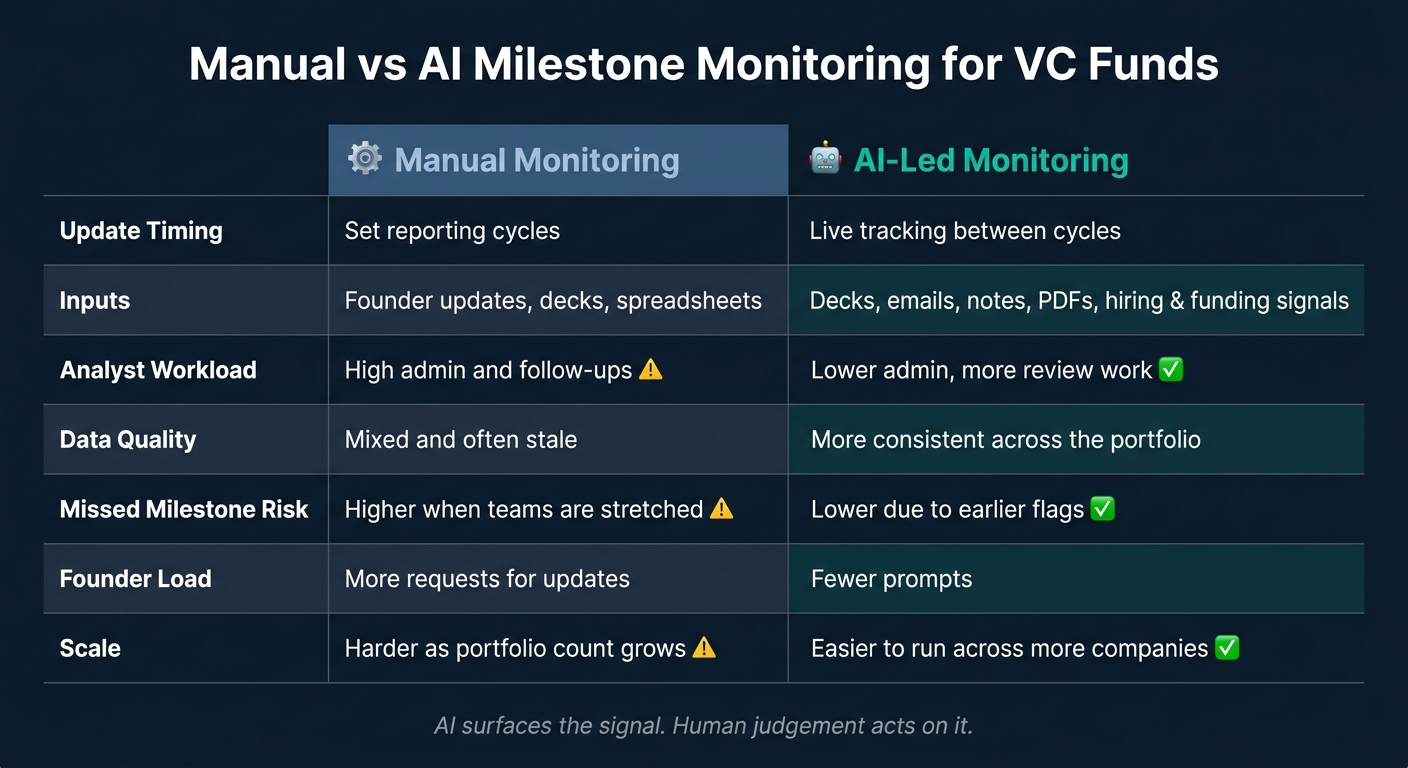
Manual vs AI Milestone Monitoring for VC Funds: Side-by-Side Comparison
| Area | Manual | AI-led |
|---|---|---|
| Update timing | Set reporting cycles | Live tracking between cycles |
| Inputs | Founder updates, decks, spreadsheets | Decks, emails, notes, PDFs, hiring and funding signals |
| Analyst workload | High admin and follow-ups | Lower admin, more review work |
| Data quality | Mixed and often stale | More consistent across the portfolio |
| Missed milestone risk | Higher when teams are stretched | Lower due to earlier flags |
| Founder load | More requests for updates | Fewer prompts |
| Scale | Harder as portfolio count grows | Easier to run across more companies |
My takeaway is simple: AI does not replace investor judgement. It helps me spot movement earlier, cut spreadsheet work, and keep LP reporting cleaner. Then people still make the call on risk, support, and next steps.
sbb-itb-c96cd03
Manual milestone monitoring: where time and visibility are lost
The bottleneck in manual monitoring isn't judgement. It's collecting the information in the first place.
In many funds, manual milestone monitoring means analysts chasing founder updates, pulling figures from static documents, and pasting everything into a tracker that's already old by the time it's filled in.
Time spent on follow-ups, reminders, and spreadsheet upkeep
Most of the work isn't analysis. It's admin.
Analysts send update requests, wait for replies, send reminders, chase again, and then copy figures into internal spreadsheets by hand. As the portfolio grows, even a monthly update cycle can eat up a lot of analyst time. That time would be better spent working out what the data says and helping founders act on it.
Instead, it gets swallowed by inbox follow-ups and spreadsheet maintenance. The whole monitoring process starts to run around the analyst's calendar, not the portfolio's pace.
Data gaps, missed updates, and uneven reporting quality
Even when updates come in, they rarely look the same.
Some are detailed. Some are brief. Some arrive late. Some don't arrive at all. KPI definitions also shift from one company to another, which makes cross-portfolio comparison slow and shaky. Uneven updates, inconsistent KPI definitions, and late submissions leave the fund with a patchy record.
The knock-on effect matters. Decisions end up being made on stale signals, and coverage becomes uneven. Funds review what happens to land in the inbox, or what only becomes visible once the issue is obvious somewhere else. By the time a missed milestone is spotted, there's less room to step in or update LPs.
That's where AI-led monitoring changes the workflow.
AI-led milestone monitoring: what changes and how it works
Continuous signal capture and live milestone tracking
AI-led monitoring picks up signals from multiple sources without waiting for a founder to send an update. It brings together structured inputs, like board packs, and unstructured inputs, such as emails, meeting notes, PDFs, hiring signals, leadership changes, product launches, and funding activity.
So instead of relying on a founder to mention that they’ve hired a VP of Sales or closed a seed extension, the system can spot those moves as they happen and show them in the context of the fund’s portfolio. That means less chasing, less admin, and less chance that something slips through the cracks.
The day-to-day impact is simple: the milestone view keeps moving between reporting cycles, not only when those cycles end. Funds can see meaningful progress earlier, while there’s still time to step in, ask questions, or help.
Avyn, for example, is built as an AI analyst for private market investors. It monitors hiring signals, market activity, and funding updates on a continuous basis, then ranks portfolio companies against a fund’s specific investment thesis in real time.
Lower collection workload and cleaner reporting outputs
AI also changes who does what. The system handles extraction, normalisation, and flagging. The human deals with judgement calls and edge cases. In plain terms, that means fewer manual checks and a cleaner reporting trail.
When information comes in from dozens of portfolio companies in different formats, manual consolidation creates inconsistency at almost every step. AI can take raw documents - PDFs, meeting notes, and investor updates - and turn them into a normalised view across the portfolio, without the same level of manual error.
That leads to investment committee materials and LP updates that are faster to produce and easier to trust, all built from one continuously updated source.
Those shifts become clearest when you compare manual and AI-led approaches across time, data quality, and scale.
Manual vs AI milestone monitoring: side-by-side comparison
Time, data quality, and missed milestone risk
The difference becomes clear when you put the two approaches next to each other.
The biggest split comes down to timing. Manual monitoring happens at set intervals. AI-led monitoring runs all the time. That matters more than it might seem at first glance. Milestone slippage can creep in for weeks before a quarterly update brings it to light. By then, a fund has less room to respond.
AI-led systems spot those changes earlier. They pick up signals such as hiring slowdowns, lower technical activity, or new website launches. That gives funds more time to step in, ask questions, and decide what to do next.
Put bluntly, no human analyst can track every signal across a full portfolio and stay on top of it all.
| Factor | Manual monitoring | AI-led monitoring |
|---|---|---|
| Update frequency | Periodic; tied to reporting cycles | Continuous; runs between cycles |
| Data sources | Founder-submitted updates, spreadsheets | Board packs, emails, notes, and live external signals |
| Follow-up load | High; requires active chasing | Low; automated flagging |
| Missed milestone risk | High; limited by analyst bandwidth | Low; flags unusual patterns and early signals |
| Data quality | Uneven; prone to gaps and stale inputs | Consistent; extracted from live signals |
That’s the day-to-day gap. The next issue is where human judgement still fits.
Reporting depth, founder experience, and scalability
Manual monitoring also puts an uneven load on founders. When analysts need updates, they ask for them, often more than once, across several portfolio companies, and often at the same time. For early-stage founders already stretched thin, that friction adds up. Time spent replying to update requests is time not spent running the business.
AI-led monitoring cuts that load. The system pulls from signals that already exist instead of asking founders to produce fresh updates each time. In practice, that means fewer check-ins and fewer prompts landing in the inbox.
There’s also a clear gap on the internal side. Manual processes need more people as the portfolio grows. AI-led monitoring doesn’t hit that same limit in the same way.
| Factor | Manual monitoring | AI-led monitoring |
|---|---|---|
| Reporting quality | Variable; depends on analyst capacity and founder responsiveness | Consistent; built from continuously captured signals |
| Founder interaction | Frequent check-ins and update requests | Fewer prompts; system draws from existing signals |
| Scalability | Breaks down as portfolio grows; more companies means more hours | Scales without proportional headcount increases |
That shift lets analysts spend more time on exceptions, judgement, and founder conversations.
Automation changes how information is collected. It does not remove the need for investment judgement.
Where human review still matters and what funds should take away
Judgement, governance, and founder relationships
Even with better automation, milestone monitoring still needs human judgement at the decision stage.
AI can flag missed milestones. But partners still have to decide what those misses mean. Is it just noise? A deliberate trade-off? Or a sign of real risk? That call depends on the company, the founder, and the market context. Investment committees are still led by people, and for good reason.
The same applies to follow-on decisions, board-level conversations, and governance checks. These are high-stakes moments. Judgement, accountability, and founder trust matter just as much as speed.
AI changes the analyst’s role. Instead of spending time chasing data, analysts can focus on exceptions, nuance, and judgement calls.
Key takeaways for funds considering a shift
That points to a clear operating model for funds.
Manual monitoring feels familiar, but it often leads to delay and inconsistency as a fund grows. AI-led monitoring improves coverage, timeliness, and reporting quality. The best setup uses both: AI as the analyst layer that never sleeps, with human partners handling interpretation, governance, and relationship management.
Use AI to surface the signal. Use human judgement to act on it. That’s the right split of labour for milestone monitoring.
FAQs
When does manual monitoring stop scaling well?
Manual milestone monitoring stops working well once the number of companies and signals climbs past what human analysts can sensibly track.
As coverage expands, teams often fall back on shortlists and reactive tracking. That usually means missed updates, patchy data, and weaker real-time visibility across the portfolio or the broader pipeline.
What signals can AI track between reporting cycles?
Between formal reporting cycles, AI can monitor high-frequency market activity and help venture funds keep a closer eye on what’s happening.
That can include funding updates, hiring patterns, and shifts in general market activity. The upside is simple: teams get an earlier read on a company’s trajectory and momentum before periodic reports land in their inbox.
What still needs human judgement?
AI can work through large datasets, spot prospective companies and take care of admin-heavy workflows. But when the stakes are high, human judgement still matters.
Investors still need to check each action, read subtle market signals, judge the less measurable strength of a founder’s vision and decide which investments match the fund’s thesis.