
7 Leadership Hiring Signals for VC Deal Sourcing
Use seven leadership hiring signals—timing, role scope and stage—to spot startups before funding news breaks.
If I want to spot a company before funding news hits, I look at leadership hiring first. In most cases, senior hires show intent weeks or months ahead of a round, a market push, or a shift in how the company plans to grow.
Here’s the short version: I’d focus on seven signals - hiring velocity, the first senior commercial hire, a CFO, a COO, board additions, cross-functional leadership build-out, and senior turnover followed by a targeted replacement. On their own, these are just people moves. In context, they can point to momentum, stage fit, and the right time to get in touch.
If I were using this in a sourcing workflow, I’d ask four simple questions first:
- Is this a new role or a backfill?
- Does the hire match the company’s stage?
- Does it fit my fund thesis?
- Is this the right moment to reach out?
A few patterns stand out fast:
- 1–3 months after stealth or funding, clustered senior hires often point to a company moving into its next phase
- A first Head of Sales, VP Sales, or CRO often means founder-led selling is no longer enough
- A CFO hire 6–12 months before a Series B/C or exit can point to tighter finance and reporting ahead
- A COO or scale leader can show that founder bandwidth is being stretched by growth or complexity
- Independent directors or chairs may point to board formalisation before institutional money comes in
- A technical hire plus a commercial hire in the same quarter often shows product and go-to-market are moving together
- Senior exits only matter if the replacement closes a clear gap rather than just filling a seat
Here’s a quick comparison of what each signal usually tells me:
| Signal | What it may show | Best use in sourcing |
|---|---|---|
| Leadership hiring velocity | Team build-out in a short window | Move the company up the list |
| First senior commercial hire | Shift towards repeatable revenue | Reach out early |
| CFO appointment | Finance discipline and prep for later-stage process | Watch timing closely |
| COO or scale leader | Company strain from growth or complexity | Check whether systems are being built |
| Board additions | Board formalisation and prep for outside scrutiny | Look for warm intro routes |
| Build-out by function and layer | Deliberate sequencing across teams | Judge stage fit |
| Turnover plus targeted replacement | Planned reset or gap closure | Separate progress from pressure |
The core idea is simple: titles do not matter on their own. I’d care more about timing, role scope, and what changed around the hire than the seniority label itself.
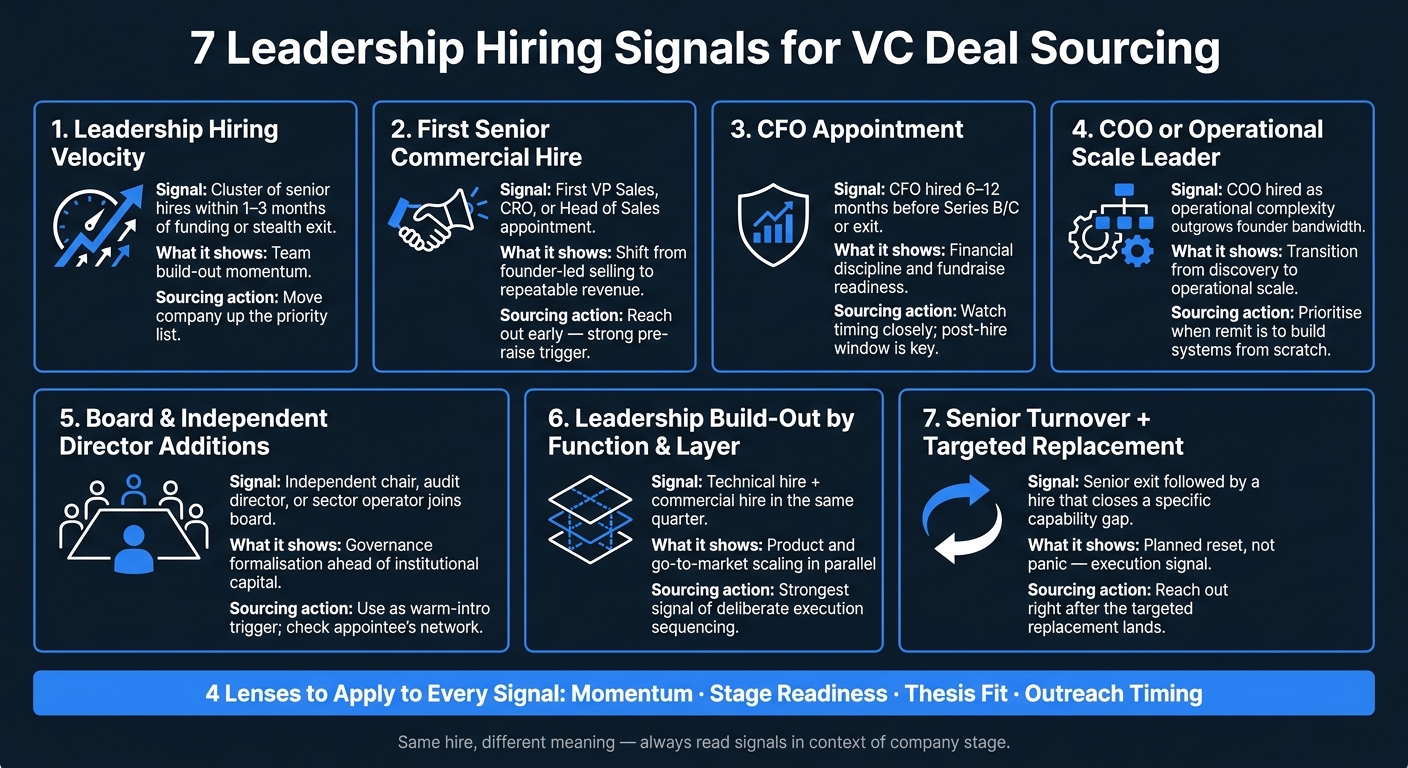
7 Leadership Hiring Signals for VC Deal Sourcing
Why Leadership Hiring Data Matters in UK and European Deal Sourcing
Leadership hires often show up before funding news does. When a company brings in a Head of Sales or hires a Founding Engineer, it's usually signalling intent weeks or even months before any press release lands. What matters most here is momentum, role scope, team build-out, and the timing ahead of a fundraise. The job isn't just to spot the hire. It's to read that move through your thesis instead of treating it as a one-off event.
That's where thesis-led sourcing starts to pull ahead. The edge comes from seeing hiring moves early, before they surface in funding coverage.
Stage makes a big difference. Pre-seed, Seed, and Series A companies tend to show different leadership patterns. An early technical build-out, like a Founding Engineer joining a small team, can point to a company moving from prototype to production. By Series A, the signal often shifts. You start seeing senior commercial hires who can handle multi-stakeholder sales cycles as the company builds out its go-to-market motion.
Investors now underwrite capital efficiency, sustainable unit economics, and a clear path to profitability. That’s why role scope matters just as much as the hire itself. A senior title alone doesn't tell you much. The remit behind it does.
Hiring data also broadens coverage and helps surface companies earlier. It becomes far more useful when you plug it into a sourcing workflow, rather than reading it as standalone market commentary.
sbb-itb-c96cd03
How Investors Read Leadership Signals Through a Thesis-Led Lens
Before you get into the seven signals, run them through four filters. The same hire can mean very different things depending on the fund. A senior commercial hire might point to scale for one investor, but look like extra burn for another. That’s why each hiring move needs to be read through four lenses: momentum, stage readiness, thesis fit, and outreach timing. Each signal below links to one or more of these lenses.
Momentum looks at pace - in plain terms, how fast the leadership team is coming together. Stage readiness asks whether the hire marks a real step change for the business. Thesis fit comes down to alignment with what the fund actually wants to back; if the hire lines up with the fund’s target market or business model, it matters more. Outreach timing is the most practical of the four. A leadership hire creates a natural opening, which often makes well-timed outreach far more effective than a colder approach later on.
When you use these lenses properly, hiring signals become much easier to act on. You can sort them into a simple call: prioritise outreach, keep monitoring, or pass. With that frame in place, the seven signals below are easier to rank and act on.
1. Leadership Hiring Velocity
Leadership hiring velocity means a startup brings in senior people across a few functions within 1–3 months of a funding round or just after coming out of stealth. If you look at it through the lenses of momentum, stage readiness, thesis fit and outreach timing, it stands out as one of the clearest early signals. Put simply, a fast leadership build-out often tells you more than any single hire ever could.
The main thing to watch is new roles versus replacements. A backfill keeps the machine running. But a first-time Head of Sales hire alongside a Founding Engineer points to functional build-out, not replacement. That’s the pattern that tends to show genuine momentum.
A good example came in mid-2026, when London-based AI startup Avyn exited stealth and added a Head of Sales and a Founding Engineer. That signalled a move from product build to go-to-market. When hires land in a cluster like that, timing becomes the whole game.
This should trigger outreach when a technical founding team brings in its first senior commercial lead in stealth or just after seed. The strongest version of this signal is usually that first senior commercial hire. That’s often the first clear sign of commercial intent. For thesis-led sourcing, it’s a practical trigger to move that company up the list and watch for follow-on hires. It works best when read alongside the first senior commercial hire.
2. The First Senior Commercial Hire
Leadership hiring speed tells you how fast a company is moving. The first senior commercial hire tells you what they plan to do next.
When a company brings in its first VP Sales, CRO or Head of Sales, it’s a clear sign that founder-led selling isn’t enough anymore. The business is moving towards repeatable revenue.
Why does that matter? Because this kind of hire usually comes after early traction and a sales motion that’s starting to repeat. In plain English: they’ve found something that seems to work, and now they want to turn it into a proper growth engine.
The background of the hire can tell you even more. Someone from enterprise sales often points to:
- longer sales cycles
- larger contracts
- more people involved in the buying decision
Avyn’s June 2026 Head of Sales hire after stealth marked a shift from founder-led build to commercial scale-up phase.
Treat the announcement as an outreach trigger. A pre-raise hire can point to proof that the sales motion works. A post-raise hire usually points to scale.
3. A CFO Appointment
A CFO appointment signals financial readiness, not just a push for growth. When a business brings in a CFO, it often means it's moving beyond informal financial management and into tighter governance, sharper reporting, and a clearer route to profit. Put simply: the company is shifting from growth at all costs to better capital discipline. For sourcing, the big question is simple: did the hire happen before a fundraise, or after pressure started to show?
Timing matters most here. A CFO appointment often happens around 6–12 months before a Series B/C or exit. That makes the period straight after the hire a strong outreach window.
The CFO's background tells you a lot too. Someone with experience in complex, multi-stakeholder markets can signal that the business is getting ready for longer fundraising cycles and tougher diligence. And if their remit includes building financial systems and processes, rather than just keeping existing ones running, that's a sign the company is in the middle of scaling. In that case, the post-hire window is often the cleanest point to reach out.
When you're reading this signal, separate a proactive hire from a reactive one:
- A proactive CFO hire ahead of a raise is a good sign.
- A reactive CFO hire points to pressure rather than momentum, so it should rank lower.
4. A New COO or Operational Scale Leader
A CFO tends to point to financial readiness. A COO points to operational readiness.
That matters because a COO hire often marks the moment a company starts moving from product discovery into operational scale. And in many cases, that hire shows up before a public scale-up or fundraise. So it can work as an early sourcing trigger.
The meaning shifts a bit by sector, but the main signal stays the same: the business is running into more operational complexity.
In B2B SaaS, this often comes after GTM scale-up. In fintech, it can come before licensing or partnership expansion. In marketplaces, it often means day-to-day complexity has started to outgrow founder bandwidth.
Prioritise this hire when it comes after another scale signal and the remit is to build systems from scratch, not simply manage an operation that already exists. It’s strongest when it appears alongside other scale signals.
5. Board and Independent Director Additions
A COO hire can hint at operating scale. Board changes hint at governance scale. That usually means fundraising prep or a push into tougher markets. When a founder brings in an independent director, chair, or sector operator, it often shows the company is getting ready for a raise or stepping into a market with more moving parts.
The kind of appointment matters just as much as the appointment itself. An independent chair can point to a more formal board ahead of diligence. An audit-focused director can show governance readiness - the sort of oversight fiduciaries and institutional investors tend to want before backing higher-stakes businesses. A sector operator with deep domain experience can suggest the company is shifting from building broad tools to solving repeat, paid-for problems in a complex or regulated market.
The line between a real signal and a cosmetic governance move usually comes down to the appointee's background. A director who has lived the problem and brings hands-on sector experience sends a much stronger signal than a polished name added to tick a box. In practice, sector operators often matter more than brand-name additions on their own.
For sourcing, board additions are worth treating as an early outreach trigger. They often show up when founders are getting ready for institutional capital, and they can create new warm-intro routes. A new independent director may already sit somewhere in your network, which can give you a more natural way into the founding team than a cold message.
Read board changes alongside recent senior hires to work out whether the company is building towards a raise or just reshuffling oversight.
6. Leadership Build-Out by Function and Layer
Board changes can show governance readiness. Layered hiring shows operating readiness.
One senior hire on its own is just a data point. A coordinated build-out across functions says much more. The key question isn’t how many senior people joined. It’s whether those hires line up with the company’s next stage.
When a company brings in a Head of Sales at about the same time as a Founding Engineer, it sends a clear message: the technical and commercial sides are scaling together. That usually points to deliberate sequencing from the founders, not a scramble under pressure.
Avyn’s sequence - technical depth first, then a commercial hire - shows that same deliberate approach. From a sourcing point of view, the pairing of a technical hire with a commercial hire is the strongest form of this signal. It suggests the product is ready for market, not just ready for more building. A Founding Engineer plus a Head of Sales in the same quarter is a strong sign of execution.
The next thing to check is whether the team is filling gaps or replacing churn.
7. Senior Turnover Paired with Targeted Replacements
The last test is senior turnover followed by a targeted replacement. A senior exit doesn't always mean trouble. What matters is what happens next. If the company moves fast to bring in someone with the missing skill set - regulatory know-how, institutional relationships, or deep sector experience - it looks like a planned reset, not a company in a panic.
A hire with direct experience in the missing function points to execution, not firefighting. That's the part that changes stage readiness and outreach timing. And that's why this is a sourcing signal, not just an HR update.
The best time to reach out is right after that targeted hire lands. At that point, the company has closed a capability gap and is often moving into faster growth or a go-to-market shift. If you wait for the formal announcement or for a funding round to show up in the press, there's a good chance those talks have already begun without you.
The main question is simple: does the replacement close a gap, or just fill a seat?
Stage-by-Stage Table: What Leadership Build-Out Usually Signals
As a company grows, its leadership hires start to follow a fairly clear pattern. That's the difference between reactive sourcing and thesis-led sourcing.
Put simply, the same seven signals mean more when you tie them to stage. Look at them in isolation and you might miss the point. Map them to company stage and the picture gets sharper. The table below shows the main hiring pattern at each stage, and what action it should trigger.
| Stage | Roles Commonly Added | Investor Interpretation | Sourcing Action |
|---|---|---|---|
| Pre-Seed | CEO, CTO, Founding Engineers | Core technical build-out; product-market fit discovery | Track founders and founding engineers with strong technical backgrounds; begin early relationship building |
| Seed | Head of Sales, Product Managers, Senior Commercial Lead | Transition from product development to commercial validation; initial revenue generation | Prioritise outreach immediately; evaluate whether the commercial hire has the depth for complex, multi-stakeholder markets |
| Series A+ | CFO, COO, Head of AI, International Leads | Institutionalisation; focus on growth efficiency and operational maturity | Watch for a near-term fundraise; adjust conviction based on capital efficiency signals and accretive acquisitions |
| Late Stage | Independent Board Directors, Finance and governance leaders | Preparing for exit or large-scale infrastructure build-out; governance and institutional standards | Evaluate the path to profitability and institutional readiness |
The key point is simple: the same hire can mean different things at different stages.
At pre-seed, the signal is mostly about the founding team's credibility and technical depth. You're not looking for polished scale-up structure yet. You're looking for whether the people at the core can build something that matters.
At seed, the first senior commercial hire is often the clearest sign that the product is ready to be sold, not just built. That's a big shift. It suggests the company thinks demand is close enough, or strong enough, to justify bringing in someone to turn product work into revenue.
By Series A and beyond, the lens changes again. Investors start underwriting capital efficiency, sustainable unit economics, and operational maturity. You can see that shift in the hires themselves: finance leaders, operators, AI leadership, and market expansion roles don't show up by accident.
The next step is separating positive build-outs from warning signs.
Positive Leadership Change vs Warning Signs
The same leadership hire can point to progress or pressure. A new exec isn't always good news.
Use the table below to tell the difference between a planned team build-out and a reactive hire.
| Signal Type | Positive Signal | Negative Signal |
|---|---|---|
| Commercial hire | First Head of Sales brought in after product-market fit to scale a validated motion | Senior commercial hire added before product-market fit or repeatable revenue |
| Technical hire | Technical hire matches greenfield build | AI retrofitting onto legacy systems |
| Domain expertise | Founder or senior hire with direct, lived experience of the problem being solved | Technical-only team with no domain depth in the market they're entering |
| Leadership gap filled | Strategic hire that closes a clear capability gap | Reactive replacement filling a vacancy without fixing the underlying issue |
| Headcount growth | Smaller, sharper team using efficient systems to scale output | Rapid headcount growth with no corresponding improvement in unit economics |
A good way to think about it: context matters more than the title itself. Hiring a Head of Sales after a company has found product-market fit can show that the business is ready to scale. Hiring that same person too early can mean the company is trying to force growth before the basics are in place.
The same goes for technical hiring. A new technical leader can make sense when a company is building from scratch. But if the business is bolting AI onto old systems, that move may be more about keeping up appearances than fixing the core product.
Avyn is a useful example: domain expertise first, then a senior commercial hire to scale a validated motion.
When turnover coincides with leverage or liquidity stress, treat it as a diligence flag, not an outreach trigger.
That distinction is what turns hiring data into a repeatable sourcing input.
Turning Hiring Signals into a Repeatable Sourcing Workflow
Once a signal passes the trigger test, turn it into a set workflow.
Use clear, thesis-led thresholds instead of tracking every senior hire. For a seed-stage B2B SaaS fund, a first senior commercial hire paired with faster engineering hiring should be enough to prompt a review.
When that threshold is hit, bring the company into your CRM, map warm intro paths, and line up a personalised outreach draft.
Automation should take care of the admin, but investors still make the decision. Avyn supports this workflow by ranking companies against a fund’s thesis, surfacing warm-intro paths, drafting outreach, managing follow-ups, and tracking pipeline activity. That turns hiring signals into a repeatable sourcing process, not just another feed of alerts.
Conclusion
Put together, these seven signals all point to one thing: intent. Leadership hires can hint at momentum, readiness, and fundraising timing before any of that is public.
The best funds turn those hiring signals into a repeatable sourcing process. They filter by thesis, check stage fit, and move fast when a hire lines up with the company’s next build phase.
Seen this way, hiring signals are more than market noise. The edge comes from reading each hire in context: the company’s stage, what the role changes, and whether it opens a genuine outreach window. The actions themselves are simple - filter, prioritise, outreach - but that discipline is what separates proactive sourcing from reactive monitoring.
Used well, leadership hiring data turns early intent into earlier conversations.
FAQs
How can a reader tell a new hire from a backfill?
Look at how the role lines up with the company’s stage of growth. A backfill usually means the company is replacing someone who left, so the team stays more or less the same.
A new hire, on the other hand, often points to growth in an area that didn’t have coverage before, or to a shift in direction. Hiring pace and job descriptions can help you see what’s going on: is the company just keeping capacity steady, or is it adding net-new capabilities?
Which hiring signal matters most at seed stage?
At seed stage, the clearest hiring signal is a move away from tweaking the product and towards solving a painful problem that customers already pay to fix.
That’s what investors want to see before a company scales: early product-market fit.
Avyn helps VC and growth equity firms track team build-outs, company momentum, and role scope so they can spot those signals early.
When should investors act on a leadership hire?
Investors should move when a leadership hire points to likely momentum or a coming growth push. These hires often hint at a shift in direction or a move to scale operations, which gives investors a window to engage before a formal fundraising cycle starts.
When you track these roles against a fund’s investment thesis, it becomes easier to spot high-potential businesses earlier. Avyn can surface these signals in the pipeline, helping teams reach out at the right time and book meetings sooner.