
How AI Ranks Warm Intro Paths for Funds
AI should shortlist warm-intro routes, while humans own, approve and log outcomes to protect relationships.
If I want better warm introductions, I need to rank paths before anyone sends a message. The article’s core point is simple: I should pull relationship data from across the fund network, clean it, score each possible route, assign one owner, and review every intro by hand.
In plain terms, the workflow looks like this:
- Gather data from partners, portfolio companies, advisers, LPs and founders
- Clean the records so duplicate contacts and bad matches do not create false paths
- Score each route using relationship strength, recency, distance, sector fit and fund mandate fit
- Choose one owner for each target so no connector gets duplicate requests
- Review each intro manually before it goes out
- Log the outcome so future rankings improve over time
A few numbers shape the logic here. For example, relationships active in the last 30 to 90 days tend to matter more than ones with 2+ years of silence. And even a one-hop path can lose to a two-hop path if the second route comes through someone with stronger sector knowledge and a better intro track record.
| Step | What I look at | Why it matters |
|---|---|---|
| Data input | CRM, email, calendars, fund documents, public sources | Missed data means missed paths |
| Data cleaning | Deduplication, identity matching, verification | Stops false warm intros |
| Path ranking | Strength, recency, distance, thesis fit | Helps sort better routes from weaker ones |
| Ownership | One person owns the outreach | Stops overlap and mixed messages |
| Human review | Fit, tone, timing | Keeps poor intros from being sent |
| Feedback loop | Accepted, ignored, declined, meeting held | Helps improve future scoring |
My takeaway: AI should sort options, not make the final choice. I still need clean data, one clear owner, and a manual check at the end if I want a controlled process that protects relationships.
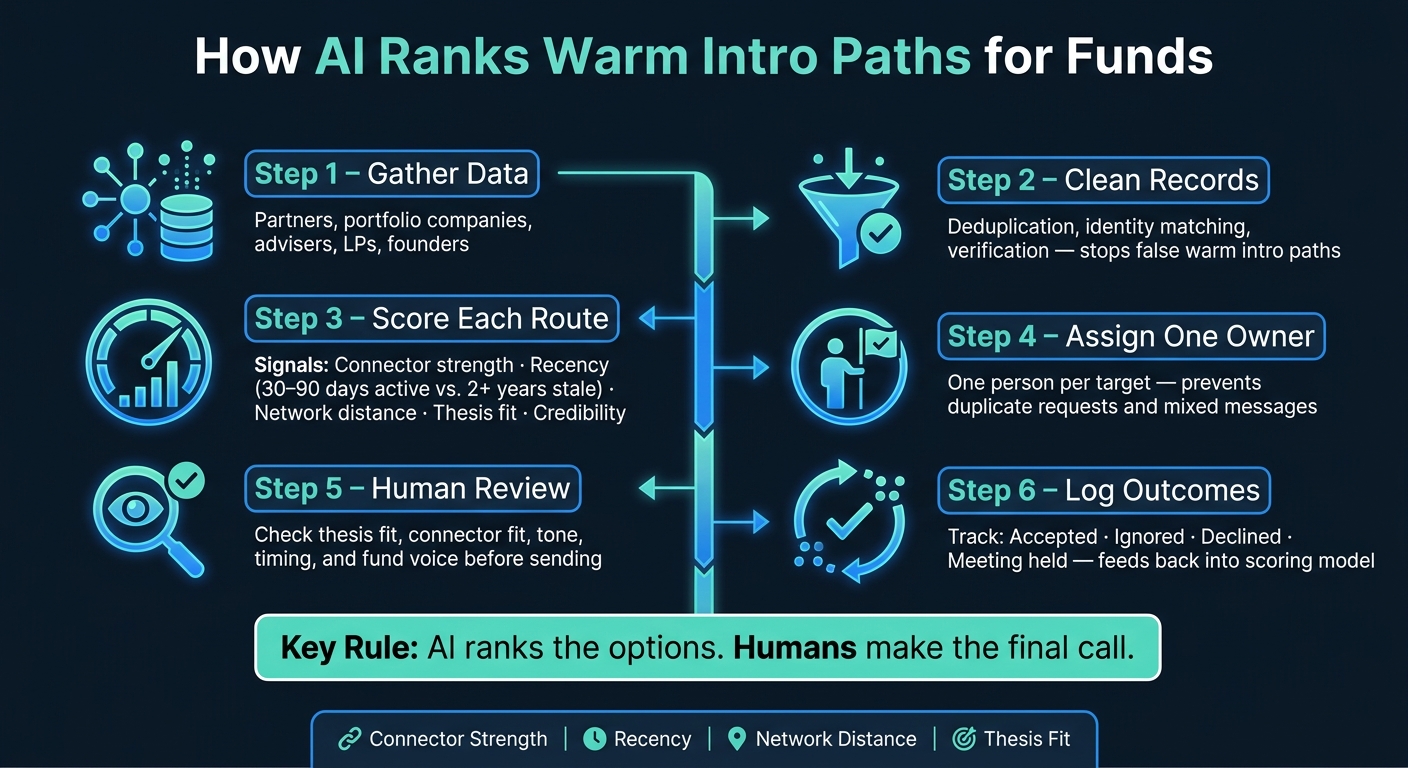
How AI Ranks Warm Intro Paths for Funds: 6-Step Workflow
1. Define the network inputs AI needs
Before any ranking begins, the model needs clean relationship data from across the whole network.
Map connectors across partners, portfolio, advisers, LPs, and founders
Each source can show a different path to the same target. Partners, portfolio teams, advisers, LPs, and founders may each hold a separate route in. Miss just one layer, and the model ends up working with only part of the picture.
Interaction history helps sort active relationships from stale ones. Email headers and CRM logs show how recent a connection is and how often people have been in touch. That makes it easier to tell the difference between a genuinely warm intro and a name that’s been sitting untouched in a spreadsheet. From there, the raw network data needs cleaning before any scoring can happen.
Clean and link relationship records before scoring
This is where most ranking projects go wrong. Duplicate records and mismatched email addresses can create false warm intro paths - routes that look good on paper but go nowhere.
Before scoring, deduplicate records, match identities across CRM and email, and check current relevance against public data. Some relationship signals are buried in static documents, so they need extracting before they can be scored. The simplest way to handle it is to map each source to a cleaning task first.
| Data Source | Records to Link | Required Action |
|---|---|---|
| Internal CRM | Partner contacts, meeting notes | Deduplication and identity matching |
| Communications | Email threads, calendar invites | Recency checks and strength scoring |
| Fund documents | Capital calls, distribution notices | Extraction from static PDFs |
| External/public | LinkedIn profiles, news mentions | Enrichment and verification |
Only clean, linked records should go into the ranking model.
sbb-itb-c96cd03
2. Rank intro paths by strength, fit, and timing
Once the relationship records are linked, the model can judge every possible intro path on the same basis. And that matters, because the shortest route often isn't the one most likely to work. A trusted, active connector can beat a stale direct link every time. The goal is to weigh the main signals together and bring forward the path with the best chance of landing.
Score connector strength, recency, distance, and credibility
Four signals do most of the heavy lifting.
Connector strength looks at how well the connector knows the target. Not just whether they're linked on a platform, but whether there's a real relationship behind it. A past co-investment or a portfolio founder who made a recent successful intro carries far more weight than a loose second-degree link.
Recency matters just as much. If the connector spoke with the target in the last 30 to 90 days, that's still a live relationship. Leave it for two years with no contact, and it's cold.
Network distance shapes friction. Fewer hops usually means fewer chances for things to go sideways. But distance on its own doesn't tell you much. A one-hop route through someone with no standing in the target's sector can be weaker than a two-hop route through a connector with deep domain knowledge and a track record of accepted intros.
That's where credibility comes in. Has this person made introductions before that were accepted? Do they carry weight in the target's network?
Thesis fit also plays a part. A path into a company that matches the fund's mandate should score higher than one that only fits at a broad sector level. Put those signals together, and you get a clearer view of which connector to use first and which paths should go to human review before outreach starts.
Ranking rules comparison table
| Factor | High Priority | Low Priority |
|---|---|---|
| Connector Strength | Direct relationship; recent successful intro | Distant connection; no recent contact |
| Relationship Recency | Interaction within the last 30–90 days | No contact for 2+ years |
| Target Relevance | Connector has deep domain expertise in target's sector | Connector has no industry overlap with target |
| Thesis Fit | Target matches specific fund mandate (e.g. SaaS Series A) | Broad sector match only |
Avyn ranks warm intro paths using relationship strength, recency and fund thesis fit to surface the most credible path for the current mandate.
After ranking the paths, assign one owner and send only the approved intro forward.
3. Apply ownership and approval rules before outreach
Once AI has ranked the strongest intro paths, the next step is ownership.
If several intro paths lead to the same target, pick one owner before outreach starts. If you skip that step, the same connector may get duplicate requests or mixed messages. That gets messy fast.
Assign a single owner when multiple routes exist
Once AI has surfaced the top paths across partners, portfolio founders, advisers and LPs, a human still needs to make the final call on who owns the introduction request.
AI shows the routes. The investment team chooses the owner for that relationship. That keeps coverage steady, no matter where the deal first shows up.
The outcome is simple: one owner for each outreach path, with no duplicate requests sent to the same connector.
Review every suggested intro before sending
Every suggested intro should go through a manual check before anything is sent. That review should confirm thesis fit, connector fit, timing and fund voice.
This step matters because decision-makers can spot generic AI-generated outreach in seconds. AI can draft the intro blurb, but a human should still check that it is concise, personalised and written in the fund’s voice.
At that point, the team stops acting like drafters and starts acting like editors and approvers, stepping in where judgment is needed.
Approved intros should then feed into outcome tracking.
4. Track outcomes and improve future rankings
Approved intro paths should send outcome data back into the ranking model. What happens after the intro goes out is the part that makes the model sharper - or leaves it stuck where it is.
Capture acceptance, meeting conversion, and pass reasons
Once outreach gets approved, the model only gets better if the team logs what happened next. Every declined intro and every meeting that goes nowhere should count as training data for the ranking model. Record acceptance, meeting conversion, and pass reasons for every path.
Capture the result, then feed it back into scoring.
If a highly ranked connector keeps sending intros that get no response, their weighting should fall. If intros sent at a certain stage rarely turn into meetings, the timing assumptions need to change. That kind of tuning only happens when the team records outcomes in a steady way instead of leaning on memory or anecdote.
Feed intro performance into a thesis-driven workflow
Those outcome records should update the same scoring inputs used to rank the next path. Feed acceptance rates, meeting conversion, and pass reasons back into connector strength, recency, and timing scores. Update connector strength, recency, distance, and credibility scores based on accepted, no response, and declined intro outcomes.
Avyn can support this loop. Avyn can log outcomes inside an approval-based workflow, so each review helps improve future rankings. This creates a closed loop between sourcing, review, and ranking.
Conclusion: Build a controlled warm intro workflow
Once you’ve ranked your intro paths, you still need guardrails around the process: clean data, one clear owner, and human sign-off. That keeps AI in its proper role: a screening layer, not the one calling the shots.
AI should back the team, not replace it. People review the suggestions, decide who owns what, and feed the results back into the model.
Avyn supports thesis-driven sourcing, approval-based workflows, and outcome tracking. The result is a controlled, repeatable workflow that protects relationships and gets better with every reviewed intro.
FAQs
What data is most important for ranking warm intro paths?
Warm intro paths are ranked mostly on two things: how well they match the fund’s investment thesis and how likely it is that the fund already has the right connection to make an introduction.
That can include identifiable people or owners across partner, portfolio, adviser and founder networks.
Why can a two-hop intro be better than a direct connection?
A two-hop intro can work better than going in direct when it creates a warmer path through someone both sides trust. That changes the feel of the request. It seems more credible and a lot less cold.
In practice, AI can rank these routes across partner, portfolio, adviser and founder networks. That helps teams focus on the paths most likely to lead to a meeting before they start outreach.
How should a fund measure whether intro scoring is working?
Measure intro-scoring success from end to end. Look at the hit rate for warm-intro targets, track how often outreach turns into meetings, and check whether those meetings lead to actual pipeline, such as diligence or material opportunities, instead of going nowhere.
It also helps to compare results across ranked cohorts, like top-ranked versus lower-ranked routes. That way, you can see whether higher scores win more often on a consistent basis, rather than just producing more activity.