
How AI Maps Warm Intro Paths to Founders
Explains how AI builds a unified relationship graph, ranks warm intro paths by fit and strength, and keeps human approval before outreach.
If I want a meeting with a founder, the best route is often through someone they already know. This article shows how AI helps me find that route by pulling data from email, calendar, CRM, portfolio companies, public profiles, and internal notes, then ranking the best path before I send a message.
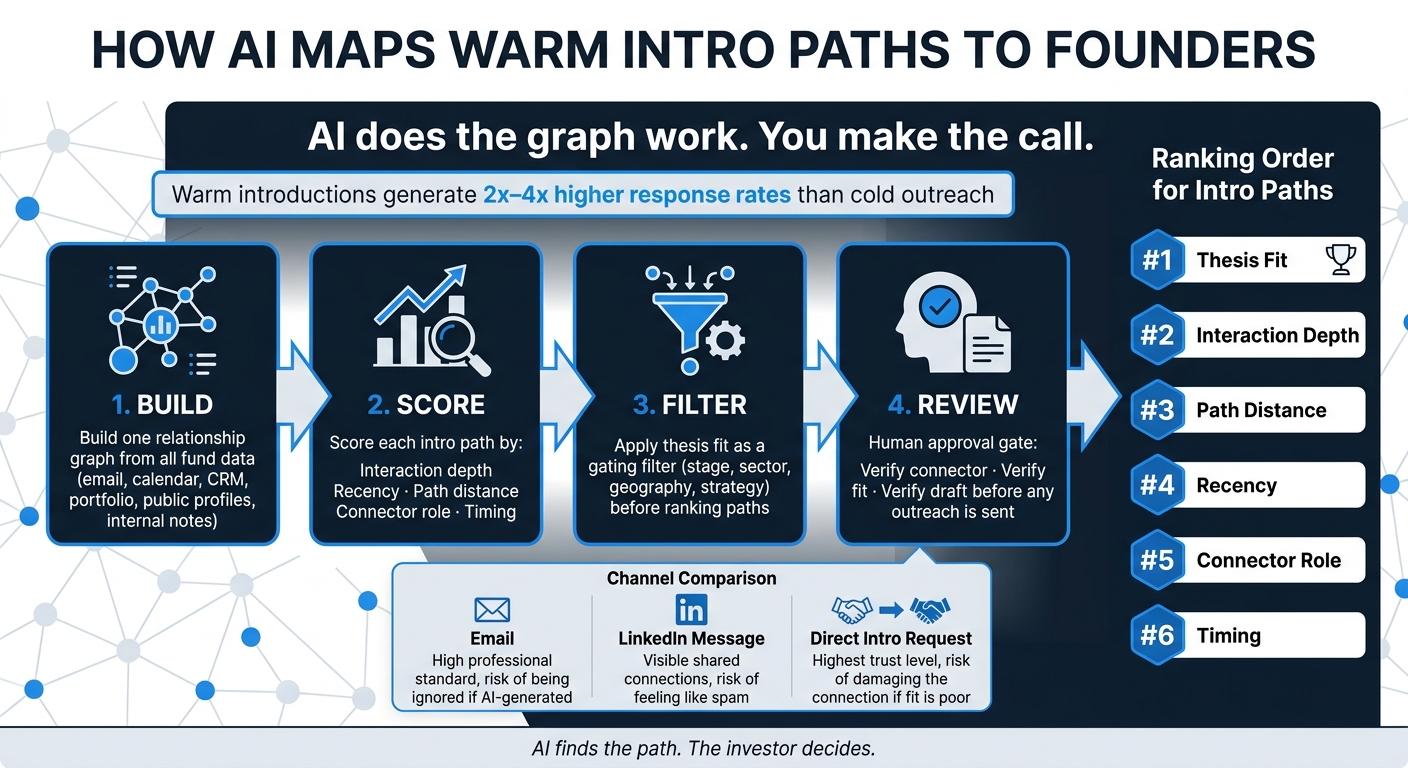
In short, the process comes down to four checks:
- Build one relationship graph from all fund data
- Score each intro path by recency, depth, distance, role, and deal context
- Filter by thesis fit first so I do not chase the wrong company
- Keep a human review step before any outreach goes out
A simple fact sits underneath all of this: in sales and investing alike, warm outreach tends to beat cold outreach. Some studies have put response rates for warm introductions at 2x to 4x higher than cold contact, though results vary by market and stage. That is why path quality matters as much as target quality.
What I like here is the core idea: AI does the graph work; I make the call. It can join scattered relationship signals, spot a likely connector, draft the first message, and track follow-ups. But I still need to check whether the connector is right, whether the company fits the fund, and whether the message sounds like something I would send.
So this is not about replacing investor judgement. It is about using data to answer one simple question faster: who should introduce me to this founder, and should I ask at all?
How AI Maps Warm Intro Paths to Founders
Building the relationship graph from fund data
The goal is simple: pull relationship data into one place so the fund can see who knows whom, when they last spoke, and why that connection matters.
That means building a graph from email, calendar, CRM, portfolio, public network, and internal note data. When it works well, you get a single view that links fund contacts, intermediaries, and founders. No more hopping between tools or piecing things together by hand. Once that graph is in place, the next job is to fill it with the strongest signals you can find.
Email, calendar, and CRM signals
Email threads, calendar history, and CRM activity show two things straight away: frequency and recency. In plain English, they tell you how often two people have been in touch and how recently that happened.
Those interactions become nodes and links inside the relationship graph. And that matters, because a contact from last week usually carries more weight than one from three years ago. So when a fund is picking the best warm intro path, recent exchanges often sit higher than older ones.
Portfolio, network, and public graph data
Direct connections don't always tell the whole story. In many cases, the best route to a founder isn't a straight line.
Some of the strongest intro paths run through portfolio company data and public network links that sit one or two steps away from the fund. That's often where useful intermediaries show up - people who may not be obvious at first glance, but who can help open the door.
Internal notes and entity resolution
Notes and call summaries add the kind of context that structured systems often miss. A CRM entry might show that two people met. A note can tell you what that meeting meant.
AI can read notes and summaries to pull out relationship context - whether a contact knows the founder, how much weight they carry as an intermediary, and whether the path is recent or relevant.
The other key step is entity resolution. That's the process of matching name variations across systems, so the same person or company doesn't appear as multiple nodes. Without that clean-up, the graph gets messy fast, and intro paths become less accurate. With the graph cleaned and enriched, the next step is ranking which path deserves outreach.
sbb-itb-c96cd03
Scoring and ranking intro paths
Once the graph is built, AI can score each route by strength, distance, and fit. In plain terms, it helps sort the intro paths that are actually worth chasing from the ones that only look good at first glance.
Relationship strength and path distance
AI scores paths based on interaction depth, recency, consistency, and responsiveness - not just the number of mutual contacts. Someone with repeated, meaningful interaction and recent engagement should score far higher than a person whose only link was a single meeting years ago.
Path distance matters just as much. A direct, trusted connector - someone who knows both the fund and the founder well - will usually beat a weaker third-degree link, even if that third-degree contact looks strong on paper.
That’s the key point: connection strength is only the first pass. After that, the connector’s role changes the score again.
Connector role and timing and deal context
Not all connectors carry the same weight, even when their relationship strength scores look close. Board members, lead investors, and repeat collaborators often carry more credibility than a casual mutual contact. AI scoring should reflect that through connector role weighting, giving more credit to people whose position gives them real influence over whether the founder takes a meeting.
Timing and deal context shift the score too. If a connector has recently co-invested, sat on a board, or been active in a relevant sector, that context can improve path quality. That’s why domain-specific scoring matters. It turns network data into intro paths a team can actually use.
The best path still fails if the company sits outside the fund's mandate.
Thesis fit alongside path quality
A strong path to the wrong company is wasted effort. So thesis fit should act as a gating filter in the ranking process, not something checked later. AI should assess whether the target company matches the fund’s stage, sector, geography, and strategy before that path moves to the top of the list.
A simple ranking order works best:
- Thesis fit
- Interaction depth
- Path distance
- Recency
- Connector role
- Timing
Filter for thesis fit early. Don’t push strong paths to companies that sit outside the fund’s mandate.
Reviewing paths before outreach goes live
A ranked intro path still needs human approval before outreach goes live. AI can spot the route, score the connector, and draft the message. But the moment that outreach leaves the fund, it carries the investor’s reputation with it. That’s why there needs to be a human approval gate between the ranked list and anything sent outside the firm.
Human approval for intro requests and outbound messages
After ranking, the last step is a manual review before any outreach is sent. The reviewer should make three direct checks: verify the connector, verify the fit, and verify the draft.
Verifying the connector means checking that the relationship is strong enough to support the ask, not just that the person shows up in the graph. Verifying the fit means checking that the path still matches the fund’s mandate. Verifying the draft means cutting generic phrasing, made-up details, and tone that doesn’t sound like the firm. Only approve messages that sound human and factually right.
Channel choice, compliance, and message drafting
After approval, the next call is choosing the channel that best fits the strength of the relationship.
UK GDPR checks sit here because this is the point where internal relationship data turns into external outreach. Teams should confirm that the personal data used to build and score the relationship graph is being handled in a proportionate way before any message is sent.
| Channel | Typical use case | Strength for warm intros | Risks or limitations |
|---|---|---|---|
| Formal, direct outreach to founders or connectors | High professional standard; allows for detailed context and thesis explanation | High risk of being ignored if it sounds AI-generated | |
| LinkedIn message | Leveraging mutual connections or professional milestones | Visible shared connections; easy for connectors to see shared networks | Can feel like sales spam if not highly personalised |
| Direct intro request | High-conviction paths through a trusted mutual contact | Highest trust level; carries the strongest endorsement | Risk of damaging the connection if the fit turns out to be poor |
Once a path passes review, the workflow can hand it off for drafting, follow-up, and tracking.
Running the workflow inside Avyn
From thesis to shortlist and intro path
Avyn screens the market against a fund's thesis, then builds a shortlist of companies that match. From there, it maps the relationship graph to show the strongest warm intro path for each target.
From approved path to tracked outreach
Once a path is approved, Avyn turns it into outbound activity. It drafts outreach in the investor's voice for the chosen connector and founder.
When outreach goes live, Avyn automates follow-ups, logs responses, and keeps the full trail in one place. That means the relationship graph, outreach, and follow-up history stay aligned.
The result is less admin and more judgement. Teams spend more time deciding which paths to pursue and which founders to prioritise.
Conclusion
AI brings relationship signals into one ranked view. Put the relationship graph in, get prioritised intro paths out.
It also takes care of the admin around warm intros, but it doesn't replace judgement. And that's the bit that matters. AI can show the path; the investor still decides whether to use it.
Discovery gets broader. Ranking gets sharper. Outreach stays led by relationships. AI helps investors find more paths, while they keep control of the call.
FAQs
How does AI decide the best intro path?
Avyn finds the best way in by looking at a fund’s current network and what the team already knows.
It checks connections across email, CRM, portfolio data and internal notes to spot the people most likely to make a warm introduction to a target founder. The goal is simple: use relationships that are already there to improve the odds of getting a positive reply.
Why is thesis fit checked before outreach?
Thesis fit is checked before outreach, so warm introductions line up with the investor’s stated strategy. The AI ranks each opportunity against the fund’s thesis, which helps surface the right companies and founders first.
That cuts out off-strategy outreach, improves path quality, and makes each message more relevant.
What still needs human review before sending?
Before outreach goes out, a human must review and approve any message drafted by Avyn.
Avyn can analyse the market, rank companies against an investment thesis, spot warm introduction paths, and draft correspondence in the fund’s voice. But the final check stays with a person. That review helps make sure each message meets professional standards and fits the intended communication style.