CRM vs. Deal Sourcing Platform: What Growth Equity Funds Need
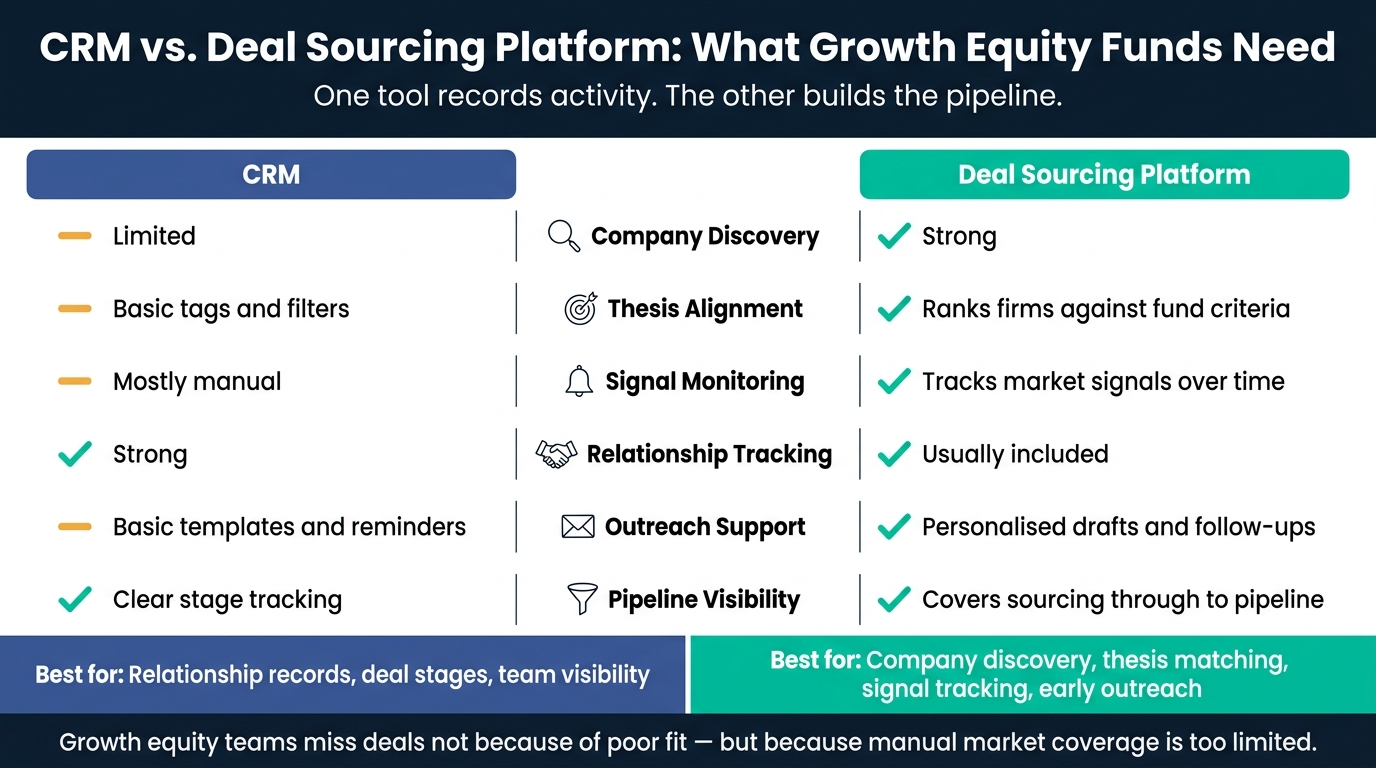
CRMs track known relationships; deal sourcing platforms discover firms, match investment theses, monitor signals and automate outreach.
If I had to sum it up in one line: a CRM helps me track deals I already know about, while a deal sourcing platform helps me find the ones I do not.
For a growth equity fund, that difference matters at the top of the funnel. A CRM is good for contacts, notes, pipeline stages and follow-ups. But if I need to scan a market, check thesis fit, watch signals over time and reach out with the right context, I need more than a CRM.
Here’s the short version:
- CRM: best for relationship records, deal stages and team visibility
- Deal sourcing platform: best for company discovery, thesis matching, signal tracking and early outreach
- Main issue: growth equity teams often miss firms not because they are a poor fit, but because manual market coverage is too limited
- Main test in this article: 6 day-to-day criteria
- company discovery
- thesis alignment
- signal monitoring
- relationship tracking
- outreach support
- pipeline visibility
- Bottom line: if my sourcing model depends on finding firms early, a CRM on its own is not enough
A simple way to look at it: sales tools are built to move leads through a process; growth equity teams need tools that spot the right firms before any process starts.
CRM vs. Deal Sourcing Platform: Side-by-Side Comparison for Growth Equity
Quick Comparison
| Criteria | CRM | Deal sourcing platform |
|---|---|---|
| Company discovery | Limited | Strong |
| Thesis alignment | Basic tags and filters | Ranks firms against fund criteria |
| Signal monitoring | Mostly manual | Tracks market signals over time |
| Relationship tracking | Strong | Usually included |
| Outreach support | Basic templates and reminders | Personalised drafts and follow-ups |
| Pipeline visibility | Clear stage tracking | Covers sourcing through to pipeline |
That is the core point of the article: one tool records activity, the other helps build the pipeline in the first place.
sbb-itb-c96cd03
CRM for growth equity: strong on records, weak on sourcing
A CRM brings contact records, notes, reminders and deal stages into one place. That helps once a company is already in the pipeline. But here's the catch: a CRM records history. It doesn't create new opportunities. Its strength is relationship management, not discovery.
Where a CRM adds value
Once a company is on the radar, a CRM starts to earn its keep. Teams can log every interaction - calls, emails and introductions - then attach notes that add context for the next conversation. Stage-based pipeline views show the whole team where each deal sits, from first contact to diligence. And light automation can handle reminders and internal tasks, which helps stop things slipping through the cracks.
For managing a known set of companies and contacts, that gives teams a strong base.
Why manual sourcing gaps remain
The gap shows up the moment a team needs to look beyond what it already knows. CRMs are built to track relationships, not to read the whole market. If an investment team wants to find companies based on hiring patterns or founder activity across a sector, a CRM doesn't offer much help. That data has to come from somewhere else - often a mix of databases and manual research - and then someone has to enter it by hand.
That's where the drag starts. Analyst time is limited, and every hour spent moving figures between tools is an hour not spent on judgement. The problem runs through discovery, thesis fit and market monitoring.
| Criteria | What CRMs do well for growth equity | Where CRMs fall short for deal sourcing |
|---|---|---|
| Relationship tracking | Centralising contact data for founders, advisers and intermediaries | Limited to known entities; cannot automatically surface new warm introduction routes |
| Pipeline visibility | Providing stage-based views of active deals and deal progress | No visibility into top-of-funnel market discovery |
| Data capture | Logging meeting history, activity and internal coordination notes | Heavily dependent on manual entry and copying figures from PDFs and spreadsheets |
| Sourcing | Managing a shortlist of companies already identified by the team | Weak at discovering new companies or reading the entire market |
| Thesis alignment | Basic categorisation by sector or stage | Cannot automatically rank companies against a specific investment thesis |
| Outreach automation | Lightweight workflow automation for reminders and internal tasks | Lacks AI-driven outreach that drafts personalised outreach in the team's voice |
| Diligence tracking | Managing tasks and documents during the active deal process | Fragmented research and spreadsheet workarounds for signal monitoring |
CRMs are built for depth with known relationships, not breadth across an unknown market. That works well for a defined contact list. It does not fix top-of-funnel discovery for growth equity, which leaves the sourcing gap in place.
Deal sourcing platforms: built for thesis-driven discovery and automation
A deal sourcing platform is built for private markets. It finds, ranks and engages companies against a fund’s investment thesis, and it brings opportunities to the surface before they hit the pipeline.
These platforms are AI-native and made for messy private markets data: pitch decks, news, hiring signals and founder activity. That makes the biggest difference at the top of the funnel, where teams need to spot fit before a process even starts.
What growth equity teams need at the top of funnel
Growth equity sourcing is about finding the right company early, before any formal process gets going. For that to work, discovery has to line up with the thesis. The platform needs to understand what a fund is actually looking for and rank companies against those exact criteria, not just broad sector labels.
Signal-based sourcing matters just as much. Many of the most interesting growth equity targets haven’t shown up in a database or landed in an inbox yet. Sourcing platforms track signals - hiring patterns, product launches and management changes - across disconnected data sources, then surface those companies early. Watchlists keep them in view until the timing is better.
Those same signals also need to feed into outreach and tracking without extra manual effort. Otherwise, the team ends up doing the same work twice.
How sourcing platforms cut operational drag
These platforms expand market coverage and automate the work that doesn’t need human judgement: reading, ranking, tracking and drafting initial outreach.
Across the workflows that matter most, the gap is pretty clear: one tool records activity, the other drives discovery.
| Criteria | Traditional CRM features | Deal sourcing platform features for growth equity |
|---|---|---|
| Thesis understanding | Manual tagging and static industry codes | Automated ranking of the entire market against a specific fund thesis |
| Data sources | Mainly internal records and manual entries | Market-wide scanning of unstructured data and external signals |
| AI capabilities | Often retrofitted or limited to basic automation | AI-native; acts as an automated analyst across the full sourcing cycle |
| Sourcing automation | Reactive; tracks deals already in the pipeline | Proactive; identifies companies and keeps them on watchlists before they become obvious |
| Pipeline integration | Standard sales-style funnel tracking | Integrated discovery, engagement and long-term tracking in one workflow |
| Outreach support | Generic templates and mass mailing | Personalised AI-generated outreach and warm introduction surfacing |
| Diligence tracking | Manual document storage and notes | Automated signal tracking and structured data extraction |
The next step is turning those signals into one workflow for sourcing, outreach and tracking.
Where Avyn fits for growth equity funds
This only works when sourcing, outreach and tracking live in one place.
Avyn is built for private market investors. It uses AI to source, prioritise and track opportunities in a single workflow. And it handles unstructured market data and market signals, rather than acting like a generic workflow tool.
For growth equity teams, that means they can move from thesis to action without jumping between platforms.
From thesis to shortlist to outreach
Avyn ranks companies against a fund’s own investment criteria and brings forward warm introduction paths by spotting people the investment team already knows.
That matters because a shortlist isn’t much use if it goes stale the moment the team starts reviewing it. Avyn updates the shortlist based on team approvals, so recommendations stay tied to what the fund is actually looking for.
One workflow for sourcing, engagement and tracking
Once a company is shortlisted, Avyn drafts outreach, follows responses and updates the deal record within the same flow.
It can draft, send and follow up across email and LinkedIn, with meeting booking built in, all in the fund’s tone of voice. Every message is reviewed before sending, so human judgement stays in the loop the whole time.
Pipeline and diligence tracking also sit inside the same workflow. On top of that, automated monitoring flags key company updates as they happen.
Conclusion: What growth equity funds actually need
It comes down to one thing: does the fund need to record deals, or discover them?
A CRM does one job well. It keeps relationship records tidy and shows where each deal sits in the pipeline. But for growth equity teams running thesis-led, outbound-heavy strategies, a CRM on its own falls short at the top of the funnel.
When a CRM works - and when it doesn't
A CRM works when sourcing is reactive. It starts to fall short when sourcing needs to be proactive. As soon as a fund has to find new companies, not just log the ones already on the radar, a CRM stops being enough.
Put simply, a CRM manages records. A sourcing platform handles discovery, ranking and outreach.
Key takeaways for investment teams
- Growth equity sourcing is not the same as sales pipeline management. Thesis fit needs to happen at the top of the funnel, not after a shortlist is already in place.
- Automation should take care of discovery, ranking and initial outreach, while people stay in control of the calls that matter.
- Unified workflows cut friction in a way disconnected tools simply can't match.
That’s the difference between managing a pipeline and building one.
FAQs
When is a CRM enough for a growth equity fund?
A CRM is enough when a fund can still track, research and engage a small pipeline by hand. In that setup, it works well as a system of record for known relationships and active deals.
It starts to fall short when the job shifts from managing known contacts to finding new opportunities across the market. That’s where manual tracking becomes a drag. Signals get missed, data ends up stuck in silos, and teams spend too much time chasing crumbs instead of acting on them.
Can a deal sourcing platform replace a CRM entirely?
No. A deal sourcing platform helps you spot opportunities, rank them against your investment thesis, and support early outreach. But you still need a CRM.
The two tools do different jobs. The platform is built to find and engage new prospects. The CRM stays your system of record for pipelines, past interactions, and internal deal workflows.
What signals matter most for finding companies early?
The most important signals come from the full market, not just a hand-picked shortlist. Strong early sourcing starts with steady analysis of available company data, then ranking each company against your investment thesis.
When you automate that work, your fund can spot high-potential targets sooner, find existing network connections for warm introductions, and scale outreach without letting good opportunities slip through the cracks.