How AI Tracks Pipeline Health for VC Teams
How AI uses structured data, timestamps and stage rules to score deals, flag stalls, and streamline VC pipeline work.
Most VC pipeline problems are not about deal volume. They are about slow movement, missed follow-ups, weak fit, and bad data. If I want AI to track pipeline health well, I need three things in place from day one: structured company data, timestamped activity data, and clear stage rules.
Here’s the short version:
- AI tracks pipeline health by watching signals across the funnel: sourcing, outreach, follow-ups, meetings, and stage changes.
- It looks for warning signs like deals sitting still for 14+ days, founder reply times stretching past 48–72 hours, or missing fields at key stages.
- It scores each deal using signals such as dwell time, touchpoint frequency, founder engagement, and thesis fit.
- It works best when data is clean and dated. If notes, emails, calendars, and CRM updates are scattered, the output will be weak.
- It should support, not decide. I can let AI draft outreach, flag stalled deals, and update reports, while people still approve sends, stage changes, and investment calls.
A healthy pipeline is not just a long list of companies. It should show whether the right deals are moving by sector, geography, cheque size, and stage. In practice, that means using AI to spot delays early, cut admin, and give the team a clearer view of what needs attention now.
If I were putting this into use, I’d start with one part of the funnel - such as sourcing or first-touch outreach - and expand once the data and rules are working well.
The data AI needs to monitor pipeline health
Most VC teams still track pipeline data across inboxes, calendars, CRMs, and note tools. That creates a messy picture. AI can only help if the data underneath is structured and timestamped.
Company, founder, and market data
This is external data. It’s the information AI uses to judge whether a company matches the fund’s thesis.
That includes sector, geography, headcount, funding history, hiring activity, product launches, press mentions, and founder background. The key step is to define thesis parameters as structured fields. If you do that, AI can score the full market, not just a handpicked shortlist.
That gives the team a clearer view of thesis fit and helps surface deals that deserve active attention.
Outreach, follow-up, and meeting activity data
This is internal activity data: emails, LinkedIn messages, warm introduction attempts, calendar events, meeting notes, transcripts, and follow-up task status.
Every one of these needs a timestamp. That part matters more than it sounds. Without it, AI can’t tell whether a reply was missed, whether follow-up is dragging, or whether there’s been a long silence between meetings.
This data usually sits in different places:
- inboxes
- calendars
- CRMs
- note-taking tools
And most of the time, those systems don’t connect well. So the first job is simple: pull it into one place.
Pipeline stages and historical outcomes
The third layer is structural. This covers stage names, the transitions allowed between them, exit criteria for each stage, and standard lost reasons for every deal that leaves the funnel.
If those pieces aren’t standardised, AI can’t compare current deals with past outcomes in any useful way. It has no stable frame of reference. Historical outcomes give AI a baseline, especially for spotting odd dwell time before a deal goes cold.
Put plainly: stage definitions and past outcomes help AI flag stalled movement and deals that are lingering longer than they should.
| Data category | Key fields | Typical source systems |
|---|---|---|
| Company & market | Sector, location, headcount, funding history, hiring activity, press mentions, founder background | Data providers, web scrapers, LinkedIn |
| Outreach & activity | Email/LinkedIn logs, reply dates, meeting notes, transcripts, follow-up task status | CRM, Gmail/Outlook, LinkedIn, Zoom/Teams |
| Pipeline structure | Stage names, transition dates, exit criteria, lost reasons, historical conversion data | CRM (e.g., Affinity, Salesforce, HubSpot) |
With these inputs in place, AI can track signals, score health, and trigger alerts.
sbb-itb-c96cd03
How AI tracks signals, scores health, and triggers alerts
Once data is structured and timestamped, AI can follow how each deal is moving. In practice, that means watching what happens at each stage, pulling those signals into one health score, and showing alerts that point to a clear next move.
Stage-specific signals AI watches across the funnel
The signals that matter shift as a deal moves through the funnel. At sourcing, AI flags companies that fit the fund's thesis. At outreach, it tracks response rates and reply speed. If response is low, that's often a sign the targeting is off or the messaging isn't landing.
During follow-ups, AI watches for missed touchpoints - moments when someone should have reached out, but didn't. At the meeting stage, it tracks meeting frequency and whether conversations are moving towards next steps or getting stuck after the first call. Across the full funnel, AI also tracks stage movement, including deals that sit in one stage much longer than similar deals have done in the past.
How AI builds health scores from dwell time, activity, and engagement
AI blends several signals into a single health score for each deal. The main inputs are stage dwell time against the historical norm, touchpoint frequency, founder reply speed, meeting-to-next-step conversion, and thesis fit.
A deal that has been stuck in "First Meeting" well beyond the usual range, with no reply to recent follow-ups, will score poorly - even if the company looks strong on paper. That score helps guide review; it doesn't replace judgement.
Alert rules that lead to clear action
Alerts work best when they focus on exceptions and link each one to a single action.
| Alert type | Trigger condition | Recommended action | Owner |
|---|---|---|---|
| Stalled deal | No stage movement or activity for more than 14 days | Review deal notes; trigger re-engagement outreach | Associate |
| Falling engagement | Founder response time exceeds 48–72 hours | Send personalised follow-up or leverage a warm introduction | Associate |
| Traction spike | Sudden surge in hiring, web traffic, or press signals | Fast-track to partner review or schedule immediate meeting | Principal |
| Missing data | Key financial or thesis-fit fields empty at Stage 2 | Request data room access or founder clarification | Analyst |
| Thesis drift | Company pivot reduces alignment with fund thesis | Re-evaluate ranking; move to watchlist or pass | Principal |
That way, alerts stay useful without taking decisions out of the team's hands.
Keeping human control while reducing manual work
Manual vs AI-Assisted VC Pipeline Operations: Key Differences
Alerts and health scores only help if the team trusts them enough to use them. And that trust comes down to one thing: investors still need to stay in charge of what AI can send, update, or change.
Approval-based workflows for key actions
The most practical setup is a draft-and-approve workflow. AI pulls things together, drafts messages, or suggests the next move. Then a person checks it and signs it off before anything goes out or gets changed.
At the final decision stage, term sheets and capital commitments remain fully human. No alert, score, or recommendation pushes a deal ahead on its own. A person stays in the loop at every key decision point.
Governing scoring models, alerts, and data quality
Health scores can drift when deal stages are not updated, fields are left blank, or thesis fit shifts over time. That means AI-led analysis should be treated as an early view, not the final word. Teams should review false positives in alerts on a regular basis and tune scoring models against recent pipeline results.
Stage updates matter just as much. If associates skip updates or leave key fields empty, the AI is working with gaps. It’s a bit like trying to judge a match from half the scoreboard. A short weekly check on data completeness, including missing fields and stages that have not moved, helps keep the model tied to what is actually happening.
With those controls in place, the next step is simple: let AI handle more of the legwork without changing who signs off on it.
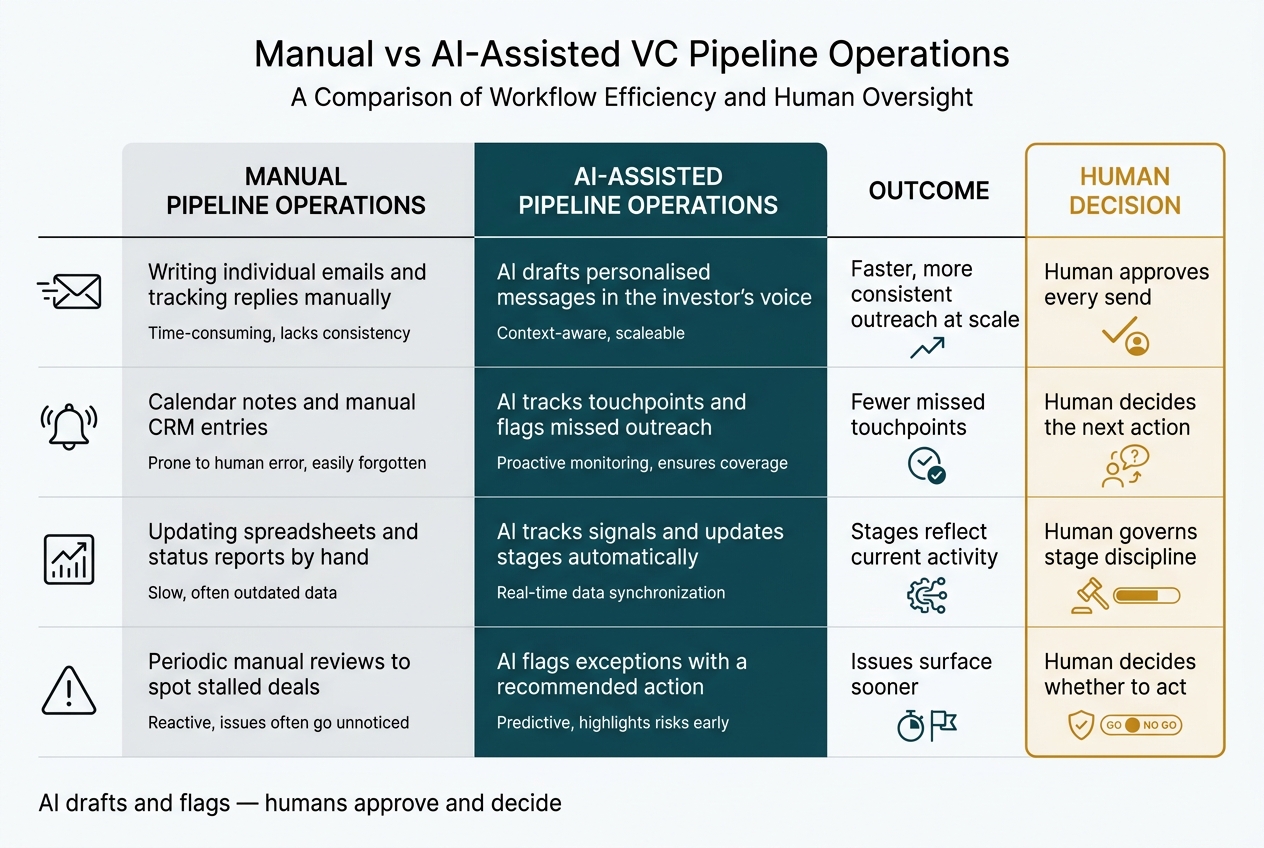
Manual versus AI-assisted pipeline operations: a direct comparison
The clearest line is between work AI can draft or flag, and decisions people still own.
| Workflow area | Manual approach | AI-assisted approach | Outcome | Human decision |
|---|---|---|---|---|
| Outreach drafting | Writing individual emails and tracking replies manually | AI drafts personalised messages in the investor's voice | Faster, more consistent outreach at scale | Human approves every send |
| Follow-up reminders | Calendar notes and manual CRM entries | AI tracks touchpoints and flags missed outreach | Fewer missed touchpoints | Human decides the next action |
| Pipeline reporting | Updating spreadsheets and status reports by hand | AI tracks signals and updates stages automatically | Stages reflect current activity | Human governs stage discipline |
| Alert handling | Periodic manual reviews to spot stalled deals | AI flags exceptions with a recommended action | Issues surface sooner | Human decides whether to act |
That’s the balance Avyn applies across sourcing, outreach, follow-ups, meetings, and pipeline tracking.
Putting it into practice with Avyn
How Avyn supports sourcing, outreach, and pipeline tracking
For teams that want less manual tracking, one workflow can make health signals much easier to use.
Avyn brings sourcing, outreach, follow-ups, meetings, and pipeline tracking into one workflow. That means pipeline signals come from live activity, not manual updates. It handles sourcing and early pipeline in the same place, while logging the exact signals mentioned earlier: stage movement, engagement, and follow-up activity.
In practice, Avyn ranks companies against the fund’s investment thesis, drafts outreach, tracks follow-ups, books meetings, and logs stage movement and engagement. If a deal starts to stall, teams can spot it sooner. The result is simple: more opportunities can be processed with less admin getting in the way.
The point here is admin automation, not investment judgement. Sends and updates still stay approval-led.
That makes it much easier to watch one stage cleanly before using the workflow across more of the pipeline.
Conclusion: Start with one pipeline segment, then expand
Start with one pipeline segment, like sourcing or first-touch outreach. Then expand once the workflow is reliable.
Set a clear investment thesis, connect the right data sources, and make sure the AI ranks companies against the thesis fields and stage rules your team already uses.
Once the first segment is stable, extend the same rules across the rest of the funnel.
FAQs
What data should we clean up first?
Start with siloed, disconnected data. First, pull fragmented information into one unified system so deal sourcing and tracking rest on precise, validated outcomes.
That gives AI a clean base to cut through noisy manual tracking, surface signals you can act on, and rank opportunities against your investment thesis with more accuracy.
How long does AI need to score pipeline health well?
There’s no set timeframe for when AI starts scoring pipeline health well.
With Avyn, the work starts from implementation. It continuously analyses market data against a fund’s investment thesis, helping with deal flow, outreach, and pipeline tracking right away.
Which pipeline stage is best to automate first?
Deal origination is usually the first stage worth automating. It carries the most weight in the investment process and means scanning a whole market, which is exactly where manual work tends to stretch analysts too thin.
AI can help you find companies, score them against your investment thesis, and manage first outreach in your own voice. The result is simple: more capacity, more deal flow, and fewer missed opportunities.