
How Much of a VC's Job Is Sourcing vs. Picking?
Sourcing fills the VC funnel while picking determines returns—AI can streamline sourcing, but human judgement still makes the final investment call.
Most VC time goes into sourcing. Most VC results come from picking.
If I had to sum up the whole article in a few lines, that’s it. Sourcing fills the pipeline through outreach, referrals, research, and market signals. Picking is what happens next: screening, diligence, valuation, structure, and the final yes or no. One gives a fund more shots. The other decides whether those shots make money or lose it.
Here’s the simple version:
- Sourcing = finding companies early
- Picking = deciding which ones deserve capital
- Sourcing takes more weekly work
- Picking carries more downside if you get it wrong
- AI can cut a lot of the manual sourcing load
- Investors still need to lead the final call
One number from the piece says a lot: a 50% loss needs a 100% gain just to get back to even. That’s why a fund can have a busy pipeline and still perform badly. More deals seen does not mean better returns.
| Area | Sourcing | Picking |
|---|---|---|
| Main job | Build the pipeline | Make the investment decision |
| Typical work | Signal tracking, outreach, referrals, meeting set-up | Diligence, references, valuation, fund fit |
| Time use | More weekly effort | More pressure at decision points |
| Main risk | Missing a deal | Backing the wrong deal |
| AI role | Handles much of the repetitive work | Supports evidence review, not final judgement |
My takeaway: sourcing creates options, but picking decides outcomes. The best setup is simple: let AI handle repeatable top-of-funnel work, and let investors spend more time on judgement, diligence, and capital allocation.
That’s the lens I’d use for the rest of the article.
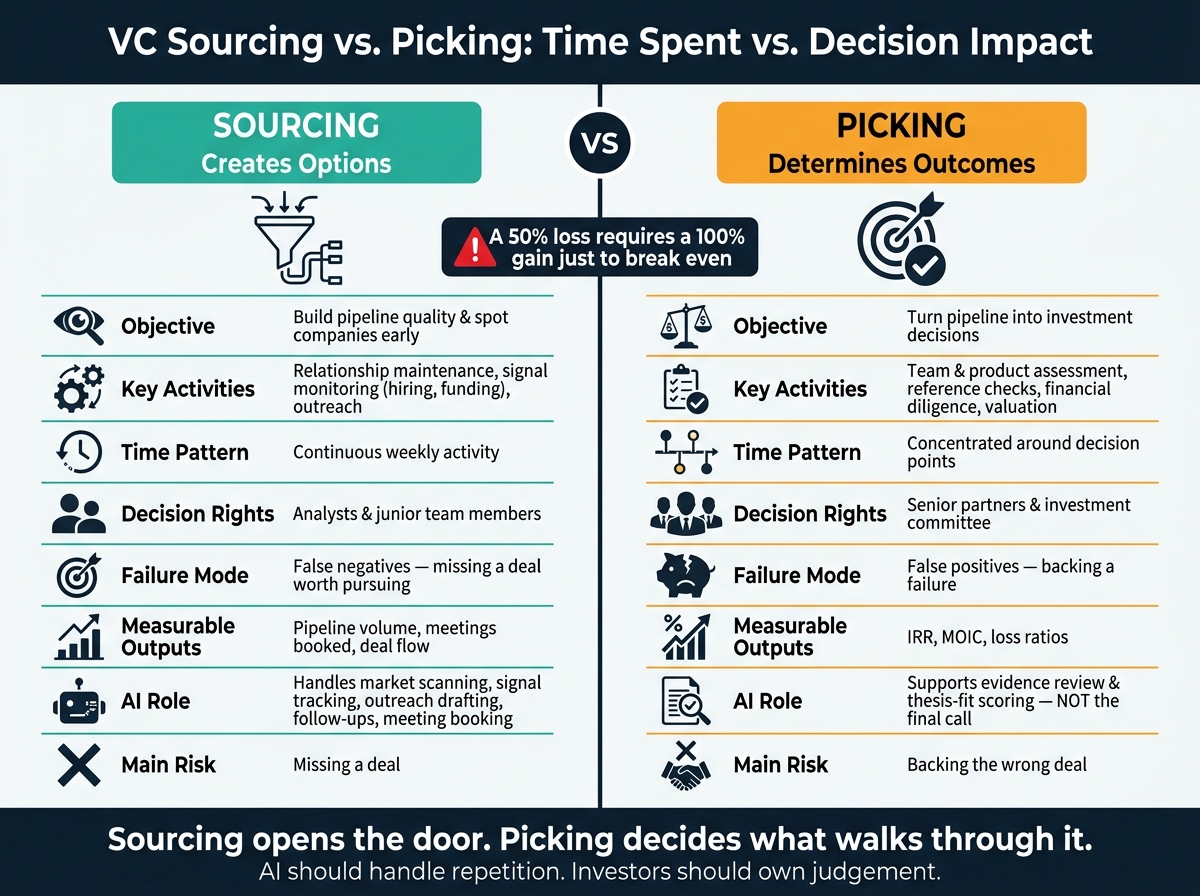
VC Sourcing vs. Picking: Time Spent vs. Decision Impact
Sourcing vs. picking: where each activity sits in the investment funnel
Sourcing fills the top of the funnel. Picking turns that funnel into decisions.
That sounds simple, but it matters a lot in practice. Strong sourcing without disciplined picking leaves you with a busy pipeline and no clear edge. More companies in the funnel do not automatically lead to better returns. On the other hand, strong picking without enough sourcing shrinks the opportunity set too soon.
Put plainly: sourcing creates options; picking decides outcomes.
| Sourcing | Picking | |
|---|---|---|
| Objective | Build pipeline quality and spot companies before they become obvious | Turn pipeline into investment decisions |
| Key activities | Relationship maintenance, signal monitoring (hiring, funding), outreach | Team and product assessment, reference checks, financial diligence, valuation |
| Information produced | Leads, founder data, growth signals, market maps | Investment memos, risk assessments, valuation models, term sheets |
| Weekly workload | Weekly time: tracking and outreach | High judgement load: concentrated decision-making |
| Creates options | Supplies the opportunity set and options | Drives returns: determines the actual fund outcomes |
In practice, sourcing is about finding the right signals early, not just adding more names to a list.
How sourcing builds pipeline quality
Good sourcing is not about volume alone. It’s about timing and fit.
The best signals often show up before a company appears in a database. Hiring spikes, talent moves, and stealth incorporations can all point to momentum early. If a fund waits for a formal announcement, it’s already behind.
Relationship maintenance matters just as much. Staying close to founder communities, angel networks, and sector operators means inbound comes with context. That makes a huge difference. Without that context, even a large pipeline becomes hard to sort, and harder still to rank with any confidence.
Once a lead enters the queue, the work shifts.
How picking turns pipeline into investment decisions
Picking is where investor judgement is under the most pressure.
The first pass usually relies on filters such as stage, sector, geography, and cheque size. Those filters cut down the list fast. After that, things get tougher: judging the team’s track record, the product’s actual traction, the market, and whether the business model still works when conditions get tight.
This is also where outside conversations matter. Speaking with former colleagues, early customers, and sector experts brings out details that no data platform will show you. Only then does valuation and portfolio fit come into view - asking whether the entry price makes sense and whether the company belongs in the fund as it stands.
Speed helps, of course. But it only helps when the judgement behind it stays rigorous.
sbb-itb-c96cd03
Which part of the job matters more: time spent vs. decision impact
Once sourcing fills the funnel and picking works through it, the main issue is where time goes and where value sits.
There’s no fixed split. It shifts with strategy, seniority, market conditions, and portfolio load.
The useful way to look at it is time spent versus capital at risk.
You can see that difference in the work itself:
| Sourcing | Picking | |
|---|---|---|
| Time horizon | Continuous, weekly activity | Concentrated around decision points |
| Decision rights | Analysts and junior team members | Senior partners and investment committee |
| Failure mode | False negatives: missing a deal worth pursuing | False positives: backing a failure |
| Measurable outputs | Pipeline volume, meetings booked, deal flow | IRR, MOIC, loss ratios |
| Effect on returns | Supplies the raw material for alpha | Determines realised returns and loss avoidance |
Why sourcing tends to take more visible weekly time
Sourcing is relentless. Teams are always monitoring signals, sending outreach, following up, and lining up meetings. It’s not a one-off burst of work. It keeps running in the background every week, whether or not a deal is near the finish line. If that effort slows down, the pipeline can dry up quietly and fast.
The amount of work here is large. AI-assisted sourcing can materially increase deal flow, which gives you a good sense of how much territory a single analyst is often expected to cover by hand.
Why picking tends to carry more weight on outcomes
This is where the maths hits hard. A 50% loss needs a 100% gain just to get back to even. So one bad investment call can wipe out months of efficient sourcing.
Speed without rigour destroys value.
Picking packs the highest-stakes judgement into a small number of moments. Those moments may take fewer hours in the diary, but they carry far more weight on outcomes. That judgement usually comes from experience and domain knowledge. That’s why picking usually sits with senior partners and investment committees, not analysts.
So while automation can take a lot of the sourcing burden off the team, the call on picking still stays human-led.
How AI shifts the balance between sourcing and picking
If sourcing eats up the weekly manual grind, AI changes how much of that grind still sits with the team. It doesn't replace sourcing or picking. What it does is cut down the manual work in both.
Where Avyn can automate sourcing and top-of-funnel work
Avyn tracks market signals and scores companies against a fund's approved thesis criteria. When a target starts to look like a fit, it drafts outreach in the fund's tone, handles follow-ups, books meetings, and updates the pipeline. The result is a larger, better-organised pipeline.
Just as importantly, outreach stays context-aware because it uses existing CRM notes and prior team interactions.
That helps a fund get in front of more companies. It does not make the investment call.
Where investors still need to lead on picking
AI can sort and surface evidence, but it can't judge what that evidence means.
Take a signal like rapid headcount growth. On paper, that can look strong. But an investor still needs to ask the hard question: is that hiring driven by real customer demand, or is a founder just burning through a seed round? That call still belongs to the investor.
The same goes for founder quality, portfolio fit, and committee judgement. AI can widen the evidence base, but investors still decide which deals deserve capital.
You can see the split most clearly in the workflow:
| Category | AI handles | Investor leads |
|---|---|---|
| Automated workflow | Market scanning, signal tracking, outreach drafting, follow-ups, meeting booking, pipeline updates | Relationship management, warm introductions, deal orchestration |
| AI-assisted judgement | Full-market scan, initial thesis-fit scoring | Evaluating ambiguous evidence, assessing founder quality, weighing portfolio fit |
| Human accountability | Proposing scoring updates based on recorded corrections | Final judgement, diligence interpretation and capital allocation |
Conclusion: sourcing supplies options, picking determines outcomes
Sourcing and picking aren't rival priorities. They're two parts of the same job. Sourcing opens the door; picking decides what walks through it. So the point isn't to argue about which matters more. The point is to make sure both work well together inside a fund's workflow. That's where AI has the biggest effect.
Sourcing tends to take up more time each week. Picking carries more risk when it comes to outcomes. A fund doesn't win because its pipeline looks busy. It wins or loses based on the investments it chooses. Sourcing builds the set of options. Picking determines returns.
AI-led sourcing can expand deal flow in a material way without adding the same level of workload. That means less manual sourcing and more time for judgement. And that's the time that matters most: diligence and the final investment decision. That's the work that shapes returns.
The funds that will do best are the ones that treat sourcing and picking as one system: automated when the work is repetitive, human-led when judgement matters. AI should handle repetition; investors should own judgement.
FAQs
Why does picking matter more than sourcing for returns?
Picking matters more because the investment decision itself, and the thinking behind it, is what drives success.
Sourcing matters because it helps you find opportunities. But that’s just the start.
The real value comes from assessing a company against your investment criteria and deciding whether it’s worth backing.
How can a VC tell whether sourcing quality is improving?
A VC can see if the signals they track are starting to converge into real, qualified opportunities.
The key is to watch whether signals like hiring velocity, senior moves, product launch momentum, and market engagement start stacking up in short timeframes - and then lead to faster outreach and pipeline movement, not just more noise.
You should also look for:
- better funnel conversion
- signals that repeat
- signals that line up with the fund’s thesis
That’s the difference between tracking activity and spotting something worth acting on.
What parts of sourcing and picking should AI handle?
AI should take care of the admin-heavy, repeat tasks in sourcing and picking. Think of it as an analyst that never sleeps, not a substitute for human judgement.
It works best when it scans for signals, ranks opportunities against your investment thesis, manages pipeline logistics, finds warm intro paths, drafts personal outreach, and tracks follow-ups.
Where should you draw the line? Don’t hand over nuanced outreach or final investment calls. Those still need a human read of the room, a sense of timing, and plain old judgement.