
How Do VC Funds Find Startups to Invest In?
VC sourcing is a structured pipeline: set a thesis, combine referrals, outbound research, accelerators and AI, screen fast and track deals.
VC funds usually don’t find start-ups by luck. I’d sum it up like this: they set a clear investment view, pull companies in through referrals and outbound research, screen them fast, and track everything in a CRM. The best-known routes are warm intros, accelerators, events, university spinouts, inbound pitches, and thesis-led outbound search.
If you want the short answer, here it is:
- Funds start with a thesis: sector, stage, geography, and cheque size.
- They source from a mix of channels: referrals, founder networks, demo days, conferences, public data, and direct inbound.
- They screen fast: market, founder fit, product proof, traction, and risk.
- They use systems: CRMs, market maps, alerts, and AI scoring to sort large volumes.
- Founders can improve their odds by making their company easy to understand, easy to verify, and easy to refer.
In other words: VC sourcing is a pipeline job first, and a people job second. Warm referrals still convert best, but they can bias access. Outbound research helps funds spot companies earlier, including stealth and bootstrapped teams. AI now helps rank leads and draft outreach, but the investor still decides who gets a meeting.
For founders, the takeaway is simple: say plainly what you do, who it’s for, and why now. Keep your website, LinkedIn, and public signals aligned. And build relationships before you start fundraising.
| Source | What funds like | Main downside |
|---|---|---|
| Warm referrals | High trust and better reply rates | Closed networks |
| Accelerators | Pre-screened early-stage teams | Heavy investor competition |
| Events | Early conversations and market read | Low conversion |
| University spinouts | Strong IP and research roots | Long path to market |
| Outbound research | Finds stealth and bootstrapped firms | Time-heavy without tooling |
| Inbound outreach | Broad reach | Hard to filter |
That’s the full picture in brief: clear thesis, mixed sourcing, fast screening, tight tracking, and better discoverability for founders.
Where VC funds find startups
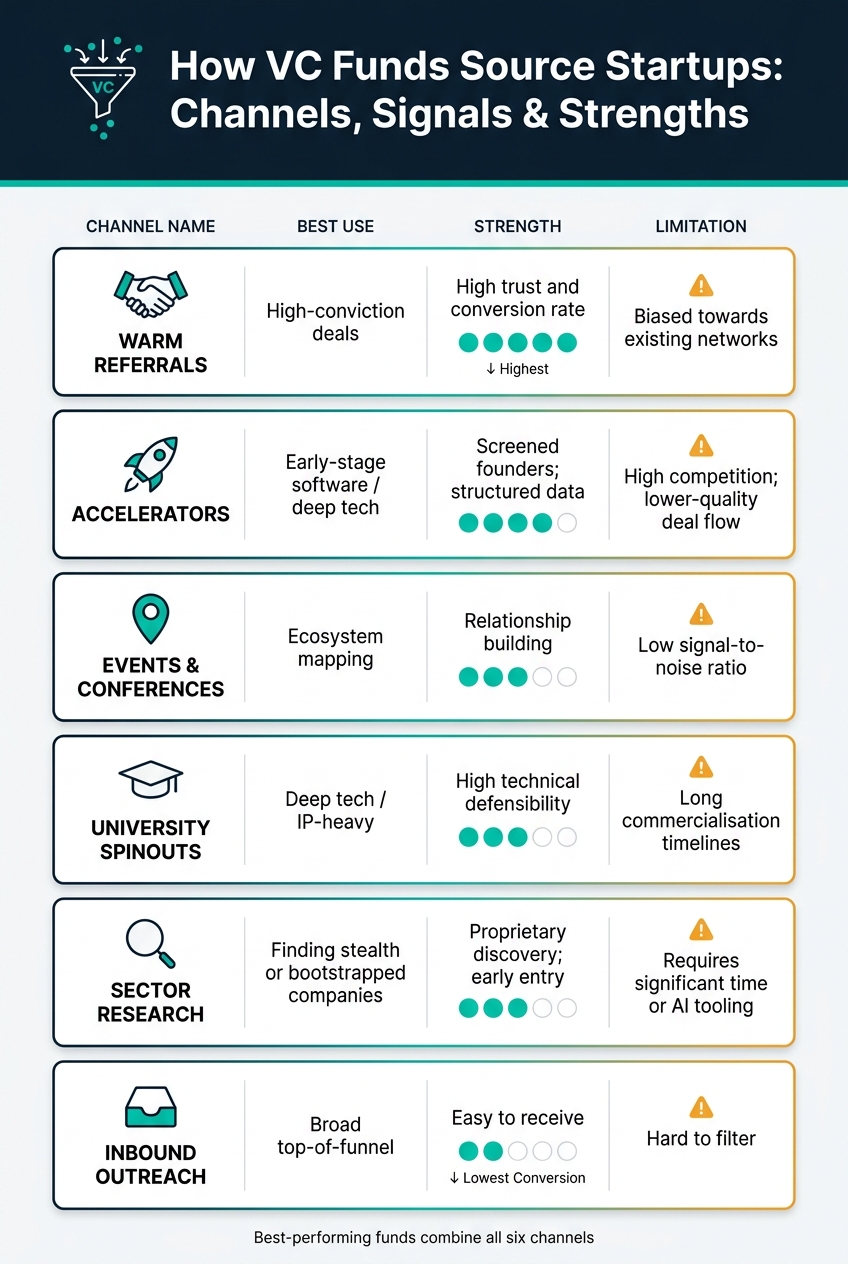
How VC Funds Source Startups: Channels, Signals & Strengths
Funds use different channels to build trust, extend reach, and spot companies early. The best firms don't treat these channels as substitutes. They use them together.
Warm referrals, founder networks, and co-investor relationships
Introductions from portfolio founders, angels, limited partners, lawyers, and co-investors are still the most efficient sourcing channel in venture. The reason is simple: the referrer has already done some filtering. That signal carries far more weight than a cold pitch from someone the fund has never met.
In plain terms, a fund's network shapes the kind of deal flow it sees. Funds that stay close to operator communities, angel syndicates, and other GPs often get in front of better companies sooner.
There is a downside, though. Referral networks are closed by nature. They often bring forward founders who already know the right people, which means founders outside those circles can be missed again and again.
When network-led sourcing starts to thin out, funds look further afield through more structured channels and public signals.
Accelerators, inbound outreach, events, and university spinouts
Accelerators such as Y Combinator, Entrepreneur First, and Seedcamp package many early-stage companies into one visible cohort. Demo days give investors a concentrated look at screened founders, which makes them useful for sourcing. The catch? By the time demo day arrives, many serious funds are already watching the same group.
Direct inbound, like cold emails and LinkedIn messages from founders, brings volume but not much signal. Most funds get a large number of unsolicited pitches, and only a small share goes anywhere. It still works as a catch-all channel, but it rarely delivers the strongest deals.
Events and conferences such as Slush and Bits & Pretzels are more useful for meeting founders early and getting a feel for the market than for sourcing deals that convert at a high rate.
For deep tech, the source changes. Instead of relying mainly on founder networks, funds pay closer attention to research output and IP. University spinouts matter most here, where patent filings and lab exits can surface companies early. The hard part is timing. Deep tech spinouts often need years before they reach a stage that a fund can back.
Sector research and thesis-driven outbound sourcing
Outbound research turns public signals into a search process a fund can use again and again. Thesis-led research looks for signs that appear before a company shows up in standard databases: hiring spikes, product launches, patent activity, open-source contributions, and stealth incorporations. That's especially useful for finding bootstrapped or stealth-mode companies that would otherwise stay hidden.
The signals shift by sector. For software companies, growth in engineering headcount and GitHub activity can point to momentum early on. For deep tech, talent moving out of tier-one research labs and specific patent classifications tend to matter more.
| Channel | Best Use | Typical Signal | Strength | Limitation |
|---|---|---|---|---|
| Warm Referrals | High-conviction deals | Intro from portfolio founders or LP | High trust and conversion rate | Biased towards existing networks |
| Accelerators | Early-stage software / deep tech | Demo day pitches; cohort announcements | Screened founders; structured data | High competition; lower-quality deal flow |
| Events & Conferences | Ecosystem mapping | Face-to-face meetings at Slush or Bits & Pretzels | Relationship building; low immediate conversion | Low signal-to-noise ratio |
| University Spinouts | Deep tech / IP-heavy | Patent filings; research lab exits | High technical defensibility | Long commercialisation timelines |
| Sector Research | Finding stealth or bootstrapped companies | GitHub activity; hiring spikes; product launches | Proprietary discovery; early entry | Requires significant time or AI tooling |
| Inbound Outreach | Broad top-of-funnel | Direct LinkedIn or email pitches | Easy to receive, hard to filter | Easy to receive, hard to filter |
sbb-itb-c96cd03
How investors decide which startups are worth pursuing
Once a startup lands in the pipeline, the team does a fast initial screen. The goal is simple: decide if the company is worth partner time. This is the point where a sourced lead either moves to a first meeting or gets passed on.
Thesis fit, market size, and founder quality
The first check is usually thesis fit. Does the company line up with the fund’s sector focus, stage preference, geography, and capital needs? If not, it’s often a quick pass.
If the startup clears that bar, investors turn to the market opportunity. They want to see a painful, recurring problem and clear customer spend behind it. Put plainly, a problem that already has budget attached is more interesting than one that just sounds clever.
Founder quality gets looked at at the same time as market fit, not later. Investors tend to back founders with direct domain experience or first-hand exposure to the problem. After that, they’re looking for something more practical: can this person hire well, and can they make sound decisions when things get messy?
Product, traction, and fundraising context
At the first-pass stage, investors aren’t expecting polished revenue numbers. What they want is stage-appropriate proof that the company is real. That might be early usage, customer interest, pilots, or another signal that shows the business has substance.
They also pay attention to the founder’s fundraising timing and the quality of existing backers. That context matters. A company can look very different depending on when it’s raising and who has already decided to support it.
Risks, exclusions, and early market signals
Some startups get screened out before the team spends much time on the product. A thesis mismatch, a geographic mismatch, or regulatory risk the fund isn’t set up to handle can all trigger an early pass.
Hiring spikes can help a startup get noticed, but they don’t prove demand on their own. Investors still want to check whether growth comes from actual customer adoption or just aggressive spending. Early market signals can help teams decide who to contact first, but they don’t replace thesis fit or proof of traction. The next step is to track those signals in a system that can rank more companies at speed.
How funds run sourcing at scale with systems, workflows, and AI
Once funds spot the right signals, the next job is turning that into a repeatable process. Tracking signals and screening start-ups only helps if the information ends up somewhere useful. If there’s no system behind it, leads slip through the cracks, follow-ups get missed, and teams end up reviewing the same company all over again. The funds that do sourcing well, month after month, usually have a clear operating setup underneath it all.
CRM, market maps, and structured pipeline management
A CRM keeps each company record, contact route, stage, and pass reason in one place. That matters more than it might seem. If the same start-up comes back six months later with stronger traction, the team needs to see what changed, not restart the whole review from zero.
Market maps do something similar. They give investors a structured view of where companies sit in a sector and make it easier to track how that space is changing over time. They also help teams see a simple truth: some founders are already easy to spot, while others are much harder to find.
Data platforms and alert-based market monitoring
Beyond the CRM, many active funds use data platforms to keep an eye on what’s happening across the market. The upside is simple: earlier discovery and faster qualification. These platforms can surface companies sooner by tracking signals such as hiring, founder moves, product launches, GitHub activity, and new incorporations. Market data providers then add financing history and transaction data for diligence.
Used together, these tools let investors build alert-based monitoring around specific signals. That could be a sudden headcount jump in a target sector, a founder leaving a relevant company, or a new entity filing in a space the fund already watches. The result is faster discovery and cleaner qualification, without waiting for a company to announce itself.
How AI supports sourcing without replacing investor judgement
The main change is a move from manual searching to AI that scores and ranks companies for review. More data on its own doesn’t fix much. What matters is a workflow that turns that data into ranked opportunities.
In practice, an investor might ask an AI analyst to find UK seed-stage climate software companies and get back a scored shortlist ranked against the fund’s own criteria. From there, the system can check for any warm paths through the team’s existing relationships and prepare a draft personalised outreach email, all before the investor decides whether to send anything.
That’s where the useful model comes in: approval-based. AI prepares the shortlist and drafts the outreach. The investor decides what’s worth pursuing. In that setup, AI can expand coverage by automating screening, ranking, and first-draft outreach, while the final call stays with the person.
Manual sourcing is reactive. CRM-backed sourcing is organised. AI-assisted sourcing is proactive and approval-based.
That approval-based model is what keeps investor judgement in the loop. AI flags the opportunity and drafts the message; the investor decides whether the company is worth chasing and whether the outreach sounds right. That line between automation and decision-making is what makes the setup practical, not just fast. It also points to the next part of the puzzle: what founders can do to show up in a fund’s search in the first place.
What founders can do to become easier for VC funds to find
Founders can shape how easy they are to find and size up. In plain terms, discoverability starts long before a fund opens a CRM record.
Make company information clear, searchable, and easy to verify
Start by making your company easy to understand for both investors and the tools they use. AI sourcing tools read company websites a lot like an analyst would. They look for a clear business model, direct sector labels, and a plain explanation of what the product does.
So don’t make people guess. Say what you do, who you serve, and where you fit.
Keep your website and public profiles tight, current, and easy to check. Your public signals should line up, so investors can confirm your progress without digging through mixed messages. If you’re bootstrapped, founder-owned, or currently raising, say so plainly.
Build relevant relationships before the round starts
Being visible helps, but warm access still works best. Referrals land better when people already know your company before you ask for an intro.
That usually means building ties with the right operators, advisers, and portfolio founders who already know the investors you want to reach. Short, steady updates, like a new hire or a product launch, can keep you on their radar without overdoing it.
Outreach also works better when it feels personal and matches the investor’s thesis. Generic mass outreach, even with good timing, rarely gets much traction.
For founders, the message is simple: be specific, stay current, and build relationships before you need them.
FAQs
What makes a warm intro so effective?
A warm introduction works because it builds on trust that already exists. And in a crowded market, that helps investors cut through the noise that comes with cold outreach.
When the intro comes through a mutual contact, like a portfolio CEO or a trusted partner, the investor gets instant context and a reason to pay attention. The opportunity no longer feels like a random pitch landing in their inbox. It feels screened, relevant, and worth a closer look, often even before any formal fundraising process starts.
How do VC funds spot startups before they start fundraising?
VC funds often spot startups before they start fundraising by watching for early signals long before any public announcement.
Those signals can include:
- faster hiring in sales or engineering
- senior executive hires or departures
- quicker product releases on GitHub
- customer traction
- activity in niche communities
With AI-driven tools, investors scan these data points, line companies up against their investment thesis, and often reach out weeks or even months before a formal round begins.
What should founders do to be easier for investors to find?
Founders should step up their public presence and digital footprint. A lot of VC firms now use AI-led tools to watch market signals, so staying visible matters.
Share technical content on LinkedIn, GitHub and X. Spend time in niche communities where people already talk about your product, and keep your public activity steady. If you go quiet for long stretches, the trail goes cold.
Investors often watch for signals like hiring speed, senior team moves, product shipping pace, and customer traction. Those small public clues can add up fast.