
Stop Sourcing Like It's 2015
Use thesis-led, AI-driven market scans, live signals and a connected CRM to source deals earlier with less manual work.
If I still rely on warm intros, inbox deals and hand-built lists, I will see too few companies and see them too late. In 2026, the fix is simple: I need thesis-led sourcing, live market signals, automated outreach and one connected CRM flow.
Here’s the article in plain English:
- Manual sourcing does not scale: one analyst can only track so much, so good deals get missed.
- Reactive deal flow is late deal flow: if I wait for inbound, the market has often moved first.
- Data is often split across tools: spreadsheets, PDFs, inboxes and CRM records slow teams down.
- Modern sourcing starts with a thesis: sector, stage, geography and model become live filters.
- AI helps with market scanning and outreach: some funds report 5x more deal flow from AI-driven sourcing.
- Human judgement still matters: the admin work is automated; approval and decision-making stay with the team.
- The stack has clear roles: Avyn for sourcing and outreach, Affinity for relationship paths, Airtable for custom tracking, and HubSpot for pipeline management.
- The move away from spreadsheets is step-by-step: centralise records, standardise fields, map relationships, then add the AI layer.
My main takeaway: better sourcing is not about working longer hours. It is about building a process that scans more of the market, flags the right signals earlier and keeps every action in one place.
| Area | 2015-style approach | 2026 approach |
|---|---|---|
| Deal discovery | Shortlists and referrals | Thesis-led market scanning |
| Signal tracking | Manual checks | Live alerts across data sources |
| Outreach | One-by-one follow-up | Drafted and tracked with approval |
| Pipeline view | Spreadsheets and siloed notes | Connected systems with clear ownership |
If I want earlier access, less admin and a process I can run the same way each time, this is the shift the article is arguing for.
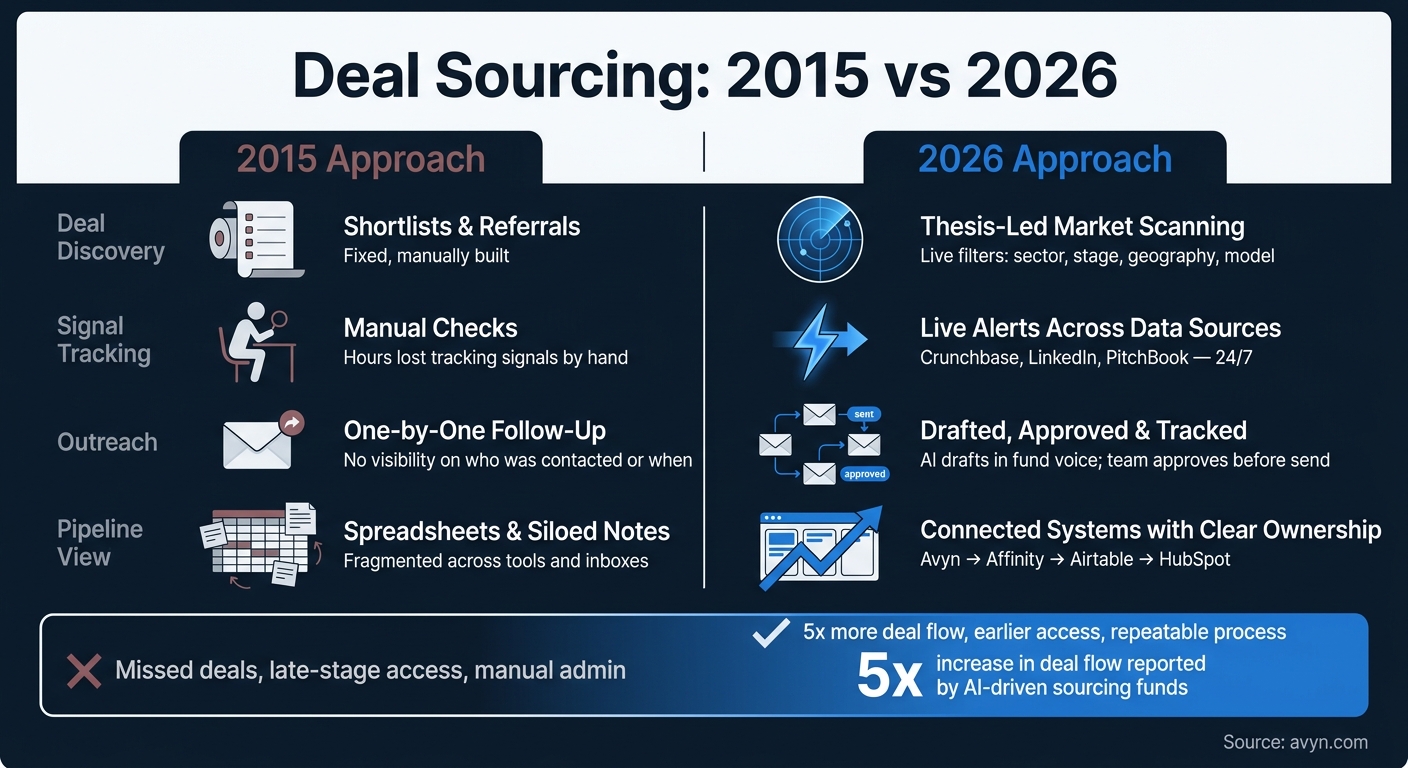
Manual vs AI-Enabled Deal Sourcing: 2015 vs 2026
The mid-2010s sourcing playbook and its limits
What a typical 2015 sourcing workflow looked like
In the mid-2010s, sourcing usually meant manual shortlists, hand-updated contact records and a stack of spreadsheets. It worked, but only up to a point.
The bigger issue was that sourcing depended on human effort rather than a system you could run again and again. If someone forgot to update a file, missed a contact, or kept notes in their own spreadsheet, the process started to wobble.
Where that approach breaks down in 2026
The issue is pretty simple: people only have so much time, and manual updates slow down discovery. That gap shows up in four clear areas.
| Problem | Old method | Why it fails now |
|---|---|---|
| Market coverage | Manual shortlists | Missed deals outside the visible shortlist |
| Pipeline tracking | Ad hoc updates across spreadsheets and CRM | No reliable hand-off or contact history |
| Data reconciliation | Locked PDFs and other locked files | Thousands of manual hours lost extracting and verifying data |
| Outreach visibility | Manual notes | No reliable view of who has been contacted or when |
When sourcing data, outreach activity and CRM records sit in separate places, teams lose sight of what’s happening. Progress becomes harder to track, follow-ups slip, and lead hand-offs get messy.
That’s why the next step is a sourcing system built around live signals, not static lists.
sbb-itb-c96cd03
Why manual, reactive sourcing underperforms today
Low coverage, slow cycles and fragmented data
When sourcing shifts from static lists to live signals, the first thing that breaks is capacity. The issue isn’t effort. It’s bandwidth. No human analyst can scan the whole market, because there just aren’t enough hours in the day.
Live signals only help if a team can review and act on them fast enough. If they can’t, those signals pile up and go stale. That limit pushes teams into a narrow slice of the market instead of the full picture.
On top of that, disconnected tools make things messy. It becomes hard to see what’s already been actioned, who owns the next step, and where follow-up stands. And a lot of high-value information still sits in static files like PDFs, so teams lose hours pulling data out, matching it across sources, and checking what’s correct instead of moving on the best leads.
Why waiting for inbound means seeing deals too late
If a team waits for inbound, it often sees deals only after they’ve already done the rounds. At that point, early access is usually off the table.
| Dimension | Manual sourcing | AI-enabled sourcing |
|---|---|---|
| Speed | Slow; hours spent tracking signals by hand | Real-time; 24/7 market scanning |
| Coverage | Limited to shortlists and known networks | Reads and ranks the entire market against a specific thesis |
| Data quality | Fragmented; data trapped in PDFs and siloed tools | Structured; automated extraction and continuous verification |
The end result is simple: more time goes into data entry and reconciliation, and less goes into judgement.
That’s why the next step is a thesis-led workflow built on live signals.
What modern sourcing looks like in practice
Thesis-based company discovery and live target lists
Once the thesis is set, the system turns it into a live watchlist. Teams apply that thesis as live filters across the market - sector, stage, geography, and business model - so the right companies keep surfacing over time instead of being found one by one by hand.
That changes the pace of sourcing. AI can scan the whole market all the time, which helps teams spot relevant companies earlier. Funds using AI-driven sourcing have reported a 5x increase in deal flow. That didn't happen because they eased their standards. It happened because they were no longer stuck with a fixed shortlist.
Signal tracking across Crunchbase, LinkedIn and PitchBook
A watchlist is only useful if it responds to what is happening on the ground. Modern workflows track funding activity, hiring growth, founder moves, product launches and increased customer traction on a continuous basis.
The point isn't having more data dumped into the system. The point is getting there sooner. If a team catches a signal early, it can reach out before the rest of the market piles in. Teams that depend on inbound usually see the same opportunity later, if they see it at all.
Automated outreach and follow-up without losing control
The same idea carries into outreach. AI can draft messages in the investor's own voice, schedule follow-ups, and send and track outreach across email and LinkedIn, while also spotting warm introduction routes.
That doesn't mean the team loses oversight. Approval workflows let the investment team decide what goes out and when. Each touchpoint then feeds straight into pipeline tracking, so every message and follow-up stays visible as leads move through the funnel.
The next step is wiring that workflow into the team's CRM and pipeline tools.
AI or Inefficiency: How VC Funds Are Rebuilding Deal Sourcing Today | UAtech × Reply.io
Building a sourcing workflow with Avyn, Affinity, Airtable and HubSpot
Automated outreach only works when sourcing, relationship tracking and CRM activity live inside one connected workflow.
If those tools are split up, sourcing stays reactive. Teams jump between spreadsheets, inboxes and CRM records, and things slip through the cracks. The fix is simple in principle: connect discovery, outreach and pipeline tracking so they work as one process. That only happens when sourcing, relationship data and CRM activity are tied together.
Using Avyn to connect sourcing, outreach and pipeline activity
Avyn sits at the front of the workflow. It keeps the investment thesis active and surfaces companies that match it.
When a company is a close enough fit, Avyn finds warm introduction routes and drafts outreach in the fund's own voice. Messages sent out, and replies that come back, flow straight into pipeline tracking. The investment team still approves what gets sent, so the process stays systematic without losing human judgement.
Where Affinity, Airtable and HubSpot fit in the workflow
Once a company moves beyond early discovery, relationship tracking and CRM systems take over. The easiest way to look at the stack is by layer: discovery, relationship mapping, flexible tracking and pipeline management.
| Tool | Primary Role | Workflow Strength | Typical Fund Use |
|---|---|---|---|
| Avyn | Sourcing & Outreach | AI-driven discovery, scoring and personalised outreach | Market scanning, thesis matching |
| Affinity | Relationship Intelligence | Surfacing warm intro paths and automated contact tracking | Identifying who in the network knows a target founder |
| Airtable | Flexible Record Tracking | Customisable views and fields | Ad hoc research, sector shortlists, custom data sets |
| HubSpot | Pipeline Management | Structured deal stages and reporting | Managing active deal flow from qualification to close |
Affinity maps internal relationships so the right person can make the introduction without delay. Airtable is useful for niche data points that do not sit neatly inside a standard CRM. HubSpot takes over once a lead becomes an active opportunity, with stage tracking and IC reporting.
Once this structure is in place, the main task is moving from scattered records to one operating process.
A phased move away from spreadsheets and ad hoc processes
The most practical path has four steps, with each one setting up the next:
- Centralise records - move fragmented spreadsheet data into the primary CRM to create a single source of truth across the team.
- Standardise stages and fields - define consistent deal stages and data fields before connecting new tools, so the data moving between them stays clean.
- Map relationships in Affinity - make sure every company surfaced by the sourcing layer already has a mapped intro path.
- Deploy the AI layer - bring Avyn in to handle continuous market scanning, company scoring and outreach drafting, with human approval at each step.
That gives the whole team a workflow they can run the same way every time.
Conclusion: Source earlier, cut manual work and make origination repeatable
When sourcing, relationship data and CRM activity are connected, the whole process gets easier to repeat and scale. The gap between 2015-style sourcing and what’s possible now comes down to one thing: coverage. Manual workflows miss companies because analysts simply run out of hours. Reactive inbound has a different problem - teams see deals after the opportunity is already in market. Working harder doesn’t fix either issue. Changing the process does.
Deal sourcing still leans on disconnected tools, siloed data and manual signal tracking. Modern origination changes that. It swaps the shortlist for market-wide scanning, manual signal tracking for automated alerts, and ad hoc outreach for personalised messages sent at the right moment. The result is earlier discovery, less manual work and a pipeline the team can run in a consistent way.
Thesis-driven discovery, signal tracking, structured outreach and connected CRM systems only do their job when each stage feeds the next. Tie live signals to early outreach and a cleaner pipeline hand-off, and the workflow stops feeling like a stack of separate tools. It starts to work like one operating process.
That link is what turns better sourcing into a repeatable operating model. Teams find better opportunities earlier, manual work drops and origination becomes something they can run again and again. That consistency is what separates teams that reach deals early from those that show up after the market has already moved.
FAQs
How do I build a sourcing thesis?
Define the specific criteria that set your target companies apart from the rest of the market.
Then, instead of building manual shortlists by hand, feed those criteria into an AI analyst that can scan the market and rank companies against your thesis. That gives you automated discovery and ranking, so you can shift from reactive searching to a more scalable workflow.
What signals should I track first?
Start by tracking signals that give you broad market coverage instead of manually watching a small shortlist.
Then use AI-driven tools to rank companies against your investment thesis and surface existing network connections for warm introductions. That helps you reach high-potential opportunities earlier and with more consistency than manual workflows.
How can I move away from spreadsheets?
Move from manual spreadsheets to an AI-first approach for deal origination. Instead of asking analysts to track and shortlist companies by hand, let Avyn handle the heavy lifting.
Avyn scans the market on a continuous basis, ranks companies against your investment thesis, brings the right opportunities to the surface, finds potential warm introductions, and manages outreach in your voice. The result is more scalable deal flow with far less manual data entry.