
5 Signals That Help Investors Find Deals Before Competitors
Combine hiring spikes, founder exits, product momentum, customer traction and market buzz to spot fundraising-ready startups earlier.
Most investors are late because most rounds are hidden. If around 70% of funding rounds stay private - and 75% at seed - I can’t rely on announcements if I want to spot companies early.
Here’s the simple takeaway: I’d look for five signals in combination - hiring shifts, founder or senior team moves, product shipping pace, customer pull, and public market buzz. On their own, each signal can mislead. But when two or more line up over a short period, I get a much better read on which companies may be moving towards a round.
What I’d focus on first:
- Hiring velocity: sales, customer success, or engineering hiring patterns that change fast
- Founder spin-outs and senior hires: new entities, leadership joins, and team build-outs
- Product launch pace: faster release cycles, more contributors, and rising GitHub activity
- Customer traction: support hiring, contract wins, repeat buying, and lower churn
- Market engagement: more mentions in LinkedIn, X, Slack, Discord, Reddit, and forums
The core idea is simple: I don’t wait for a fundraise to start. I track behaviour that often shows up weeks or months earlier, score what fits my thesis, and contact the company while the field is still less crowded.
Quick Comparison
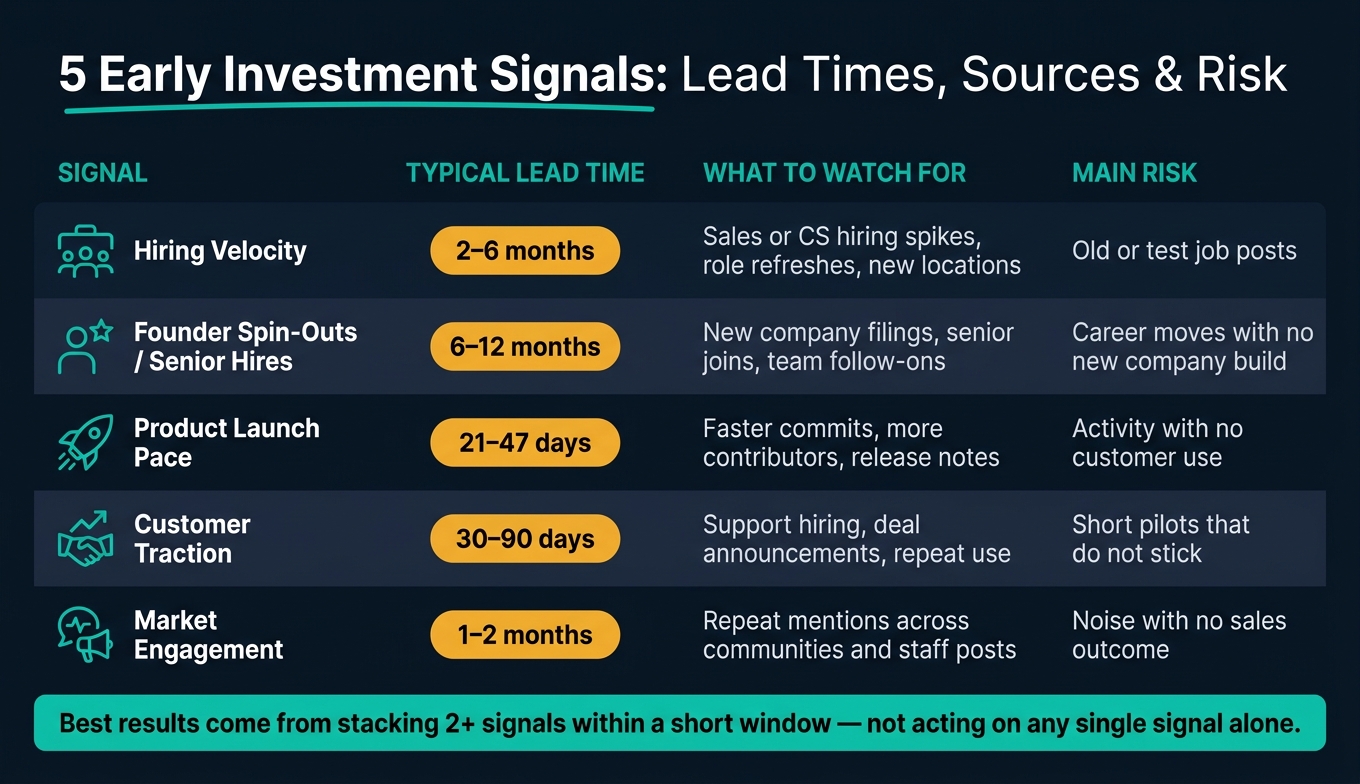
5 Early Investment Signals: Lead Times, Sources & Risk
| Signal | Usual lead time | What I’d watch for | Main risk |
|---|---|---|---|
| Hiring velocity | 2–6 months | Sales or CS hiring spikes, role refreshes, new locations | Old or test job posts |
| Founder spin-outs / senior hires | 6–12 months | New company filings, senior joins, team follow-ons | Career moves with no new company build |
| Product launch pace | 21–47 days | Faster commits, more contributors, release notes | Activity with no customer use |
| Customer traction | 30–90 days | Support hiring, deal announcements, repeat use | Short pilots that do not stick |
| Market engagement | 1–2 months | Repeat mentions across communities and staff posts | Noise with no sales outcome |
If I had to reduce the article to one line, it would be this: the best early deal flow comes from stacked signals, not single events.
sbb-itb-c96cd03
Why Combining Multiple Signals Beats Reactive Sourcing
That’s why combining signals matters. One signal on its own can send you in the wrong direction. A company might post a role just to test the market, or leave an old advert sitting there for weeks. The aim is to reach out earlier, before a round turns into a scramble.
High-priority deals tend to show up when weaker signals start to stack. If hiring velocity, a new executive hire, a product release and market expansion all point the same way within a short period, it becomes much harder to brush off.
Reactive sourcing is late by design. Once a funding announcement lands, every rival sees it too.
Filtering by sector, stage and geography helps cut through the noise and bring forward the companies that fit a fund’s thesis. That gives teams a way to prioritise outreach before anyone else gets there first.
The hard part? These signals are scattered across job boards, LinkedIn, news, CRM notes, email threads and calendars. Avyn brings them into one view, scores them and routes them into sourcing actions, so monitoring stays consistent.
The clearest place to start is hiring velocity, which often shows up first.
1. Hiring Velocity and Sales Team Build-Out
When a company posts three or more sales roles at the same time, it usually means the business is moving from product build into go-to-market mode. The main signal isn't just more hiring. It's the change in who they're hiring.
Hiring spikes often show up two to six months before a funding round becomes public. That gives investors an early look at momentum while the rest of the market is still catching up.
A move away from engineering roles and towards SDRs, account executives, and customer success hires often signals a shift from building to selling. If the company is also hiring in new cities or countries, that signal gets stronger. In plain terms, a sales hiring spike often points to market expansion and a rising need for sales support.
The best places to track this include:
- company career pages
- job-board metadata
- LinkedIn Talent Insights
- page-change trackers
One detail matters a lot: if a job post is refreshed several times within two weeks, treat it as high priority. On the other hand, roles left open for more than 45 days without updates can look more like market testing than active hiring. The aim is to spot repeatable commercial hiring patterns before competitors do.
AI-driven workflows make this much easier to scale. They can flag headcount shifts of 15%+ over six months and send the strongest changes straight to the sourcing queue.
When these hiring moves happen alongside senior appointments, the signal becomes stronger.
2. Founder Spin-Outs and Senior Executive Additions
When a founder or senior executive leaves an established firm to start something new, it’s one of the clearest early sourcing signals you can get. In many cases, it shows up before any public funding news, which gives investors a chance to spot an opportunity before the rest of the market catches on.
You can track these moves through LinkedIn Sales Navigator, Crunchbase, Google News and Companies House filings. Companies House records are especially handy because they can confirm the legal setup of a new entity weeks, or even months, before any public announcement appears.
Senior hires can also set off a chain reaction. They often bring people they trust, kick off hiring at pace and start reviewing the tech stack within 90 days. For investors, that’s a clear prompt to reach out. A senior operator can move fast, and the window for early contact doesn’t stay open for long. If those hires are then followed by faster product release, the signal gets even stronger.
3. Product Launch Momentum and Release Cadence
Hiring can hint that a team is getting bigger. Product activity shows whether that team is actually shipping.
For pre-seed and early-stage companies, GitHub activity is often the clearest public sign of product pace. Release notes, changelog updates, and product pages help confirm whether commit activity is turning into actual launches.
Raw commit volume matters less than the rate of change. The key thing to watch is movement in commit velocity, especially an accelerating 14-day rolling window, along with growth in the number of active contributors. If a team goes from two contributors to six while doubling its commit rate over a fortnight, that points to an active product build.
A 100% rise in 14-day commit velocity, paired with six active contributors, is a stronger sign than commit totals on their own.
GitHub engineering signals can surface strong targets 21 to 47 days before a pitch deck starts doing the rounds. Of course, not every spike means much. The pattern that tends to matter more is steady acceleration over several weeks, ideally checked against other signals, such as leadership hires or a hiring mix that shifts towards engineering roles. If a new CTO or VP joins and commit velocity climbs in the same stretch, it becomes much harder to brush off.
Avyn can monitor repository activity, flag contributor growth, and surface new repositories in weekly alerts. That turns what would otherwise be a manual review into a steady sourcing prompt. When release cadence climbs at the same time as customer response, the signal gets stronger.
4. Customer Traction and Retention Strength
Once product activity starts to show up, customer behaviour gives you the next clue: is the market responding, or not?
One of the steadiest signs of traction is hiring in customer success and support. If those roles jump all at once, it usually points to a growing user base that needs onboarding, help, and retention work. Public contracts, enterprise deals, and partnerships often show up around the same time. That makes sense. More customers usually mean more workload, and that often comes just before a team grows. If those same roles keep getting refreshed or reposted on the careers page, the urgency is even harder to miss.
Low churn, strong organic acquisition, and repeat purchase rates point to real product value. Organic acquisition shows whether people are finding the product without paid push. Repeat purchase rate shows whether they come back after the first buy. Put simply, customers aren't just showing up - they're sticking around.
The louder signals aren't always the most useful. Surface-level noise matters less than low turnover in core product teams and repeated hiring across support roles. There’s also another layer: employees sharing account wins or technical deep-dives in public. Those posts can hint at momentum inside the business. Match that against job posting activity, and the picture gets sharper.
When you combine customer data with hiring and product signals, traction can give investors a 30 to 90 day lead before growth becomes plain to everyone else.
When these customer signals start spilling into public discussion, the next thing to track is market engagement.
5. Market Engagement Spikes and Community Pull
When traction starts spilling into public spaces, market engagement can become an early sign worth watching. Founders speak at events. Employees share technical threads on LinkedIn. Niche communities mention the product more often. These shifts can show up before a formal fundraise even starts.
What matters most is convergence. A founder becomes more visible. Team members post technical content. People keep bringing up the product in Slack, Discord, Reddit, or specialist forums. Put together, that pattern tells you far more than any single signal on its own.
The strongest signs often sit in private channels that investors miss. LinkedIn and X are good places to begin, but Slack, Discord, GitHub, and Stack Overflow often show clearer intent. These signals don’t hang around for long, so timing matters.
Before outreach, qualify what you’re seeing. Check:
- relevance
- credibility
- whether the signal repeats across the company
Once these signals start to cluster, feed them into a scored sourcing workflow so the strongest accounts reach the team first.
How to Turn Signals into a Repeatable Sourcing Workflow with Avyn
Spotting signals is only half the job. The five signals only matter when they feed into one repeatable process.
Most teams miss the window because monitoring, relationship data and outreach live in different systems. Things get split up, hand-offs slow down, and good opportunities drift. That’s where a repeatable signal-to-outreach workflow comes in.
Avyn is built to replace scattered tools with one workflow that scans the market, ranks fit, and sends the best opportunities to the team. It works like an AI analyst, scanning for hiring velocity, founder moves, and funding signals across the market on a continuous basis, not just against a shortlist. It then ranks each company against your fund’s thesis.
Once a company clears your thesis threshold, Avyn finds warm introduction routes through your existing network, drafts personalised outreach in your fund’s voice, manages follow-ups, coordinates meeting bookings, and tracks the pipeline. Once the right accounts are ranked, the workflow can move straight from monitoring to outreach.
A simple weekly cadence keeps the process steady:
- Monday: review ranked companies flagged across hiring velocity, founder moves, product activity, customer traction, and market engagement
- Tuesday: map warm introduction routes through partners or portfolio CEOs
- Wednesday: send tailored outreach that mentions the exact trigger
- Thursday: handle follow-ups and meetings
- Friday: audit which signals turn into meetings, and which filters need tightening
This setup creates more deal flow and stronger response rates because every message points to a clear, timely trigger.
Signal Comparison Table
Not all signals move at the same pace. Some give you a short window to act. Others give you more time, but need a more senior touch. This table gives you a quick way to sort outreach by speed, source, and who should take the first shot.
| Signal | Typical Lead Time | Best Data Sources | Main False Positives | Outreach Hook | Suggested Owner |
|---|---|---|---|---|---|
| Hiring Velocity | 2–6 months | LinkedIn, Indeed, JobGrabber | Ghost jobs, backfilling high churn | Scaling pains and onboarding support | Analyst |
| Founder Spin-Outs and Senior Executive Additions | 6–12 months | LinkedIn, ZoomInfo, Apollo.io | Exploring new moves without clear intent | Congratulate the move; ask about the vision | Partner/Principal |
| Product Launch Momentum | 21–47 days | GitHub, Product Hunt, press releases | Feature parity updates with no real adoption | Support the next product phase | Associate |
| Customer Traction | 30–90 days | Contract win announcements, enterprise news | Non-recurring pilot projects, low-margin trials | Back expansion of proven enterprise wins | VP/Associate |
| Market Engagement | 1–2 months | Reddit, niche forums, web traffic data | Viral noise with no commercial conversion | Lead with community demand | Analyst |
A simple way to read it: Product Launch Momentum and Market Engagement tend to move fastest, so they often need early monitoring and quick outreach. Hiring Velocity sits in the middle and can point to team strain before it becomes obvious from the outside. Founder Spin-Outs and Senior Executive Additions usually give you the longest runway, but they often call for outreach from a Partner or Principal rather than a junior team member.
Use the table to decide two things fast:
- who should own first outreach
- which signals need the quickest response
That helps you avoid a common mistake: treating every signal the same when the timing, risk, and opening message are completely different.
Conclusion
The best investors don’t sit back and wait for founders to get in touch. By the time a formal fundraise starts, they’re often already paying attention.
That edge comes from reading signals together, not one by one. A hiring spike, a new executive hire, and rising product or market activity usually tell you more as a group than any single signal does on its own.
That matters because most rounds stay private. Be clear on your thesis, stick to a steady monitoring routine, and act when two or more signals line up.
Avyn helps surface the companies worth prioritising, so your team can go from watching to outreach without getting stuck in manual research. Watch the signals, score the fit, and move first.
FAQs
How many signals should I wait for?
You don’t need to sit around waiting for some magic number. If you wait for several signals to line up, you can miss the first-mover edge. Sometimes one strong indicator is enough to show that a company is ready for growth or a deal.
A better approach is to track five to seven different signals, weigh them against the company’s situation, and make contact early.
Which signal is usually the most reliable?
Recent fundraising is often one of the clearest signs that a company is getting ready to grow and hire. When new money comes in, especially through unannounced or private rounds, it points to two things at once: the company now has more room to spend, and it plans to expand.
For investors, keeping track of these funding events can help them spot high-potential firms early. It also gives them a chance to reach out to founders before rivals get there first.
How can a small team track these signals consistently?
A small team can stay consistent with a simple signal-triage routine. For example, set aside 30 minutes every Monday to review key signals such as hiring velocity and press releases.
It also helps to use monitoring tools that pull funding rounds, leadership changes and product launches into one dashboard. That cuts down on manual research and makes it easier to work in a more proactive, prioritised way.