
Proprietary Deal Flow: How Top Funds Source Off-Market Companies
Find off-market deals early: map a tight thesis, track timing signals, use referrals/outbound/AI, and run a single workflow.
Most funds miss deals long before they lose them. In private markets, the edge usually comes from seeing the right company before a banker-led process starts, then reaching the founder at the right time with a clear reason.
If I had to boil this article down, it comes to four things:
- Define a tight target list instead of relying on a broad sector brief
- Separate filters, scoring, and timing signals
- Use more than one sourcing route: referrals, outbound, signal tracking, and formal processes
- Build one workflow so every lead has an owner, a next step, and a follow-up date
The article also makes one point very clear: proprietary access is not the same as exclusivity. A founder can speak to more than one investor, and you can still be early enough to build trust before a sale or funding process starts.
A few facts stand out:
- A 240% headcount increase over 24 months can be a useful signal
- Banker-led processes tend to come later and pull in more bidders
- AI can cut research time from hours per company to minutes, but people still need to check context, approve outreach, and own the relationship
Quick comparison
| Area | What matters most |
|---|---|
| Proprietary deal flow | Getting in early, before a formal process |
| Inbound | Warm, but hard to scale |
| Outbound | Best when tied to a clear thesis and a reason to contact now |
| Ecosystem monitoring | Good for spotting early movement from outside signals |
| Intermediated deals | Higher competition, less room to build conviction |
| AI in sourcing | Best for scanning, ranking, summaries, and first drafts |
| Human role | Judgement, fact-checking, and founder relationships |
I’d sum it up like this: the best sourcing systems are simple, early, and disciplined. You pick the right universe, watch for movement, use warm paths where you can, and make sure no target sits idle.
sbb-itb-c96cd03
Turn your investment thesis into a searchable target universe
Once your sourcing channels are clear, the next step is figuring out which companies are actually in scope. A broad mandate like "B2B software in Europe" is a starting point. It is not a sourcing tool.
If you want to source off-market companies on a consistent basis, you need to turn that mandate into a clear screen. That screen should show who qualifies, how to rank them, and when to reach out.
Separate hard filters, scoring factors, and timing signals
The simplest way to build a target specification is to split your criteria into three layers. They work together, but each does a different job: one sets the universe, one ranks it, and one tells you when to move.
Hard filters define the universe: sector, geography, stage, ownership, and headcount cap. If a company sits outside those limits, it doesn't qualify, no matter how interesting it looks. That might mean B2B software companies headquartered in the UK or Germany, bootstrapped or 100% founder-owned, with fewer than 50 employees.
Scoring factors rank the companies that pass those filters. These are the traits that increase conviction: a founder with a prior exit, efficient growth, fit with your thesis, or a technical founder profile that matches the sector. These are not yes-or-no checks. They are weighted signals that help you decide which companies deserve attention first.
Timing signals show when to act. A sudden hiring spike, a new product launch, a founder change, or a cluster of senior hires can point to an inflection point. Use timing signals as prompts, not proof. Keep confirmed facts separate from signals that still need human checking.
| Layer | Purpose | Examples |
|---|---|---|
| Hard Filters | Define the searchable universe | Sector, geography, stage, ownership, headcount cap |
| Scoring Factors | Rank by thesis fit | Founder pedigree, efficient growth, fit with your thesis |
| Timing Signals | Identify the right moment to reach out | Hiring spikes, product launches, founder changes |
Build a thesis-driven market map with ownership and next steps
Once your criteria are set, the market map is where the work becomes usable. Think of it as a live worksheet, not a static shortlist. Your team should update it as new evidence comes in.
Each row should record the company, thesis-fit score, ownership, timing signal, relationship path, and next action. It also helps to log relationship history and internal notes in the same place. That stops duplicate outreach and keeps the team aligned on where each company sits in the pipeline. The map also helps you prioritise founder tracking, referrals, and outbound sequencing.
This only works if the map stays current. Ownership changes, new hires, product launches, and founder changes can all shift a company's place on the list. Keep it live. Rescore companies as new signals appear so the team is working from the latest view, not an old snapshot.
That live market map then feeds the signals and outreach channels that create first contact.
The core channels that generate off-market access
With your market map live and your criteria set, the next question is simple: where does the deal flow actually come from? The funds that keep seeing companies before everyone else don’t depend on one route. They run a few channels at the same time, and each one does a different job.
Track founder and company signals that come before a fundraising process
Once the market map is in place, the next step is spotting the earliest signs of movement. Use outside signals to decide when to act, not to prove intent. That includes things like a sharp rise in engineering hires, a new product line showing up on a company website, new company registrations, or a founder moving from a senior role at a prominent company.
None of these signals proves that a company is about to raise. A 240% headcount increase over 24 months is worth flagging, but someone still has to check whether that growth comes from actual customer demand. AI tools can track hiring, code activity, and company formation, which helps teams spot these shifts early. But the edge isn’t just getting access to the tools. It comes from moving on the signal faster, and with better context, than anyone else. Log the signal, then assign a follow-up.
Use referrals and ecosystem monitoring to find warm paths in
Referrals are one of the steadiest ways to get a first conversation. Portfolio founders know the ecosystem, meet other founders all the time, and a recommendation from a peer carries weight. Co-investors, angels, accelerator managers, university technology transfer offices, and LP networks can all do the same thing: give you a trusted way in before any process begins.
Ecosystem monitoring takes this further. Demo days, open-source communities, and technical conferences can bring companies to the surface before they show up on anyone else’s list. Then cross-check what you find outside your firm against what already sits inside your network, including prior emails, meetings, and founder notes. If someone on your team spoke to a founder before and the company has grown since then, that warm path is already there. Feed those paths back into the market map so the team can focus on the best route in.
Run sector-focused outbound with a clear reason to reach out now
Once you’ve identified a company, outbound should be led by a trigger. Generic messages usually go nowhere. Start with target selection from your market map, find the right contact, check your thesis fit, and anchor the message to something specific: a product launch, a hiring pattern, a market shift, or a recent customer win. That trigger gives you a reason to reach out now instead of three months later.
AI can help draft the first pass, but outbound should still feel human, specific, and tied to a real trigger. Early outreach shouldn’t open with a fundraising ask. The goal is to start the relationship early, so when the company is ready to raise, they already know who you are.
Build a repeatable sourcing workflow and apply AI where it helps
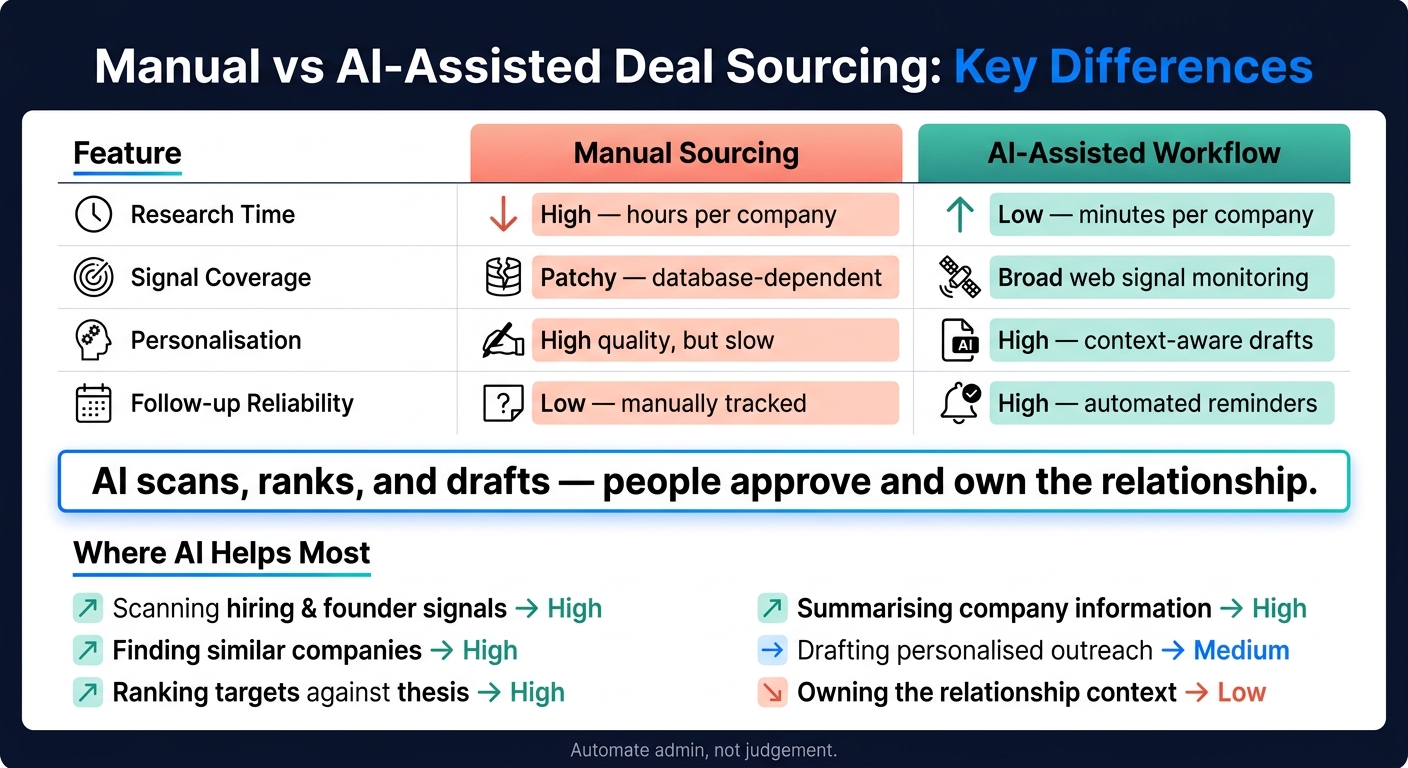
Manual vs AI-Assisted Deal Sourcing: Key Differences
Once your target universe and channels are set, execution usually becomes the sticking point. Having several sourcing channels only works if every lead moves through the same repeatable process. What you need is one operating rhythm that tracks each target from the first signal to the first meeting.
Create a single workflow from discovery to qualified conversation
Each target should have a live record that shows:
- owner
- last contact
- next action
- due date
With those fields in place, the team gets one live pipeline for ownership and follow-up.
The table below shows what changes when you move from manual sourcing to an AI-assisted workflow:
| Feature | Manual Sourcing | Partially Automated | AI-Assisted Workflow |
|---|---|---|---|
| Research time | High - hours per company | Medium | Low - minutes per company |
| Signal coverage | Patchy - database-dependent | Limited to scheduled exports | Broad web signal monitoring |
| Personalisation | High quality, but slow | Low - template-driven | High - context-aware drafts |
| Follow-up reliability | Low - manually tracked | Inconsistent | High - automated reminders |
The aim is simple: automate admin, not judgement.
Use AI for scanning, ranking, and outreach while keeping humans in control
AI earns its place in sourcing when it handles the work that is high-volume, repetitive, and time-sensitive. That’s the groundwork that needs to happen before any proper relationship-building can start. A good rule of thumb is this: AI scans, ranks, and drafts; people approve and own the relationship.
Decision-makers can spot AI-written outreach fast, often from the first line. So drafts need a final human read before they go out. The same applies to rankings. If someone corrects a score, that change shouldn’t flow straight into future rankings. It should be logged, checked against a separate set of examples, and reviewed before any update goes live.
| Task | AI suitability | Human role |
|---|---|---|
| Scanning hiring and founder signals | High | Define thesis criteria and signal weights |
| Finding similar companies | High | Validate sector relevance |
| Ranking targets against thesis | High | Review evidence and correct weights |
| Summarising company information | High | Audit for accuracy |
| Drafting personalised outreach | Medium | Final approval and voice check |
| Owning the relationship context | Low | Primary owner of the conversation |
Where Avyn fits in the sourcing workflow
In practice, Avyn supports private market teams by sourcing against thesis, scanning signals, ranking targets, and drafting outreach for approval. It supports venture capital, growth equity, and venture debt funds. It scans market signals such as funding moves, hiring activity, and founder activity, then ranks targets against configurable criteria and drafts outreach in the fund’s own voice.
Every action passes through an approval step before anything is sent. That keeps the team in control of what goes out and who receives it. The audit trail also means each AI-generated assessment can be traced back to the evidence behind it. Confidential fund and founder information stays protected throughout. You end up with one workflow that runs from discovery to pipeline tracking, with approval at each step.
Conclusion: The habits that improve proprietary deal flow over time
The edge usually comes from four habits working together: a searchable thesis, early signal tracking, warm relationship paths, and a workflow that keeps every lead moving.
Out of all four, timing matters most. Once a company shows up in a mainstream database or gets written about in the press, the chance for a proprietary conversation has often already gone. That’s why the habit to build is simple: reach out before a company becomes broadly visible. Hiring activity, founder moves, and ecosystem referrals can all point you there earlier.
Then comes the learning loop. Misses shouldn’t just be forgotten. They should feed the system. Correct the score, log the reason, and tighten the criteria. Over time, the process gets better through iteration, not from getting everything right on day one.
What separates a proprietary pipeline from a crowded, intermediated process? Consistent execution. Teams that do this well build off-market access before deals are widely shopped.
FAQs
What counts as proprietary deal flow?
Proprietary deal flow means opportunities a fund finds directly before they’re widely circulated or listed in public databases.
It often comes from spotting early signals like hiring velocity, founder moves, product shipping pace, customer traction and market engagement. That gives teams a chance to identify promising companies 30 to 90 days earlier and move from reactive sourcing to proactive, thesis-driven origination.
How do you know when to contact a founder?
Contact a founder when multiple signals line up, not when you spot just one thing in isolation.
What does that look like in practice? It could be a hiring spike, a new senior executive joining, and more movement around the product or in the market.
Some signals call for speed. Product launch momentum and market engagement usually mean you should reach out fast, while hiring velocity, founder spin-outs, and executive additions often give you a bit more time to act.
How much sourcing can AI really automate?
AI can take a lot of the grind out of sourcing, especially the admin-heavy, repetitive work. But it shouldn’t replace human investment judgement.
It can scan the market for signals like hiring velocity, founder moves, and funding activity. Then it can rank companies, draft personalised outreach, handle follow-ups, and coordinate meetings. The investor still needs to own the thesis, bring the context, and make the final call.