
The End of the Cold Intro: How Funds Source in 2026
Funds ditch cold intros and prioritise live signals, thesis-fit scoring and warm-path mapping to boost meetings and conversion.
Cold intros are losing because funds now win on timing, fit and relationship context - not message volume.
If I boil this article down to the core point, it is this: in 2026, good sourcing starts with live signals, then thesis scoring, then relationship mapping, and only then outreach. Funds that still rely on batch email outreach often get low reply rates, messy hand-offs, and duplicate founder contact. Funds that work from signal-led lists can improve signal-to-meeting conversion, cut wasted research time, and move from a raw market list to an approved outreach queue with more control.
Here’s the full idea in simple terms:
- Cold outreach underperforms when there is no clear why now
- Live signals like hiring spikes, stealth incorporations, product launches, and GitHub activity help funds spot companies before a round is public
- Thesis scoring helps teams rank companies before any message goes out
- Relationship mapping shows whether a warm route exists through a colleague, adviser, board member, operator, or co-investor
- Human sign-off still matters at each step, even when AI does the research and drafting
- Better metrics are about conversion, not send volume
A few points stand out:
- A founder is more likely to ignore a generic note than a message tied to a clear signal
- Inbound solves part of the problem, but it is still founder-led and limited by brand pull
- Manual sourcing often creates hidden costs: hours spent filtering noise, missed follow-ups, and repeated outreach from different people at the same fund
- The article argues that one well-timed message with proof of momentum can beat dozens of generic emails
Quick comparison
| Model | Timing | Relevance | Relationship context | Main weakness |
|---|---|---|---|---|
| Cold outreach | Random or unchecked | Low | None | Low replies and weak tracking |
| Inbound-led sourcing | Founder-led | High | Sometimes present | You only see what comes to you |
| Signal-driven sourcing | Event-led | High and thesis-matched | Mapped before contact | Needs clear review rules |
What I take from this is simple: the old workflow started with outreach and hoped for fit later; the new workflow starts with fit and timing, then picks the best path in.
The article then walks through that shift step by step: from poor cold intros, to signal categories, to thesis-fit scoring, to warm-path mapping, to approval-based workflows, and finally to the metrics funds should track in 2026.
sbb-itb-c96cd03
Why Cold Intros Underperform in Deal Sourcing
In deal sourcing, a cold intro is outreach sent without a checked signal, thesis fit, or relationship path. The result is pretty bleak: low reply rates, weak follow-up, and little visibility into what’s working and what isn’t.
What Founders See When Outreach Lacks Timing and Context
From a founder’s point of view, a cold intro without context feels like noise. Even if the message gets the basics right - the right name, the right company - it still misses the mark when there’s no clear reason why now is the right time to reach out. Founders are quick to spot generic outreach.
Timing matters just as much as relevance. Older databases often surface companies only after a funding round or press coverage. By then, the window for a proprietary conversation is often closed. That’s why many funds now rank targets before making contact instead of waiting for a round to bring them into view.
The Hidden Process Costs: Manual Work, Missed Follow-Ups, and Duplicate Activity
Fragmented tools slow everything down. You lose relationship history, hand-offs become patchy, and it gets hard to tie actions back to meetings. Bad sourcing doesn’t just hurt reply rates. It also creates messy workflows.
A common example: an associate emails a founder that a colleague already spoke to two months earlier. The founder notices, and trust takes a hit.
Manual signal tracking also eats up time. Analysts can spend hours filtering noise and false positives from generic databases instead of speaking with qualified prospects.
Cold Outreach vs Inbound-Led vs Signal-Driven Sourcing
The table below shows why signal-driven sourcing beats generic outreach. The gap becomes obvious when you compare the three models side by side.
| Feature | Cold Outreach | Inbound-Led Sourcing | Signal-Driven Sourcing |
|---|---|---|---|
| Timing | Random / unverified | Reactive (founder-led) | Event-triggered |
| Relevance | Low / generic | High | High (thesis-aligned) |
| Research Effort | High (manual / siloed) | Low (self-selecting) | Automated |
| Personalisation | Surface-level | Contextual | Evidence-based |
| Relationship Context | None / ignored | Existing | Mapped / warm path |
| Pipeline Visibility | Fragmented / weak | Moderate | Unified / high |
Inbound-led sourcing fixes the relevance issue because founders are self-selecting. But it’s still reactive. You only see what comes to you, so coverage depends as much on your brand as on your thesis. Signal-driven sourcing deals with both issues. It is proactive and thesis-aligned, surfacing the right companies at the right time instead of waiting for them to show up.
Signal-driven sourcing solves timing and relevance. Once the signal is clear, the next question is who can make the introduction feel warm.
How Funds Source in 2026: Signals, Thesis Scoring, and Ranked Prospect Lists
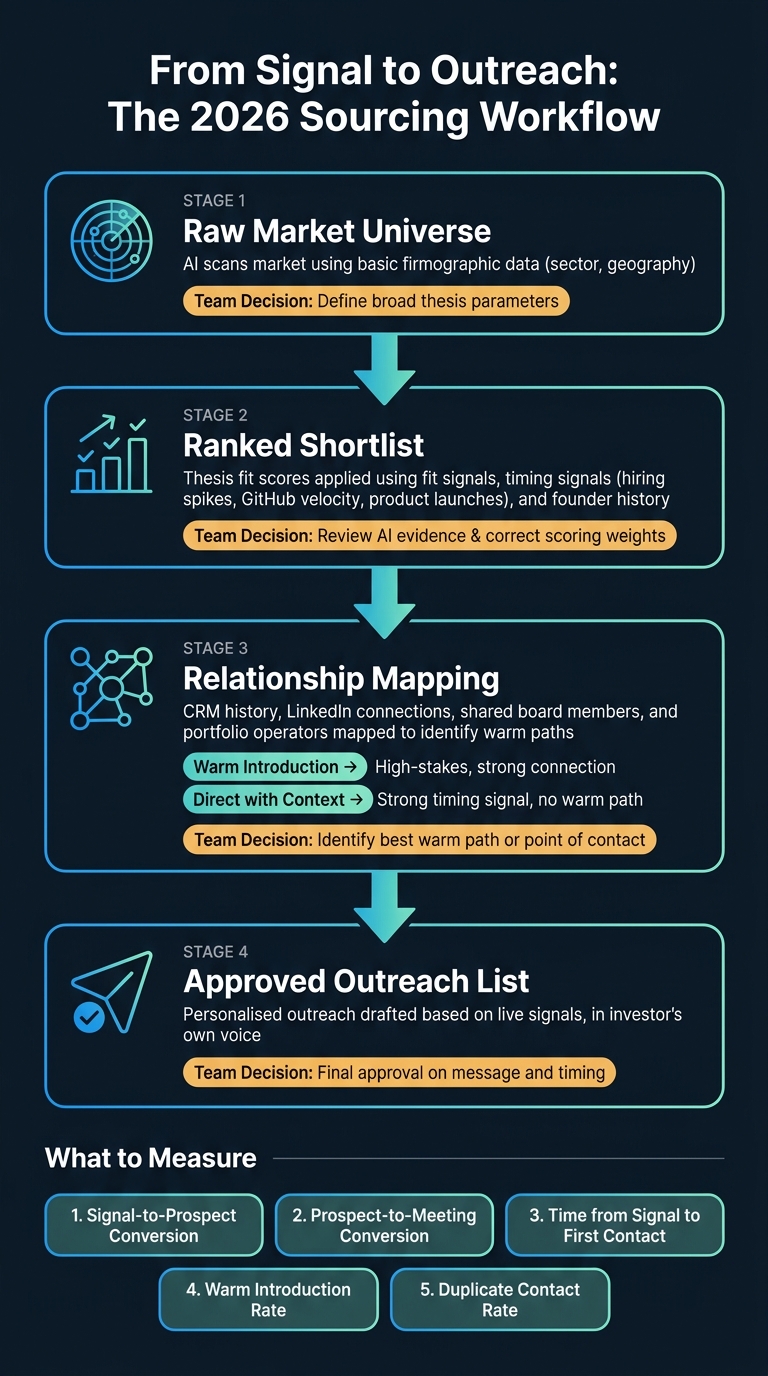
How Funds Source Deals in 2026: From Signal to Outreach
Once the warm path starts to matter, the next move is simple: rank the market before outreach.
The old playbook was broad market scanning. Pull a shortlist from a database, filter by sector and stage, then start emailing. In 2026, the better model works the other way round. Funds rank companies first, then decide who deserves a message.
The Signals That Make Outreach Timely
Not all signals mean the same thing. Some tell you whether a company belongs on your radar. Others tell you whether now is the right moment. And some tell you whether you have a warm way in.
A useful way to frame this is through three groups: fit signals, timing signals, and relationship signals.
| Signal Category | Examples | Why It Matters |
|---|---|---|
| Fit Signals | Sector, stage, AI-native architecture, capital efficiency | Confirms the company belongs in your universe at all |
| Timing Signals | Engineering hiring spikes, product launches, senior leadership appointments, GitHub commit velocity, stealth incorporations | Indicates the company is at a point where outreach is relevant |
| Relationship Signals | Previous CRM touchpoints, shared board members, mutual network connections | Determines whether a warm path exists before you go direct |
Taken together, these signals shape three decisions: who to contact, when to contact them, and which relationship to use.
The edge in sourcing comes from spotting momentum before a funding announcement, not after. Headcount growth can be a useful timing signal, but on its own it doesn't tell the full story. Pair it with product traction and customer demand, and it starts to mean something.
Turning an Investment Thesis into an Active Sourcing System
A thesis sitting in a deck is just that: a thesis. It doesn't become a sourcing system until it's turned into clear, testable criteria.
That means breaking it down into things the team can check: sector, geography, stage, traction thresholds, founder background, and clear exclusions. Once those parameters are set, an AI analyst can assess every company in the market against them.
The result is a thesis fit score based on the evidence the system finds. Then the investment team reviews that evidence directly. If the system puts too much weight on one signal, the team adjusts it. That adjustment stays tied to the record and shapes future scoring as well.
This is where the market starts to narrow. Instead of a long, messy list, the team gets a smaller group of companies worth a proper conversation.
From Market Universe to Approved Outreach List
Moving from a raw market universe to an outreach-ready list doesn't happen in one jump. It happens in four stages, and each stage needs a team decision before anything moves on.
| Sourcing Stage | Data Added | Investment Team Decision | Workflow Action |
|---|---|---|---|
| Raw Market Universe | Basic firmographic data (sector, geography) | Define broad thesis parameters | AI begins scanning the market |
| Ranked Shortlist | Thesis fit scores, headcount signals, founder history, funding status | Review AI evidence and correct scoring weights | Filter for "Strong Fit" companies |
| Relationship Mapping | CRM history, team notes, LinkedIn network connections | Identify the best warm path or point of contact | Prioritise companies with the strongest warm path |
| Approved Outreach List | Personalised outreach drafts based on recent signals | Final approval of the message and timing | Trigger outreach or book a meeting |
What matters here is the control point at each gate. The system handles the research, scoring, and draft writing. The investment team signs off on every step.
No outreach goes out without human approval. And ranking only turns into action once the warmest path is clear.
Map the Warm Path Before Contacting Founders
A strong signal can still fall flat if the way in feels generic or disconnected. Once a target has been ranked, the next step is simple: who can make the approach feel credible?
Modern sourcing brings together market signals and relationship history to answer one practical question: who already has the strongest connection here?
How Relationship Intelligence Improves Conversion
This starts with the fund’s own network, not with a new hunt for contacts.
Before anyone drafts outreach, the system checks the fund’s existing relationship history across partners, advisers, board members, alumni, portfolio operators, and previous co-investors. That cross-check brings hidden links to the surface instead of leaving them scattered across inboxes and spreadsheets.
Putting that interaction history in one place matters for two main reasons. First, it stops different team members from reaching out to the same founder separately, which can hurt credibility. Second, it helps the team spot the person with the strongest existing relationship. A past touchpoint carries more weight than a cold opener: "You spoke with my colleague Sarah a few months ago."
The result is a relationship heat map for each target - a clear view of which links are warm, which are lukewarm, and where no path exists at all.
When to Use a Warm Introduction and When to Go Direct
After the network is mapped, the team picks the fastest route that still feels credible.
Before outreach goes out, timing, thesis fit, and relationship path should all be checked. When there’s a strong warm path - a shared board member, a former colleague, or a portfolio CEO who knows the founder - a warm introduction is almost always the better move. It passes trust across straight away.
But a warm introduction is not always there, and waiting for one can mean missing the moment. If a company is showing a sudden engineering spike or a stealth product launch, timing matters more than the warm path. In that case, direct outreach with context works better. Mentioning the exact hiring pattern, product move, or thesis fit shows the fund has done its homework.
| Outreach Route | When to Use It |
|---|---|
| Warm introduction | Strong existing connection; high-stakes company where trust is the main barrier |
| Direct with context | Strong timing signal; no warm path; act quickly |
Once the route is clear, the message can move into approval and sequencing.
Build an Approval-Based Workflow and Measure Sourcing Quality
Once the warm path is clear, the next step is simple: decide what gets approved, what gets drafted, and what actually gets sent.
What to Automate and What the Investment Team Should Still Control
The repetitive, research-heavy work is where automation pays off. Signal monitoring, CRM enrichment, thesis-fit scoring, relationship mapping, outreach drafting, and follow-up sequencing can all run in the background. Avyn can track live market signals, layer in CRM history, rank prospects against a fund’s criteria, and draft personalised first-touch messages in the investor’s own voice.
The team should still control the parts that need judgement. Final approval on whether a prospect belongs on the list, how to read an unclear signal, and sign-off on sensitive outreach should stay with humans. If Avyn flags a company and suggests a thesis-fit score, the team reviews the evidence behind it. If a weight looks off, they adjust it. Those corrections should then feed back into the scoring model after review.
That’s the bit that changes everything. It’s not about how many tools you have. It’s about whether every hand-off happens inside one approval flow.
Manual Sourcing vs Fragmented Automation vs a Unified Approval Workflow
| Manual Sourcing | Fragmented Automation | Unified Approval Workflow (Avyn) | |
|---|---|---|---|
| Ownership | Individual analysts | Multiple tool owners | AI analyst + human partner |
| Hand-offs | Manual email and Slack | Brittle Zapier/API links | In-platform approval gates |
| Data continuity | Siloed, manual entry | Partial, prone to sync errors | Continuous, CRM-integrated |
| Follow-up control | Memory-based, easy to miss | Automated but generic | AI-drafted, human-approved |
| Auditability | Low - scattered notes | Moderate - tool logs | High - full correction history |
| Likely failure points | Human fatigue; missed signals | High noise; low-quality signals | Thesis misalignment (fixable via feedback) |
The aim is better deal flow, not more messages. Fit, timing, and conversion matter more than raw output.
Conclusion: Measure Conversion, Not Message Volume
This shift - from cold intros to signal-driven, thesis-led, relationship-aware sourcing - only works if the team tracks what matters. Focus on conversion through the funnel, not just top-of-funnel activity.
What to track instead:
- Signal-to-prospect conversion: how many raw signals turn into approved targets
- Prospect-to-meeting conversion: how many approved targets become qualified meetings
- Time from signal to first contact: how fast the team moves on a live opening
- Warm-introduction rate: what share of outreach goes through a mutual connection
- Duplicate-contact rate: whether different team members are reaching the same founder on separate paths
These metrics change the conversation. A fund that sends fewer, highly contextual, thesis-matched messages and books more qualified meetings is doing better than one that sends far more generic notes and books fewer - even if the top-line numbers look smaller at first glance.
FAQs
What counts as a live signal?
A live signal is a clear, time-sensitive sign that a company is building momentum. It helps investors spot possible opportunities before the rest of the market catches on.
A few common examples:
- Fast hiring, mainly in sales or customer success
- Senior founder or executive changes
- A faster product shipping pace
- Customer traction, such as contract wins or repeat purchases
- Higher engagement across forums and social platforms
On their own, these signs can be interesting. But they tend to mean more when they’re stacked together.
How do funds score thesis fit in practice?
Funds score thesis fit with AI by keeping a live watch on companies and ranking them against set investment criteria, instead of working from fixed shortlists. Avyn tracks signals like hiring speed, founder moves, product activity and customer traction to judge companies in real time.
Each company gets a score based on evidence-led criteria. Teams can then adjust those scores with manual corrections, and those changes are tested on new examples before they’re put into use.
When should a fund go direct instead of waiting for a warm intro?
A fund should go direct when high-priority signals show that a company is gearing up for growth or a deal, instead of waiting for a formal fundraise or a warm introduction.
If you rely only on warm intros, you can miss the first-mover advantage. Signals like hiring pace, senior executive moves, and product traction often point to intent weeks or even months before any public announcement.