
5 Deal Sourcing Mistakes That Cost Funds the Best Companies
How narrow networks, stale filters, late signals, weak thesis workflows and poor CRM cost funds top deals — and how to fix them.
Most funds miss good companies for five simple reasons: narrow networks, old filters, late reactions, weak thesis execution, and poor follow-up.
If I had to boil the article down, it would be this: the best sourcing comes from a system, not from luck or memory. When I rely too much on warm intros, use old screening rules, wait for public signals, leave my thesis sitting in a document, or let follow-ups drift, I make it easier for other funds to get there first.
Here’s the full picture in plain English:
- Warm introductions limit reach and skew pipelines towards familiar names
- Old sourcing criteria miss new company types, especially lean AI teams and new categories
- Late signal tracking kills timing, because press coverage and funding news come too late
- A thesis without a workflow does little, because teams still default to ad hoc sourcing
- Bad CRM discipline loses deals, even after the right company has been found
The article’s core fix is simple: scan the market early, score companies against your thesis, act fast, and track every next step in one place. One data point stands out: funds that moved from manual shortlists to AI-led ranking saw 5x more deal flow.
| Mistake | What goes wrong | What to do instead |
|---|---|---|
| Warm intros | You only see companies inside your network | Use signal-led sourcing first, then use intros for access |
| Old criteria | You filter out good companies too early | Review and update sourcing rules on a set schedule |
| Late signals | You reach out after everyone else has noticed | Track founder, product, and market signals early |
| No thesis process | The thesis exists, but not in day-to-day work | Turn it into scoring, ranking, and clear team steps |
| Poor follow-up | Good leads go cold or get lost | Put signals, owners, and follow-ups into one CRM flow |
In short: if I want to see better companies before other funds do, I need a sourcing process that runs every day and does not depend on who remembers to act.
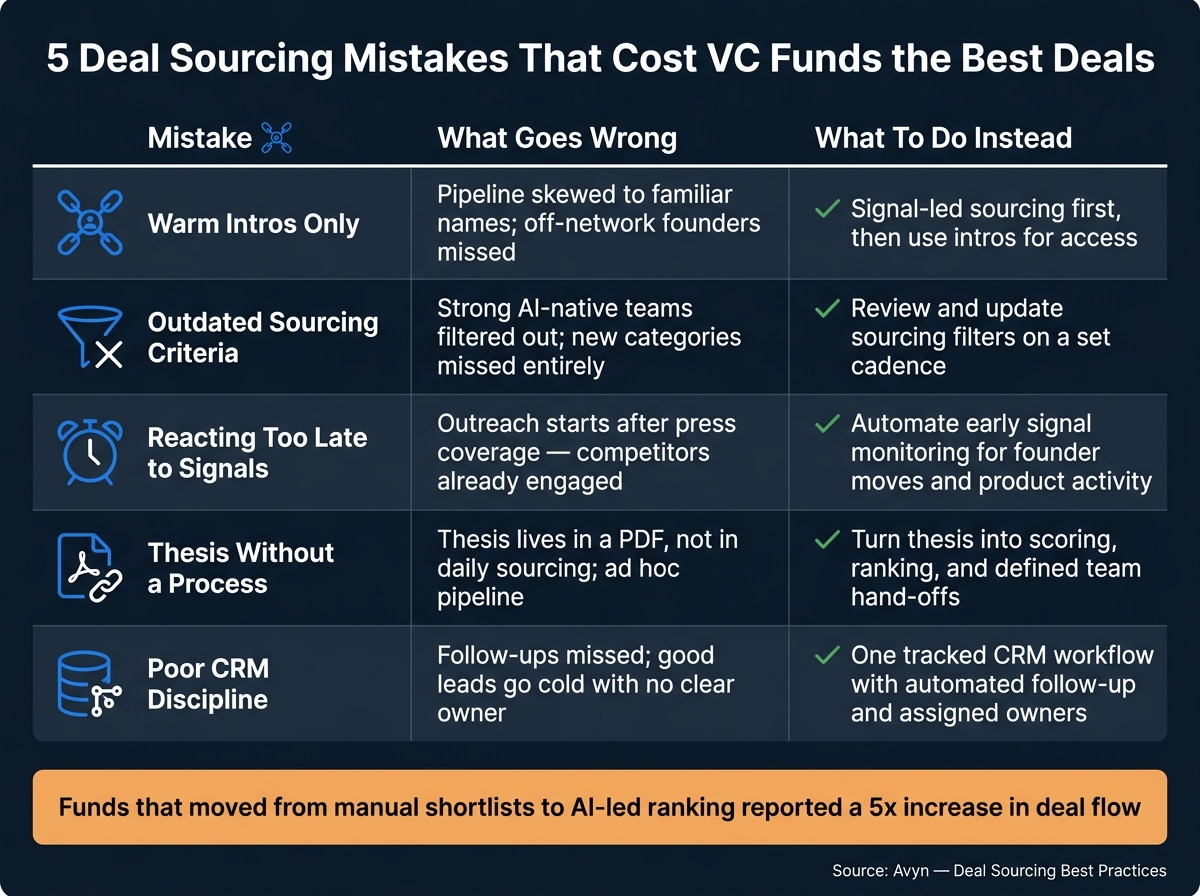
5 Deal Sourcing Mistakes That Cost VC Funds the Best Deals
1. Relying Too Heavily on Warm Introductions
Warm introductions feel safe. They come with social proof, a shared connection, and some built-in trust. That makes them comfortable to use. But comfort doesn't give you the full picture.
The main issue is reach. Introductions only bring you companies that sit inside your network, not the full market. That means bootstrapped companies with strong traction, along with other less obvious businesses, can stay out of sight. You end up with a pipeline filled with familiar names while missing the outliers that may fit your thesis best.
There's a timing issue too. By the time a company comes through a chain of referrals, competitors are often already in the conversation.
Warm intros still have a place, just not at the start. Use them as a route into a company, not as the way you find it in the first place. A signal-based approach scans the market on a steady basis and ranks companies against your thesis. That broadens relevant deal flow in a meaningful way. Then, when a high-priority match appears, relationship mapping can help you find a warm way in. The difference is simple: discovery happens outside your network, and the intro comes after.
The next failure is less obvious: teams then use stale criteria to judge what they find.
sbb-itb-c96cd03
2. Using Outdated Sourcing Criteria
Most sourcing filters age faster than the market.
As categories shift, old investment theses start to block the very companies a team should be looking at. In practice, that means stale criteria can push high-potential businesses out of the pipeline before anyone even gives them a proper look. You see this most clearly when teams still rely on signals that no longer carry the same weight.
Headcount growth used to suggest momentum. But in AI-native companies, a small team can be a strength rather than a red flag. If a fund sticks to old filters, it can rule out strong companies long before a real review happens.
New categories also show up before most screening frameworks catch on. Agentic AI security is a good example. Teams that fail to update their category view can miss whole groups of companies while rivals move in first.
The fix is simple: treat sourcing criteria as something live, not something set in stone. Keep them tied to where the market is heading. That means reviewing them on a set cadence, testing new signals against active deal flow, and updating filters before the market leaves them behind.
The next risk is timing: even the right criteria fail if the team reacts too late.
3. Reacting Too Late to Founder and Market Signals
By the time a company shows up in the press or announces a round, most funds are already on it. At that point, the shortlist is mostly a list of what everyone can already see. The signal has surfaced, the market has noticed, and the edge is gone.
The strongest signs tend to appear before a company lands on the usual lists. A founder leaving a technical role at a mature startup or a major tech company to build in private. An early prototype that shows clear domain depth. Early customers coming in with little or no marketing spend. Those are the signs that show up before the announcement, and they’re the ones many funds miss because they don’t have a set process to spot them.
Early-signal monitoring needs to run all the time, not only after something becomes public. It follows founder moves, early product activity, and niche market entries, then scores them against the fund’s thesis. When a signal lines up with that thesis, outreach starts straight away. That only works if the thesis is built into the sourcing workflow.
4. Failing to Turn Thesis into a Sourcing Process
The next problem isn't the thesis itself. It's the missing process that turns that thesis into daily sourcing choices.
Most funds do have a thesis. But in many cases, it never makes its way into the work the team does every day. When that happens, sourcing becomes reactive. And the pipeline starts to mirror the wrong priorities instead of the fund's actual thesis.
The fix is to turn the thesis into something the team can use every day. That means ranking every company against it, not just cutting obvious mismatches. In plain terms, don't stop at filtering out the bad fits. Scan the full market, score each company against the fund's criteria, and bring the top-priority names to the surface automatically.
This is where the process starts to change shape. Rather than relying on manual shortlists and gut feel, the team has a clear way to decide who matters most. Funds that have moved from manual shortlists to AI-driven ranking systems have reported a 5x increase in deal flow.
Ownership matters just as much. Someone on the team needs to own thesis-led sourcing as a process, not just be judged on the end result. That means having:
- clear criteria
- a repeatable workflow
- defined hand-offs for review, outreach, and follow-up
Who reviews the list? When does outreach begin? How is follow-up tracked? If no one owns those steps, even a strong thesis won't lead to repeatable sourcing.
And even with all of that in place, the process can still fall apart without disciplined tracking and follow-up.
5. Poor CRM and Follow-Up Discipline
Even when a deal fits the thesis, it can still fall through the cracks if follow-up sits across scattered tools and no one clearly owns the pipeline. A strong founder can go quiet for a simple reason: no one owns the next move. The issue is not finding the lead. It is losing grip on what happens after that.
The fix is straightforward: put every lead into one tracked workflow. In practice, that means logging each signal, assigning an owner, taking action, and re-engaging until the deal is either closed or closed out. Routine follow-ups should be automated, so the team only steps in when judgement is needed.
This changes how investment teams spend their time. Instead of manual data entry and chasing replies, they can focus on reviewing what the system flags and handling the few high-value exceptions that need a human call. Avyn drafts follow-up messages in the investor's own voice and tracks replies across channels, which helps teams stay consistent without letting good leads drift away. Automated follow-up keeps promising leads active without adding extra admin.
Quick Diagnostic Table
Use the table below to spot the weakest point in your sourcing workflow.
| Mistake | How It Shows Up | Cost to the Fund | Recommended Fix |
|---|---|---|---|
| Relying on Warm Intros | Pipeline built from a narrow network; off-network founders missed | Missing the best off-network companies | Signal-based sourcing |
| Outdated Sourcing Criteria | Sourcing tools returning high volumes of irrelevant targets | Wasted analyst hours and capital deployed in the wrong direction | Live thesis refresh |
| Reacting Too Late to Signals | Manual signal tracking takes hours | Slower response times and a weaker competitive position on the best opportunities | Automated signal monitoring |
| No Thesis-to-Process | Thesis lives in a PDF, not in daily outreach; disconnected tools and siloed data | Patchy deal flow and weaker prioritisation | Thesis-led workflow |
| Poor CRM Discipline | Data trapped in PDFs; follow-ups missed or delayed | Lost deals due to poor follow-up or forgotten leads | Single-CRM follow-up |
Once you know where the process breaks down, you can start turning sourcing into a system your team can run again and again.
From Manual Sourcing to a Repeatable Sourcing System
Manual sourcing starts to fall apart once deal flow picks up. Teams track signals by hand, relationships sit in different places, and the next step often depends on someone remembering to act. That creates gaps, and those gaps cost time.
The fix is one workflow that spots those signals before competitors do.
A repeatable system scans the market, maps the connections you already have, drafts personalised messages in your voice, and tracks follow-up in one place. Instead of bolting AI onto older tools, build the workflow AI-first from the start. That way, investors can spend their time on judgement calls, while the system handles the routine work.
That’s the model Avyn is built around: one connected sourcing process that brings the right companies to the surface earlier, before competitors do. The next test is simple: can that workflow run every day without people having to chase it manually?
Conclusion
The point is simple: deal flow comes from process, not luck.
These five mistakes shrink your funnel before competitors even get there. Fix them, and you get in front of better companies earlier. That’s why sourcing needs to run as a system, not as a patchwork of ad hoc tasks.
Your edge comes from spotting the right signals sooner and moving on them fast. The answer is one connected workflow that scans, ranks, and follows up on its own. Funds that build a repeatable sourcing system will see the best companies first.
FAQs
How can I spot early signals before they become public?
Move past manual tracking and short watchlists. If you want to spot early signals, you need to read the whole market, not just the slice a human team has time to cover.
That’s the problem with doing it all by hand: analysts can go deep, but they can’t scan the private market at scale.
Use AI-first tools to scan the private market, rank companies against your investment thesis, and surface relevant introductions through your existing network connections. That way, you can pick up signals that manual, siloed workflows often miss.
How often should a fund refresh its sourcing criteria?
There’s no fixed refresh schedule. If an investment team wants to avoid working from stale criteria, it needs to move away from static processes and towards dynamic, signal-based prospecting.
That means using AI-powered tools to keep reading the market, spot changes as they happen, and rank companies against a thesis that can shift over time. The upside is simple: funds can stay aligned with current opportunities instead of leaning on periodic manual updates that may already be out of date.
What should a thesis-led sourcing workflow include?
A thesis-led sourcing workflow needs to do more than produce a manual shortlist. It should scan the full market, find the companies that fit your investment thesis, and rank them automatically against that thesis.
That matters because deal teams can't afford to rely on partial coverage or ad hoc research. If your process only looks at a narrow slice of the market, good opportunities can slip through the cracks.
A strong workflow should also bring existing network connections to the surface for warm introductions, then automate personalised outreach at scale. That way, teams can keep steady market coverage without spending all day on admin - and without missing companies that deserve a closer look.