
Deal Flow Isn't a Volume Problem - It's a Filtering Problem
Screen for fit—thesis, stage, sector, geography and cheque size—and rank eligible startups by traction, efficiency and timing.
I’d screen for fit before spending time on deep review. Start with six checks: thesis, stage, sector, geography, cheque size and business model. Then rank eligible companies by traction, capital efficiency and fundraising timing.
My approach is simple:
- Advance, monitor or pass: give each company an owner, a next action and a dated reason.
- Check the facts: a £3 million funding round does not mean your fund must invest £3 million. Hiring and founder activity are leads to check, not proof of demand.
- Keep one shared record: link screening notes, sources, relationship history and follow-up dates, while keeping diligence findings separate.
- Use AI with investor approval: Avyn’s Andrew can support sourcing, ranking and follow-up, but investors check the information and approve every action.
- Measure progress, not database size: track fit, meetings, diligence, review time, documented passes, timely follow-up, decisions and returns from monitoring. Compare matched cohorts before changing the rules.
<u>My test: does the filter help the right companies reach a decision?</u> More names alone won’t answer that.
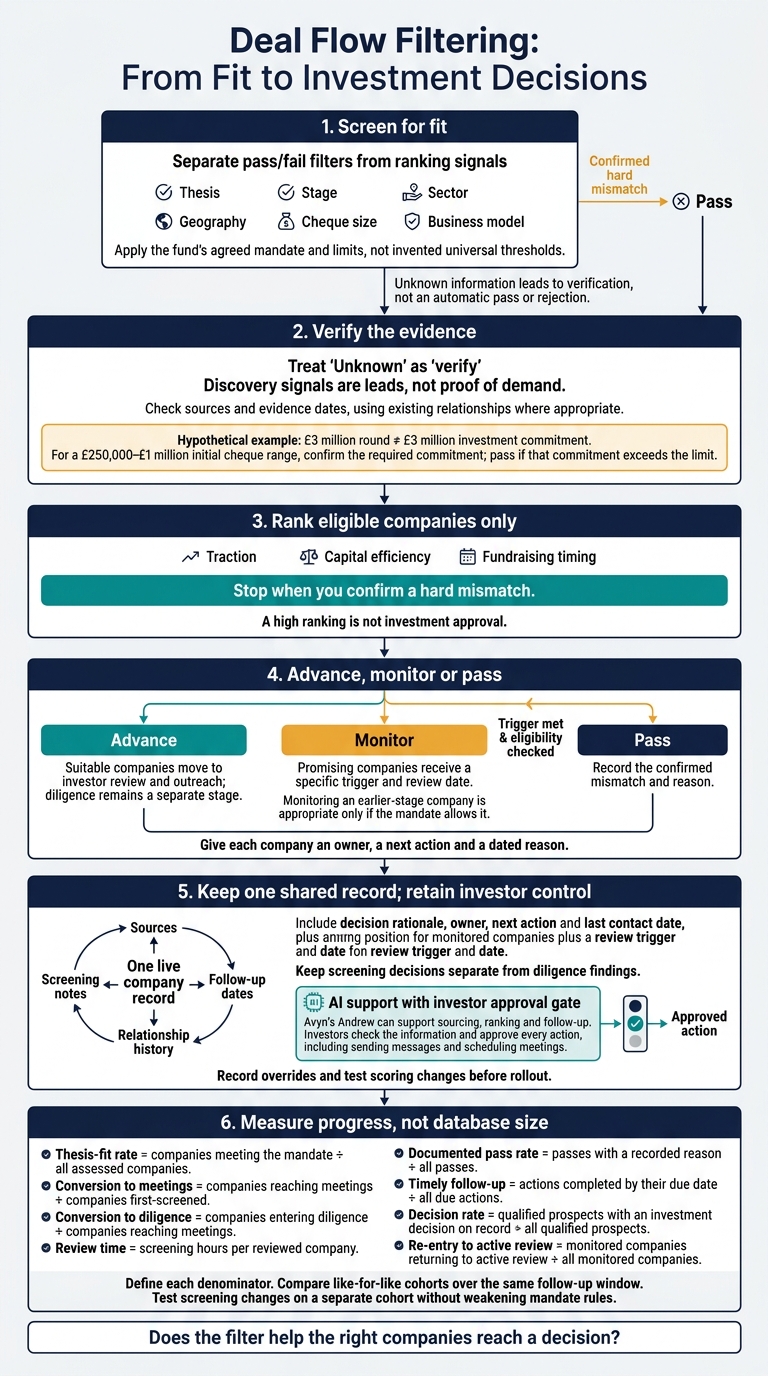
Deal Flow Filtering: From Fit to Investment Decisions
Turn Your Investment Thesis into Screening Rules
Turn your definition of fit into a repeatable screen for every new company. Give each rule a question, a threshold, evidence and an action. Separate pass/fail filters from ranking signals before starting a deep review.
Seed VC: founder background and early customer adoption; growth equity: revenue traction and financing history; venture debt: unit economics and repayment capacity.
Separate Hard Exclusions from Ranking Signals
Use sector, stage, geography, business model and initial cheque range as hard filters. Then rank the companies that pass by traction, capital efficiency and fundraising timing.
Discovery signals are leads, not proof of demand. For venture debt, revenue efficiency alone doesn’t show whether a company can repay its debt. Check its financials and unit economics.
Set Screening Thresholds, Evidence and Actions
Use the sheet below to apply the same rules each time. Replace its thresholds with your fund’s agreed limits. Treat ‘Unknown’ as ‘verify’, and follow up through an existing relationship.
| Criterion | Question | Evidence | Threshold | Action |
|---|---|---|---|---|
| Thesis alignment | Does the product fit our thesis? | Product description; founder statements; product review | Meets the fund’s stated requirements | Advance; verify unclear claims |
| Stage | Is the company at our target maturity? | Dated round announcements; financing history | Fits the fund’s stage mandate | Pass if outside the mandate |
| Sector and business model | Are both within our remit? | Company website; revenue model; relationship notes | Matches the agreed sector and model | Pass on a confirmed exclusion |
| Geography | Does the company meet our location rules? | Headquarters and founder-location evidence | Within the fund’s defined region | Pass if outside the mandate; verify unclear location |
| Cheque size | Can our initial investment fit the financing? | Founder statement; current fundraising information | Within the fund’s initial cheque range | Advance if compatible; monitor if too large |
| Traction | Is there evidence of customer demand and efficient growth? | Revenue disclosures; customer adoption; founder statements | Traction matched to stage; use revenue efficiency where relevant | Advance if verified; monitor gaps |
| Timing | Is there a reason to engage now? | Current founder statement; fundraising signals; last contact | Active or upcoming funding round confirmed by current evidence | Advance; otherwise set a monitoring trigger |
sbb-itb-c96cd03
Filter Companies Before Deep Review
Stop when you confirm a hard mismatch, and rank only eligible companies. Screening decides whether a company merits review. Diligence covers financial checks, references and approval.
Decide Whether to Advance, Monitor or Pass
Once a company clears the screen, give it a status. Advance suitable companies to investor review and outreach. Monitor promising companies with a specific trigger and review date, rather than leaving them on an indefinite holding list. Pass hard mismatches and record the reason.
Before passing on a large round, check its structure and your required commitment: the total funding round is not your cheque. Use relationship notes to confirm whether the company is currently fundraising. An old founder response provides context, not confirmation.
Test Your Filters with Hypothetical Companies
Use edge cases to check that you apply the screen consistently.
Hypothetical sector test: A company operates outside the target sector. Pass and record the sector exclusion. For a £3 million round against a £250,000–£1 million initial cheque range, confirm whether £3 million is your commitment or the total raise. Pass if your required commitment exceeds the limit.
Hypothetical stage test: A thesis-aligned, pre-revenue company sits below your target stage. Monitor if the mandate allows earlier companies to remain under consideration. Set a concrete trigger, such as evidence of traction, and a review date. If its stage breaches a hard mandate rule rather than a preference, pass.
Hypothetical timing test: A company meets the core criteria but has no current fundraising signal. Review timing through the existing relationship before prioritising outreach. Funding activity, hiring or founder activity can move an otherwise eligible company up the review queue - but none establishes investment readiness. Verify what changed, when it changed and whether hiring reflects customer demand. Use the signal to prioritise, not approve. If automation overweights that signal, record the correction and test any scoring change before rolling it out.
Build a Repeatable Filtering Workflow
Bring thesis, stage, sector, cheque size, traction and timing into one live company record, used from sourcing through to follow-up. Record the company name, location, source, evidence date, sector, stage, funding status, capital raised, round dates, lead investors, traction metrics, founders, contacts and warm introductions. Include a source for every field.
Make handovers clear. Keep the decision rationale, owner, next action and last contact date in the same note. For companies you're monitoring, add a review trigger and date to that record. Keep screening decisions separate from diligence findings: a high ranking must not be mistaken for investment approval.
This gives the AI and the team the same evidence, status and next action.
Use Avyn for Thesis-Led Review and Outreach
Avyn’s AI analyst, Andrew, sources companies against the fund’s thesis and scans fundraising activity, hiring and founder activity. It builds a shortlist by ranking companies against custom screening criteria and timing signals. Investors review the evidence and approve which companies move forward. Record any overrides so that feedback helps refine future scoring rules.
Avyn connects research with relationship history, outreach drafting, follow-ups, meeting booking, and pipeline and diligence tracking. Require investor approval for every action, including sending messages and scheduling meetings. The investor remains responsible for judging fit, checking evidence and deciding what happens next.
Compare Volume-Led and Filtering-Led Workflows
Use the same record to compare how work moves through each workflow.
| Activity | Volume-led approach | Filtering-led approach | Investor benefit |
|---|---|---|---|
| Review time | Review every company as it arrives | Prioritise eligible companies using ranked evidence | Less time spent on known mismatches |
| Decision consistency | Rely on individual judgement and scattered notes | Use shared rules and recorded reasons | Easier checks across reviewers |
| Follow-up quality | Draft messages without the full relationship history | Use dated signals, previous conversations and approved drafts | More relevant contact and fewer duplicate approaches |
| Ownership | Leave work without a named owner | Assign an owner and next action to each decision | Clear accountability for moving work forward |
| Pipeline visibility | Keep research, messages and diligence notes separate | Connect status, evidence and actions | Easier identification of stalled decisions and overdue reviews |
Conclusion: Focus Investor Attention on Fit
Once screening follows a repeatable process, judge it by how qualified companies move towards meetings, diligence and decisions - not by pipeline size. The aim is to focus attention on companies that warrant a closer look.
Measure How Qualified Companies Progress
Use these measures to check whether the filter improves the flow of qualified companies. Define each denominator before you start tracking results.
- Thesis-fit rate = companies meeting the mandate ÷ all assessed companies.
- Conversion to meetings = companies reaching meetings ÷ companies first-screened.
- Conversion to diligence = companies entering diligence ÷ companies reaching meetings.
- Review time = screening hours per reviewed company.
- Documented pass rate = passes with a recorded reason ÷ all passes.
- Timely follow-up = actions completed by their due date ÷ all due actions.
- Decision rate = qualified prospects with an investment decision on record ÷ all qualified prospects.
- Re-entry to active review = monitored companies returning to active review ÷ all monitored companies.
Track results by cohort rather than individual deals. Compare like-for-like cohorts over the same follow-up window to spot missed fits, weak signals and delays. Before rolling out a screening change, test it on a separate cohort without weakening the mandate rules.
FAQs
How can I avoid filtering out promising companies too early?
Track a cluster of signals, not just one indicator [1]. A job posting or product release may be a test. But when hiring pace, executive moves, product releases and market engagement line up over a short period, they can make a company’s intent clearer [1].
Assess these signals against your thesis, stage and sector criteria to spot potential early. Use a consistent, scored workflow to bring promising companies to your team for a closer review [1].
How should I weight traction against fundraising timing?
Traction and fundraising timing work together - they’re not competing metrics. Customer wins, repeat purchases and support hiring often come 30 to 90 days before a funding round [1].
Track these signs alongside hiring pace and product momentum to spot high-potential companies before the field gets crowded [1]. Prioritise outreach when several signals line up: they point to plans for growth, even without a public fundraising announcement [1].
How often should I review my screening criteria?
Review your screening criteria weekly [1]. Set aside time each Friday to check which signals lead to meetings and which filters need tightening to improve pipeline quality [1].
If you use automated scoring systems, test proposed criteria changes on a separate set of examples. Review the results before adopting the changes to check that they accurately reflect your investment thesis [2].