7 Reasons Your Fund's Deal Flow Is Drying Up
Deal flow isn't a market problem—it's your sourcing system: sharpen thesis, widen coverage, speed follow-up and clean your CRM.
If my fund’s pipeline is thinning, the problem is usually not the market. It’s the sourcing system. In this piece, I’d boil it down to 7 common issues: a weak thesis, too much reliance on warm inbound, poor market coverage, slow replies, messy CRM habits, weak signal tracking, and outreach that feels generic.
Here’s the short version: if I want more relevant deals, I need to tighten the thesis, scan more of the market, reply faster, keep the CRM clean, and send messages that feel personal. The article also points to one striking number: teams using AI-led sourcing workflows have reported up to 5x more deal flow.
At a glance, the 7 reasons are:
- An unclear thesis that brings in noise
- Too much dependence on warm intros and known contacts
- Thin founder and intermediary coverage
- Slow follow-up when timing matters
- Poor CRM and pipeline discipline
- Weak market signal tracking
- Generic outreach that gets ignored
What I’d take from it: deal flow is not just about seeing more companies. It’s about building a process that helps me spot the right ones early, act fast, and keep every next step moving.
Quick Comparison
| Problem | What it causes | What helps |
|---|---|---|
| Unclear thesis | Low-fit deals and wasted time | Clearer screening rules |
| Reliance on warm inbound | Missed companies outside my network | Broader market scanning |
| Weak coverage | Fewer and later opportunities | Better founder and source mapping |
| Slow follow-up | Lost meetings and missed windows | Faster first response |
| Poor CRM discipline | Dropped follow-ups and duplicate work | Clean records and clear ownership |
| Weak signal tracking | Late discovery of good targets | Early signal monitoring |
| Generic outreach | Low reply rates | More specific, personal messaging |
Put simply: if the thesis, coverage, response time, and follow-up process stop working together, deal flow starts to dry up.
sbb-itb-c96cd03
Why Deal Flow Dries Up Even in Active Markets
An active market doesn't shield a fund from weak deal flow. Pipelines start to thin when thesis, coverage, responsiveness, and outreach stop moving in sync. When that happens, the cracks tend to show up in seven places.
At the heart of it is a scale problem. Every fund is chasing the same high-quality deals, and no team can scan the whole market by hand. As Avyn puts it:
"Every fund hunts the same thing: the one deal that matters. Finding it means reading the entire market, not a shortlist. No human analyst can. They run out of hours."
Proprietary deal flow comes from systems, not reputation alone. Brand still matters. Warm networks still matter too. But they can't do all the heavy lifting on sourcing anymore.
What separates steady deal flow from a pipeline that's drying up is the work behind the scenes: how teams track signals, how fast they reply, and how closely the CRM matches what's happening in the market right now.
When tools are disconnected and data sits in silos, analysts get pushed into manual tracking, slower follow-up, and stale CRM records. That's where things start to slip. And those are the same weak spots behind the seven reasons below: weaker thesis execution, poor coverage, slow follow-up, and weak pipeline discipline.
The seven reasons below show where that engine starts to break.
1. An Unclear or Overbroad Investment Thesis
A broad thesis turns sourcing into noise. Vague criteria bring in too many low-fit deals and waste analyst time. When the criteria aren't clear, sourcing tools surface more noise than signal, and teams end up working from a shortlist instead of reading the full market.
The fix is simple in theory, but harder in practice: sharpen the thesis around the recurring pain point, the founder's lived experience, and the specific buying trigger. Think of it less like a static label and more like a ranking model. That shift matters. Once the thesis is clear, day-to-day work gets easier. Teams can rank companies faster, map sources with less guesswork, and shape outreach with more precision.
Avyn can map companies against a fund's criteria, surface warm intro paths, and draft outreach in the fund's voice.
A sharp thesis only works if the fund can cover the right founders and intermediaries.
2. Over-Reliance on Warm Inbound and Personal Networks
Even a sharp thesis can stall when sourcing still depends on the same dozen relationships.
Most funds lean on warm inbound because it cuts through noise. Fair enough. But that comfort has a downside. Your network is a shortlist, not a market view. If a company doesn’t know someone who knows you, it often never makes it onto the radar.
The timing issue is just as serious. By the time a warm intro lands, faster-moving firms may already be in the conversation with the target. As Jamie Bird, Founder of Avyn, put it:
"The infrastructure just didn't exist, which is shocking given what rides on getting to a deal first."
This doesn’t mean warm intros should be dropped. Far from it. They work best as one layer inside a broader sourcing system.
That’s where AI-led workflows have started to shift the picture. Teams using them have reported 5x more deal flow. Not because relationships stop mattering, but because firms can look at far more companies before deciding which ones deserve a personal approach.
Avyn tackles this head-on. It reads the market, ranks companies against your thesis, and surfaces warm-intro paths from your network. Then it drafts outreach in the fund’s voice, so the contact still feels personal even if discovery is automated.
"It reads every company, ranks them against your thesis, surfaces who you already know and who can make the warm intro, then writes to them in your voice." - Avyn
Once those warm paths are mapped, the bigger limit becomes coverage.
3. Weak Founder and Intermediary Coverage
Once the thesis is clear and warm paths are mapped, the next limit is visibility.
A team can have a sharp thesis and a strong network and still lose ground if it isn't seen often enough by founders, angels, accelerators, and other intermediaries in its target sectors. When that happens, the earliest deal signals tend to come from elsewhere.
This is a structural issue. If a team only watches a narrow slice of founders, angels, accelerators, and intermediaries, it misses a large part of the market.
The outcome is simple: lower volume and worse deal quality. Fewer companies make it into the funnel, and many show up after faster firms have already reached out.
The answer is steady market scanning, paired with mapped warm paths through the angels and intermediaries most likely to make the introduction. Put those two together and you get repeatable access to the right sources.
Avyn brings continuous market reading, thesis matching, and warm-intro mapping into one workflow, so analysts spend less time tracking and more time judging fit.
Once coverage gets better, speed becomes the next bottleneck.
4. Slow Follow-Up and Poor Responsiveness
Once coverage gets better, speed becomes the thing that matters. A fund can spot the right company, but if it takes too long to reply, that shot can disappear fast. In many cases, the founder has already booked another call by then. The problem is usually bandwidth. Analysts hit their limit when every signal has to be checked by hand, and when deal sourcing runs across disconnected tools and siloed data, teams burn time on manual hand-offs instead of getting back to people quickly. By the time a promising company has been ranked against the thesis, the first-response window may already be closing.
The fix is pretty simple: strip out the steps that slow down the first reply and the next action. That means automating the first pass of ranking companies against the fund's thesis, then drafting a fast, on-brand first reply as soon as a company clears the threshold. Avyn handles that triage all the time, so teams don't have to wait for manual review before responding.
This isn't about removing human judgement. It's about using that judgement where it counts most: on the call, the decision, and the relationship, not the admin work that slows everything down. Once the first reply goes out quickly, the next issue is whether each touchpoint is logged and followed up in the CRM.
5. Poor CRM and Pipeline Discipline
Deals still slip through the cracks when the pipeline behind them is messy. A founder shows promise, gets an initial reply, and then... nothing. Not because the deal went cold, but because no one logged the follow-up and no one owned the next step. That’s the problem. What matters after a reply is simple: was the interaction recorded, assigned, and carried forward?
In most firms, the issue starts with fragmented tools and siloed data. There’s no single pipeline record that everyone can see and use. The result is predictable: analysts reach out to the same founders twice, miss warm intro routes already sitting in the firm's network, and lose time copying data from PDFs into the CRM by hand. Every missed entry makes the next follow-up harder and leaves good deals harder to move along.
The answer is to shift from manual admin to an AI-first workflow. That means less time spent updating the pipeline and more time spent judging the opportunities the system brings forward. Avyn handles this by ranking companies against a fund's thesis, surfacing network connections for warm introductions, and logging every touchpoint automatically.
The aim is straightforward: every touchpoint logged, every follow-up owned. Once that discipline is in place, the next question is whether the team is tracking the right market signals.
6. Limited Market Signal Monitoring
Most investment teams are still reactive. They wait for a founder to land in their inbox or for someone in their network to make an introduction. But by then, the process is often already in motion. And when those signals finally show up, faster firms may already be moving.
The main issue is coverage. Analysts can only track a small shortlist, which means most of the market never gets looked at.
Early signals also tend to be quiet. Think pre-marketing customer pull, founders who know the problem first-hand, and manual workflows that are still waiting to be fixed.
A more active monitoring approach shifts the team from a hand-picked shortlist to full-market coverage. Avyn scans the market on a continuous basis, ranks companies against a fund’s specific investment thesis, and flags the ones that line up most closely with that thesis. That thesis fit is what turns raw signals into actual opportunities.
The point isn’t just to see more data. It’s to spot the right signals early enough to act.
That leads to stronger deal flow, sooner. Once those signals are visible, the next bottleneck is whether outreach is specific enough to convert them.
7. Generic, Hard-to-Scale Outreach
After thesis, coverage and follow-up, outreach is still one of those places where a good deal can slip away. Generic outreach hurts conversion. If founders can tell a message was sent at scale, they tune it out. And just like that, the pipeline starts to thin before a single conversation begins.
Manual personalisation creates a bad trade-off: scale or quality. On their own, neither gets the job done.
The way through this is to pair thesis-driven targeting with outreach that gets the right founders to reply at the right moment. Avyn ranks companies against your thesis, maps warm-intro routes, and drafts outreach in the fund's voice. Funds using this workflow have reported 5x more deal flow.
When outreach is specific, timely and personal, the pipeline stops leaking at the first touchpoint.
Once outreach is fixed, the next question is whether the rest of the pipeline is healthy enough to keep that flow moving.
What a Healthier Deal Flow Pipeline Looks Like
After the failure points above, the benchmark is pretty simple. The issue isn’t just deal volume. It’s whether your pipeline keeps turning up relevant opportunities at a steady clip.
A healthy pipeline stays current without constant firefighting. Funds that do this well tend to get three things right. They use the thesis as a live filter, they map sources across the market instead of leaning only on warm inbound, and they spend more time on judgement than admin work.
A stable pipeline usually has four operating features:
- The thesis works as a live filter, with fast time-to-reply targets for new signals.
- Coverage maps sources across the market and brings relevant connections to the surface.
- Weekly reviews show where the gaps are and where effort needs to shift.
- The CRM runs as a single workflow, so the team reviews exceptions instead of creating data by hand.
Outreach also needs to stay personal, consistent, and scalable. That’s the line between heavy manual effort and a unified operating system.
Manual Sourcing vs a Unified AI Workflow
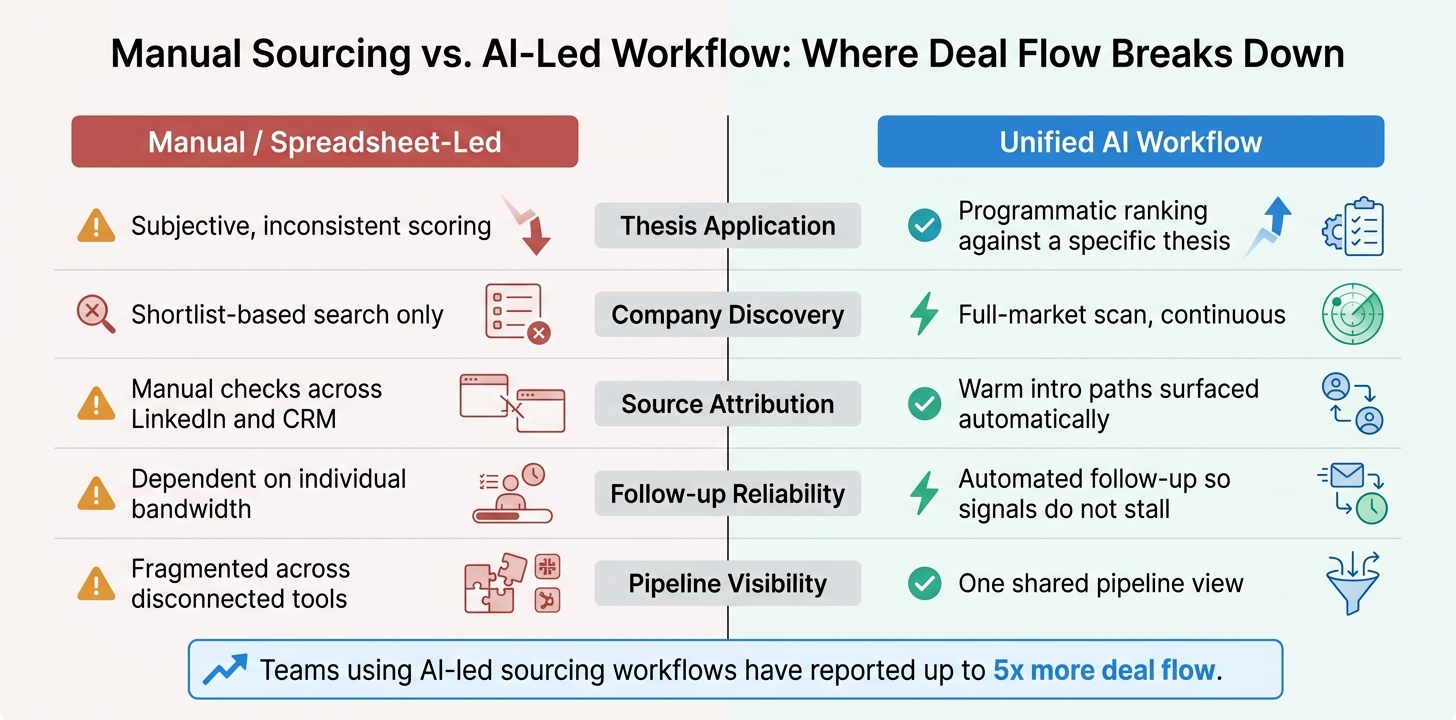
Manual Sourcing vs AI Workflow: Deal Flow Comparison for VC Funds
All seven problems trace back to one thing: sourcing is split across too many tools.
That split creates friction at every step. Teams apply the thesis unevenly, miss parts of the market, delay follow-up, lose context in the CRM, and send outreach that feels generic. In short, the earlier failures - weak thesis execution, poor coverage, slow follow-up, messy CRM, and generic outreach - all come from a fragmented workflow.
Manual sourcing also hits a hard limit: team bandwidth. A unified AI workflow pushes past that by handling coverage, follow-up, and logging in one system. That means the process can deal with a level of volume that manual work simply can't.
The comparison below shows the main operational differences:
| Dimension | Manual / Spreadsheet-Led | Unified AI Workflow (Avyn) |
|---|---|---|
| Thesis Application | Subjective, inconsistent | Programmatic ranking against a specific thesis |
| Company Discovery | Shortlist-based search | Full-market scan |
| Source Attribution | Manual checks across LinkedIn and CRM | Warm paths surfaced automatically |
| Follow-up Reliability | Dependent on individual bandwidth | Automated follow-up so signals do not stall |
| Pipeline Visibility | Fragmented across disconnected tools | One shared pipeline view |
The next question is which market signals the system should watch first.
Market Signals Worth Tracking
Once the pipeline is disciplined, the next edge comes from spotting the right signals before everyone else piles in.
Most funds watch the same things. They just spot them too late to act on them. That’s the whole point here: these signals help a team move before a deal gets crowded. It’s not about having more data. It’s about acting earlier.
| Signal | What It Tells You | Manual Monitoring | Automated Tracking |
|---|---|---|---|
| Funding Announcements | Shows market validation and rising competition. | Manually checking news sites and databases; often 2–4 weeks late. | Real-time alerts by sector and thesis. |
| Senior Hires | Signals a shift from building to scaling. | Monitoring LinkedIn updates company by company. | Detect role changes across the market. |
| Founder Exits | Serial founders are often building their next venture quietly. | Tracking individual profiles over several years. | Matching repeat founders to new company registrations before launch. |
| Product Launches | Marks the move from stealth to market entry. | Searching manually for press releases or app store updates. | Scraping web and social signals for new product mentions early. |
| Hiring Velocity | Shows momentum and likely expansion. | Periodic manual checks of job boards and LinkedIn headcount figures. | Real-time analysis of job posting volume and department-specific growth rates. |
The main difference is coverage. Manual tracking usually follows a shortlist. Automated tracking scans the whole market and flags companies that fit the thesis much earlier.
That timing changes the job of sourcing. Instead of showing up when a round is already busy, teams can start building the relationship sooner. In practice, signal tracking becomes a live sourcing queue, not a report that tells you what already happened.
How Avyn Can Help Rebuild a Consistent Pipeline
Those seven failure points come back to one thing: fragmented sourcing. The fix is pretty simple in principle, even if it’s hard in practice. You need one workflow that scores signals, maps relationships, and acts fast when someone replies. Avyn brings thesis scoring, network mapping, and follow-up into the same workflow, so the problem gets handled at the workflow level.
If an investment thesis is too broad, Avyn scores the market against a fund’s criteria and keeps the shortlist up to date. If a fund has relied too much on warm inbound, Avyn shows existing network connections and spots warm-intro paths into target companies. Once thesis and network line up, the next bottleneck is usually speed of response.
Avyn drafts messages in the investor’s own voice, manages automated follow-up, routes replies, and supports meeting scheduling, so a positive reply can move straight into a booked call. That matters because follow-up and booking only work well when they happen without manual hand-offs.
Instead of forcing teams to juggle a patchwork of sourcing and outreach tools, Avyn gives them one workflow for pipeline and CRM. That means the team can spend time reviewing exceptions, not typing data in by hand.
Conclusion
Weak deal flow usually isn’t a market problem. More often, it comes down to a systems problem: disconnected tools, siloed data, and manual signal tracking. The seven reasons all point in the same direction: the pipeline can be fixed. And the fix is mostly about operations: a sharper thesis, broader coverage, faster follow-up, and cleaner pipeline discipline.
That’s the main tension here. The market isn’t the bottleneck. The sourcing process is.
So the most useful review is a practical one. Look closely at where signals are being missed, where follow-up is slipping through the cracks, and where people are still spending time on work that automation could take off their plate. In most cases, those answers show you exactly where the pipeline is leaking.
FAQs
How can I tell which part of my sourcing system is failing first?
Audit your pipeline for common bottlenecks. Look for issues like an unclear investment thesis, too much reliance on warm inbound, weak intermediary coverage, poor CRM discipline, slow follow-up, or limited market signal monitoring.
Then map your source channels and track conversion rates at each stage. This helps you see where deals are slipping through the cracks - whether that’s due to inefficient outreach or because you’re not picking up relevant market signals early enough.
What should I track to find relevant deals earlier?
Track the whole market, not just a small manual shortlist. That cuts the risk of missing good-fit opportunities simply because your team runs out of time.
Use technology to score companies against your investment thesis, spot existing network links for warm introductions, and watch market signals automatically. The result is a steadier flow of high-quality opportunities your team can find with more consistency.
How quickly should my fund reply to new opportunities?
There’s no fixed benchmark for how fast a fund needs to reply to new opportunities.
What matters is removing workflow bottlenecks, especially manual data tracking, so your team can review the right opportunities, respond efficiently, and keep the pipeline in good shape.