
Your CRM Is Where Deals Go to Die
Turn your CRM into an active workflow: score companies, track live signals, assign owners and clear next steps.
If your CRM only stores deal notes, it slows the pipeline instead of moving it. I’d boil the fix down to this: score companies against the thesis, track live signals, assign one owner, and attach a clear next step with a due date to every active deal.
Here’s the short version:
- Deals don’t usually fail all at once. They fade through missed follow-ups, stale records, and weak handovers.
- The first problem starts before the CRM. Referrals sit in inboxes, notes stay in docs, and many strong companies never make it into the pipeline.
- Static records go out of date fast. Funding, hiring, product activity, and founder movement can change in days, while manual updates often lag behind.
- Visibility is not control. Seeing a deal in a pipeline does not mean anyone knows what to do next.
- The fix is a workflow, not more admin. Every signal should lead to context, one owner, and one next action.
- Passed deals should not disappear forever. If a company later hits a milestone, the team should be prompted to look again.
- The numbers that matter are simple: response time, screen-to-meeting conversion, days to decision, and the share of live deals with a next step. If that last figure is low, the CRM is acting like an archive.
A plain way to think about it: a CRM should help a team decide who to look at, who to contact, what to do next, and when to do it. If it cannot do that, it is just a database with stage labels.
That’s the core point of this piece, and it runs through sourcing, outreach, review, diligence, and re-engagement.
Where promising deals disappear in the pipeline
Most deals don't fall apart with a big, obvious moment. They slip away quietly.
A follow-up doesn't get sent. A company gets passed on, then comes back into view later when it fits the thesis better. A partner meeting happens with only part of the story on the table. The record is still there, but the opportunity has already moved on.
Sourcing and screening: good companies never reach the pipeline
The first leak starts before a deal is even logged.
Referrals land in inboxes and just sit there. Interesting companies get flagged, then vanish into the daily noise. And when something finally makes it into the CRM, it's often added by hand. That means the context is already thin, source attribution is weak, and the record is stale before anyone does anything with it.
Static CRMs can't follow live company signals. The signals that matter most - hiring spikes, founder moves, GitHub activity and product launches - rarely make it into the CRM in the first place.
Outreach and meetings: slow follow-up kills founder momentum
Even when a company does make it into the pipeline, speed becomes the next problem.
A founder replies to an initial email. No one picks it up for three days. By the time the follow-up goes out, the tone has changed and the window for a warm conversation has shut. Sometimes the outreach goes out on time, but it's generic. There's no reference to the relationship history or why this team fits the thesis. Response rates fall. Meetings never get booked.
Meeting notes also tend not to flow back into the shared pipeline. So the next reviewer is left starting from zero.
Partner review, diligence, and re-engagement: activity without a next step
By the time a deal gets to partner review, an associate has often spent hours pulling information back together from emails, call notes, research docs and whatever happens to be in the CRM.
So the partner meeting runs on a partial picture, and decisions get pushed because the evidence isn't in one place.
For companies that get passed on, the issue gets worse. A Passed status is recorded, and that's where the story stops. There's no trigger to revisit the company when it hits a new milestone or starts fitting the thesis better. The CRM logs the decision, but it never prompts a second look.
These are workflow problems, not just data-entry problems. The breakdown comes from the CRM model itself: static records, manual updates and no live workflow.
sbb-itb-c96cd03
Why standard CRM processes fail investment teams
The problem is structural: CRMs are built to store records, not run private-market workflows. That’s the heart of it. Standard CRM processes are made for logging activity, not pushing work forward.
Manual entry and static records go out of date immediately
Each time an analyst copies information from an email, a pitch deck or a call note into a CRM field, that record starts ageing straight away. Funding, headcount and thesis fit can shift far faster than manual updates. This isn’t a discipline issue. It’s a speed issue. Private-market signals move faster than any manual process can keep up with.
Once records go stale, the next problem shows up fast: teams can’t tell which companies need attention now.
Poor signal capture and weak prioritisation hide the best opportunities
Even when a CRM is current, it still shows a list, not a ranked set of priorities. It doesn’t have a built-in way to show which companies deserve attention now based on thesis fit, relationship strength or recent momentum. So teams end up digging through records by hand, and the best next opportunity often gets lost in the noise.
The signals that should shift priority - hiring spikes, founder background changes and product launches - live across separate tools, not inside the CRM. That leaves prioritisation as a manual task, and the best next deal stays buried.
Even if the right companies are visible, the CRM still doesn’t tell the team what to do next.
Visibility is not the same as control
A CRM shows the pipeline. It does not move it. Without assigned next steps, owners and deadlines, deals age quietly. No follow-up is sent. No partner is alerted to a new development. No trigger goes off when a passed company hits a milestone that changes the picture.
The next section covers what it takes to close that gap: turning static records into active deal execution.
What turns CRM data into active deal execution
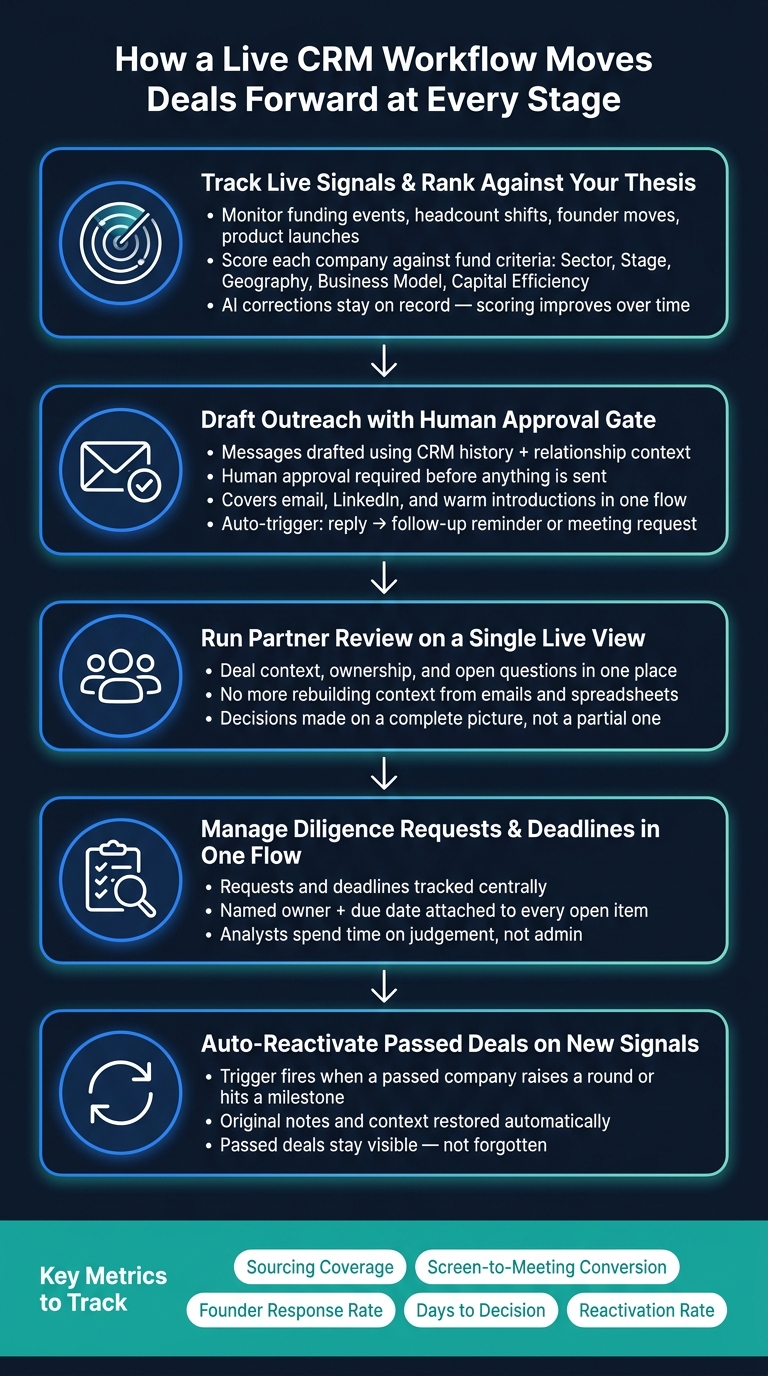
How a Live CRM Workflow Moves Deals Forward at Every Stage
The answer isn't cleaner data on its own. It's a workflow that turns signals into action, while investors still make the call.
Track live signals and rank companies against the thesis
An AI-driven workflow can watch funding events, headcount shifts, founder moves and product launches across millions of companies in real time. That means strong companies are less likely to slip past unnoticed.
But raw signals alone don't help much. They can just add noise. What makes the system useful is thesis-based ranking.
Each company that surfaces is scored against the fund's own criteria, including:
- Sector
- Stage
- Geography
- Business model
- Capital efficiency
That matters because the same signal can mean very different things in different cases. A sharp rise in headcount might look promising for one fund and less so for another. The scoring reflects that context.
And when an investor disagrees with an AI assessment, that correction stays with the record. Over time, future scoring gets better because the workflow learns from those calls.
Once signals are ranked, the next step is obvious: move straight into outreach.
Draft outreach, handle follow-up, and book meetings with human approval
At that point, the workflow should carry the same context into founder outreach.
Messages can be drafted using CRM history, relationship context and current research, then held for human approval before anything is sent.
"Decision-makers do read email. What they don't read is AI-generated email, and they can tell in a line." - Jamie Bird, CEO, Avyn
That helps stop warm interest from going cold before a meeting lands in the diary. Human approval is a mandatory gate before any message goes out or any pipeline status changes.
Email, LinkedIn and warm introductions can all sit inside the same flow. When someone replies, the next step can trigger at once: a follow-up reminder, a meeting request or a CRM status update.
Run partner review, diligence, and re-engagement in one flow
The same live context should then carry into partner review and diligence.
This is where many teams get stuck. Partner reviews slow down because context is scattered. Diligence drags on because requests and deadlines sit in different places. And passed companies often stay passed, even when new signals change the story.
A single workflow fixes those three problems in one go. Deal context, ownership, open questions and diligence deadlines sit in one live view instead of being split across emails and spreadsheets.
If a company that was passed months earlier raises a round or hits a revenue milestone, a trigger can fire and bring that deal back into the active queue, with the original notes still attached. That way, passed or parked companies stay visible when new signals make them worth another look.
Track the numbers that show whether the flow is working:
- Sourcing coverage
- Screen-to-meeting conversion
- Founder response rate
- Days to decision
- Reactivation rate
Those metrics keep each stage tied to the next action. The pipeline stays live, instead of turning into an archive.
Conclusion: Fix the workflow, not just the database
The CRM isn't the problem by itself. Deals slip away when teams miss signals, follow-up falls through, and no one is clearly in charge. At that point, the pipeline turns into a passive system of record instead of a system of action.
This is a workflow failure, not a data-entry issue.
The fix starts upstream, with the thesis. Your investment criteria need to be built into the system so every company is scored against the fund's actual thesis, and the team can see what needs attention now. From there, each stage should have a clear next action, a named owner, and a due date. Without those three things tied to every live deal, the pipeline is just a list.
Once that's in place, automation can help keep the workflow up to date. Automated capture keeps records current by syncing live signals and relationship history straight into each record. That gives analysts more time for judgement, not admin. Track response time, outreach-to-meeting conversion, and the share of active deals with a clear next step. If that last number is low, the pipeline isn't active. It's an archive.
The aim is simple: signals surface, outreach moves fast, ownership is clear, and nothing goes idle. That's how a CRM stops storing deals and starts moving them.
FAQs
How do I know if my CRM is slowing deals down?
Your CRM slows deals down when it works like a passive storage graveyard instead of an active execution tool. The warning signs are hard to miss: manual data entry, old records, and hours wasted tracking signals by hand or dealing with siloed data.
It’s also a problem when your team is chasing warm introductions across disconnected tools. Or when they’re waiting on random inbox arrivals and generic database screens, instead of tracking signals in a proactive way that lines up with your thesis.
Which live signals matter most for deal prioritisation?
Investors should keep an eye on five key signals: hiring velocity, founder or senior team moves, product shipping pace, customer pull, and public market buzz.
The best opportunities often show up when two or more signals line up within a short stretch of time. That’s usually when things start to look less like random noise and more like a company building momentum.
For example, hiring across sales and customer success can point to market expansion. At the same time, product momentum, customer traction, and public engagement can suggest a company is getting ready for a funding round.
How can we automate follow-up without losing judgement?
Use AI as an analyst, not a stand-in for human judgement. Keep control by tying scoring and outreach to your firm’s investment thesis and clear, evidence-based criteria.
Set up a workflow that lets you review, edit, and correct assessments before anything happens. That way, tracking and scheduling can run on autopilot, while relationship context and strategic judgement stay with your team.