
7 Ways AI Improves Deal Sourcing for VC Funds
AI turns VC sourcing into a continuous workflow—linking discovery, scoring, outreach and CRM to spot deals earlier and keep momentum.
AI can help VC funds find more deals, spot them earlier, and keep follow-up moving without adding more people. In the article, I see one clear theme: AI works best when it supports the whole sourcing flow, not just one task.
Here’s the article in one view:
- Discovery: AI scans for companies that match the fund thesis
- Signals: It tracks hiring, founder activity, funding news, and market changes
- Scoring: It ranks deals against set fund criteria
- Outreach: It drafts first emails using company context
- Follow-up: It keeps conversations moving after the first touch
- Scheduling: It books meetings once a founder is ready
- Pipeline tracking: It keeps sourcing and CRM activity in one place
The main point is simple: manual sourcing stops when team time runs out; AI keeps the process moving all day. The article also says some funds have seen up to 5x more deal flow from AI-led sourcing.
AI or Inefficiency: How VC Funds Are Rebuilding Deal Sourcing Today | UAtech × Reply.io
sbb-itb-c96cd03
Quick comparison
| Area | Manual sourcing | AI-led sourcing |
|---|---|---|
| Market coverage | Limited by analyst time | Tracks more of the market on a steady basis |
| Signal spotting | Often late and patchy | Flags changes as they happen |
| Lead ranking | Varies by person | Uses the same scoring rules each time |
| Outreach | Written one by one | Drafted from company data and intro paths |
| Follow-up | Easy to miss | Triggered based on replies and new signals |
| Pipeline view | Spread across tools | Held in one live workflow |
My takeaway: if you want better deal sourcing, the gain does not come from one AI feature on its own. It comes from linking discovery, scoring, outreach, follow-up, scheduling, and tracking into one system that supports investor judgement instead of replacing it.
Why AI Matters in VC Deal Sourcing
Most VC funds already know their thesis. The hard part is applying it the same way, every time, across a messy, split-up market. The thesis is there. Scaling execution is the problem.
The same five bottlenecks show up again and again in sourcing workflows, and together they weaken origination quality: fragmented data, uneven screening, late signal detection, repetitive outreach, and poor pipeline visibility. This isn’t just a time issue. It also leads to missed deals and uneven decisions that stack up across each stage of the funnel.
Manual research can’t scan the whole market fast enough to catch every signal that matters. Across the UK and Europe, market activity now throws off more signals than lean teams can sort through by hand. That’s why the first step is thesis-based company discovery.
This is where AI has the biggest role. Avyn automates the sourcing workflow across discovery, scoring, outreach, follow-up, scheduling, and pipeline tracking. Here’s how that starts in practice.
1. Thesis-Based Company Discovery
AI screens companies against the fund’s thesis and updates the shortlist as new data comes in. That leaves the team with a cleaner set of companies that fit what the fund is looking for.
But discovery only matters if it leads to fast action. Once a relevant company appears, the system can map warm-intro routes inside the fund’s network and flag who’s best placed to make the introduction.
That’s a big deal for boutique UK funds that want to look past standard inbound flow and database coverage.
Instead of spending hours building lists, analysts can focus on the outliers and edge cases. The work shifts from data collection to judgement. And once the shortlist is live, the next move is spotting founder and market signals that show momentum.
2. Founder and Market Signal Detection
Discovery is only the first step. The next job is knowing when to engage.
Once a company fits your thesis, timing becomes the next issue. And that’s where things often get messy. Manual monitoring just can’t keep up with daily market signals, so signal detection becomes the difference between broad coverage and acting at the right time.
AI tracks the market all the time for thesis-matching signals. It follows founder activity, hiring patterns, and funding moves, then ranks each chance against the thesis before manual review. Instead of asking teams to sift through a pile of updates, it brings the most relevant signals to the surface automatically.
This matters because not every signal is worth your time. Domain-trained AI cuts through the noise and highlights what matters. Private-markets-trained AI does the same for fit companies, including bootstrapped firms and fast growers that standard databases often miss.
The day-to-day impact is simple: faster, better deal flow. Once a signal is ranked, it’s ready for immediate review and action. What you get is a ranked list of active opportunities that teams can prioritise straight away.
3. Lead Scoring and Opportunity Prioritisation
Spotting a signal is one thing. Deciding which signals matter most is the tougher part. Once you’ve found them, the next step is simple to state but hard to do well: which companies should get attention NOW?
A lot of investment teams still score opportunities by hand. They pull data from different sources, piece it together, and then compare it with the fund’s thesis. That process takes time, and it can vary from one analyst to the next. AI adds a structured, repeatable scoring layer that ranks each company against the fund’s investment criteria.
AI scores every discovered company against your fund’s criteria, such as stage, sector, and geography. That means nothing gets missed just because an analyst ran out of time.
For the highest-ranked leads, AI can also flag the best warm-intro route. That cuts the distance from signal to first contact. Instead of spending hours on manual data gathering, the analyst can review the ranked output and make the final call, which is where human judgement matters most.
The result is a cleaner top of funnel. Scoring is applied the same way across the market, and the strongest leads move into outreach sooner. Once those top-priority leads are ranked, AI can turn them into targeted outreach.
4. AI-Drafted Personalised Outreach
Once leads are ranked, the next job is simple: turn that list into actual contact. And for many teams, the first email is where things slow down.
AI can draft that opening outreach email using company context like founder background, hiring moves, funding activity, and market position, all in the fund’s voice. That cuts out the lag of writing each message from scratch for every lead.
It can also surface the best internal route before outreach even begins. By using warm-intro connections, AI can help pick the right sender and shape the message around that relationship. The result is less of a cold pitch and more of a note that starts from a known connection.
The analyst still reviews and approves the draft. AI does the writing legwork; the investor keeps the final say.
From there, AI can also automate follow-ups and handle replies.
5. Automated Follow-Ups and Response Handling
Personalised outreach only works when follow-up happens on time. Most deals don’t move on the first touch. They move on the third or fourth. When follow-up is done by hand, delays creep in and momentum fades. Once the first message is sent, the hard part is keeping the conversation moving.
After that first email goes out, AI keeps the thread active without anyone having to chase manually. It watches for replies, opens, new hires, funding news, and product launches, then works out what should happen next. It picks the next step, sends it, and learns from what happens after.
When a founder replies, AI can tell if the response is positive, neutral, or not a fit, then pass it to the right investor. Warm replies can go straight to the right partner.
Analysts miss follow-ups when workloads spike. AI doesn’t. It can trigger the next action the moment a founder reply comes in or a market event shows up, so good leads don’t go cold between touches.
The payoff is simple: fewer dropped leads and more conversations with qualified founders. When a founder is ready to talk, the next move is booking the meeting automatically.
6. Meeting Booking and Scheduling Automation
After automated reply handling, AI can book the meeting on its own and cut out the back-and-forth on scheduling. That helps keep momentum up while interest is still warm.
The main bottleneck is the gap between a positive reply and a booked call. This step removes that last bit of manual coordination. Analysts spend less time sorting out diary logistics and more time getting ready for booked calls. The booked call can then move straight into pipeline tracking.
Once booked, the meeting should feed straight into the live pipeline.
7. Unified Pipeline Tracking and Workflow Automation
Building on the previous steps, once a meeting is booked, the next issue is simple: can the full path to that call be seen in one place without anyone patching things together in spreadsheets?
Unified pipeline tracking pulls sourcing, outreach and CRM activity into one live workflow, so no deal slips out of sight between sourcing and CRM. Every sourcing action feeds into the same live view.
That means analysts get a pre-filtered pipeline that matches the fund thesis, instead of a pile of raw activity. In practice, this makes thesis fit easier to spot and cuts down on missed follow-up, so the team can move faster on startups that look like a better match.
The analyst’s job also changes a bit. Instead of spending time on manual data entry, they can focus on judgement and the odd exception that needs a human call. That helps keep the pipeline current before the team moves into review and next steps.
How Avyn Covers All Seven Use Cases
Taken together, these seven use cases form one connected sourcing workflow. Avyn is built to handle that workflow from start to finish.
Instead of splitting discovery, scoring, outreach and pipeline tracking across a patchwork of tools, Avyn brings them into one system. It replaces fragmented sourcing with continuous, thesis-led monitoring, reads the market at scale, and ranks companies against a fund’s own investment thesis.
From there, Avyn scores leads, drafts personalised outreach, and automates follow-ups in the same place. Each sourcing action feeds into one live pipeline view, so deals don’t drift out of sight between sourcing and CRM. That means analysts spend less time on admin and more time using judgement where it counts.
The contrast becomes clearest when you stack manual sourcing against an AI-driven process.
Manual Sourcing vs AI-Driven Sourcing: A Direct Comparison
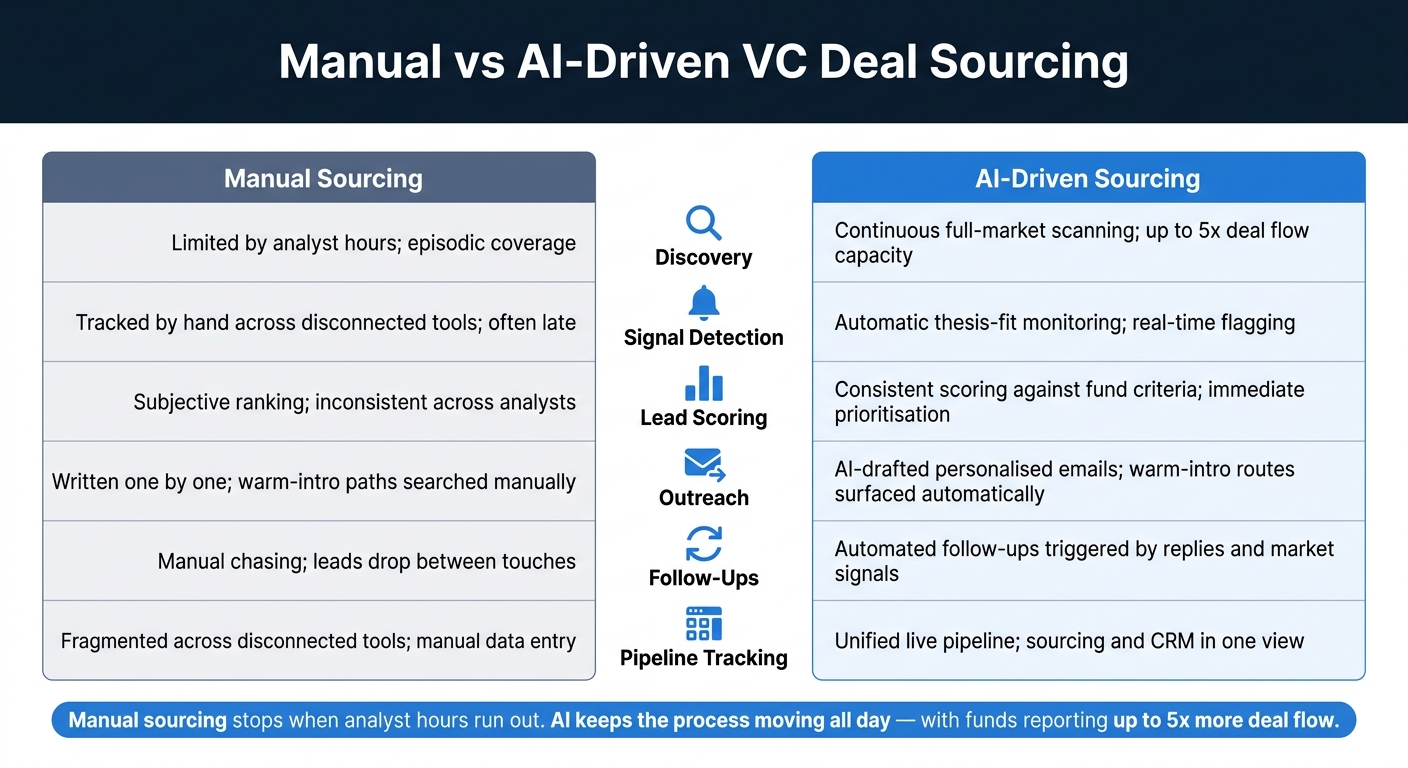
Manual vs AI-Driven VC Deal Sourcing: Workflow Comparison
Those seven use cases point to one plain difference in day-to-day work: manual sourcing is episodic, while AI-driven sourcing runs all the time.
And the gap isn't only about speed. It's about coverage. Manual sourcing stops when analyst hours run out. AI keeps scanning, sorting and pushing work forward across the full market.
That changes the job itself. In a manual setup, analysts spend a lot of time pulling data together, checking signals and updating systems. With AI-driven sourcing, that work shifts. Analysts spend less time producing data by hand and more time reviewing, pressure-testing and approving it.
Here’s how that looks across the sourcing workflow:
| Workflow Step | Manual Approach | AI-Driven Approach | Typical Time Impact | Effect on Sourcing Quality |
|---|---|---|---|---|
| Discovery | Reviewing shortlists; limited by analyst hours | Scans the full market continuously | Enables up to 5x deal flow capacity | Reduces missed deals and widens coverage |
| Signal Detection | Tracking signals by hand across disconnected tools | Monitors companies against thesis fit automatically | Saves analyst time daily | Earlier identification, less noise |
| Lead Scoring | Subjective ranking; prone to inconsistency | Ranks leads against the fund thesis | Immediate prioritisation | More consistent thesis application |
| Outreach | Manual drafting; searching for warm-intro paths | Drafts personalised outreach and surfaces warm-intro routes | Cuts drafting time | Higher response rates through personalisation |
| Follow-Ups | Manual chasing and tracking in CRM | Automated follow-ups and response handling | Removes manual chasing | Fewer dropped leads |
| Pipeline Tracking | Fragmented records across disconnected tools | Unifies sourcing and CRM data | Cuts manual admin across the funnel | Cleaner data and full pipeline visibility |
The biggest gains usually show up in discovery and pipeline tracking. That makes sense. These are often the most labour-heavy parts of the process, and they’re also where teams hit limits first.
In other words, manual workflows create a ceiling. AI removes that ceiling by letting the team cover more ground without adding the same level of manual effort.
That’s also why a single workflow matters more than a stack of disconnected tools. If one tool finds companies, another tracks signals, and a third stores notes, the team still ends up stitching the process together by hand. The work just moves around.
The practical change is simple: AI handles the scanning and routing, while investors keep the final judgement.
What UK VC Funds Need to Make AI Sourcing Work
AI sourcing works best when the inputs are clean and structured. The first building block is a clear investment thesis. Put that thesis into structured filters, such as sector, stage, geography and business model, so the AI ranks only the leads that fit.
Your CRM and sourcing data also need to be clean and consistent. If pipeline data is patchy or incomplete, the AI won’t give you insight - it will just surface the mess that’s already there. In plain terms, getting your data house in order before rolling out AI sourcing is the prerequisite.
Outreach needs guardrails too. A simple setup works well: AI drafts, partners approve. That changes the investor’s role. Instead of writing every first draft from scratch, they review the output and step in where judgment matters most.
Data usage needs clear rules as well. AI-led sourcing should include plain policies for how founder data is stored and used, along with audit trails for each action. That way, funds can move fast without losing control, and the process stays repeatable across the whole fund.
Conclusion
After seven use cases, the pattern is clear: these seven changes turn sourcing from a manual, step-by-step process into one continuous workflow.
That matters because it changes how much of the market a lean team can cover. Integrated AI sourcing helps funds track the full market on a continuous basis and move faster when strong signals appear, with funds already reporting a 5x increase in deal flow.
The takeaway is simple. The biggest gains don't come from automating just one step. They come from linking discovery, scoring, outreach, and pipeline tracking in a single workflow, so qualified leads move forward without manual handoffs. For VC teams, the edge isn't one automated task. It's one connected sourcing system.
FAQs
How does AI apply a VC thesis consistently?
AI applies a venture capital thesis in a steady way by scanning the broader market instead of leaning on short human shortlists. It reviews and ranks companies against your fund’s specific investment criteria.
That means you get objective, continuous coverage, so each opportunity is screened through your defined thesis with less drift and fewer missed signals.
What data do VC funds need before using AI sourcing?
Before using AI for deal sourcing, VC funds need a clear investment thesis. That gives the system a way to rank companies against the criteria that matter to the fund.
It also helps to plug in existing network data. When you do that, AI can compare the market with your connections, spot possible warm intro paths, and replace manual, siloed tracking with a more systematic way of working.
How much investor oversight should AI-led sourcing have?
AI-led sourcing should act like an extra pair of hands for your investment team, not a swap for it. Think of it as an analyst working in line with your investment thesis.
Your team should still set the ranking criteria, spot network connections for warm introductions, and check that the AI speaks in the firm’s voice. That way, AI can take on the research and outreach, while your investors spend their time on decisions and relationships.