
How AI Is Changing Deal Sourcing in Private Markets
AI widens and accelerates private-market deal sourcing, surfacing earlier, higher-quality opportunities while keeping humans in control.
AI is changing private market sourcing in a simple way: it helps funds find more companies, spot them earlier, rank them in a more consistent way, and cut manual work. In the article, I’d boil it down to this: AI watches market signals all the time, checks companies against a fund’s thesis, supports outreach, and keeps the pipeline active with human review still in place.
If you work in venture capital, growth equity, or venture debt, here’s the short version of what matters:
- Manual sourcing misses companies because it leans too hard on personal networks
- Research takes too long when data sits across PDFs, filings, and separate systems
- Prioritisation is uneven when each analyst screens deals a bit differently
- AI helps with discovery by tracking signals like hiring, launches, funding, filings, and web activity
- AI helps with ranking by scoring each company against the same thesis rules
- AI helps with outreach by drafting signal-led messages and follow-ups for review
- AI helps with pipeline tracking by flagging changes that may affect timing or fit
- Funds still need controls such as approvals, access rules, and a small pilot before scaling
One stat stands out: some funds using AI analysts for private market sourcing reported a 5x increase in deal flow. That does not mean AI replaces investor judgement. It means I can use it to cut admin, improve coverage, and spend more time making decisions.
At a glance, the article’s core message is clear: AI makes sourcing earlier, broader, and more consistent, but it works best when the workflow is tied to a clear thesis and checked by people before action is taken.
That’s the lens I’d use for the rest of the piece.
Impact of AI on Deal Sourcing | Venture Intelligence Day 🚀
sbb-itb-c96cd03
The sourcing problems AI is solving
AI is dealing with three connected sourcing problems: limited coverage, slow research, and uneven prioritisation. Each one feeds the next. Put them together, and it's easy to see why manual workflows start to crack when teams try to work at scale.
Network-led sourcing limits coverage and introduces bias
Most deal flow in private markets still comes from personal networks and referrals. That approach can work well. But it also has a hard ceiling.
When sourcing depends on who you already know, the pipeline ends up reflecting existing relationships rather than the market as a whole. Companies with the right connections get noticed first. Meanwhile, other strong businesses outside those circles can pass by unseen. What looks like broad market coverage is often much narrower than it seems.
Manual research and fragmented tools slow teams down
Even when analysts do find a company worth a closer look, building a proper view takes a lot of work. Data is spread across filings, static documents, and disconnected systems. Analysts still spend time moving information between tools and updating records by hand.
Private market analysts spend thousands of manual hours extracting and reconciling data trapped in static documents. That time isn't spent on judgement. It's spent on admin and process. As Swapnil D. Srivastava, Founder of DOvaSN, noted:
"The old answer to data reconciliation was throwing more late-night hours at the problem. The new answer is fixing it intelligently at the source."
Fragmented systems create another issue too: teams miss signals. If a source changes, or a useful update appears in one system, there may be no steady way to spot it unless an analyst happens to check the right place at the right time.
Late discovery and inconsistent prioritisation waste time
By the time many funds spot a company, the opportunity may already be in motion. That weakens competitive position and makes early qualification less effective. The edge in sourcing often comes from seeing a company before a process starts, but manual workflows rarely make that possible.
Then there's prioritisation. Without a steady way to score companies against a fund's thesis, screening becomes uneven, and strong opportunities can slip through.
"Every fund hunts the same thing: the one deal that matters. Finding it means reading the entire market, not a shortlist. No human analyst can. They run out of hours."
These are the gaps AI is fixing: earlier discovery, faster screening, and steadier routing of outreach.
How AI improves discovery, scoring, and outreach
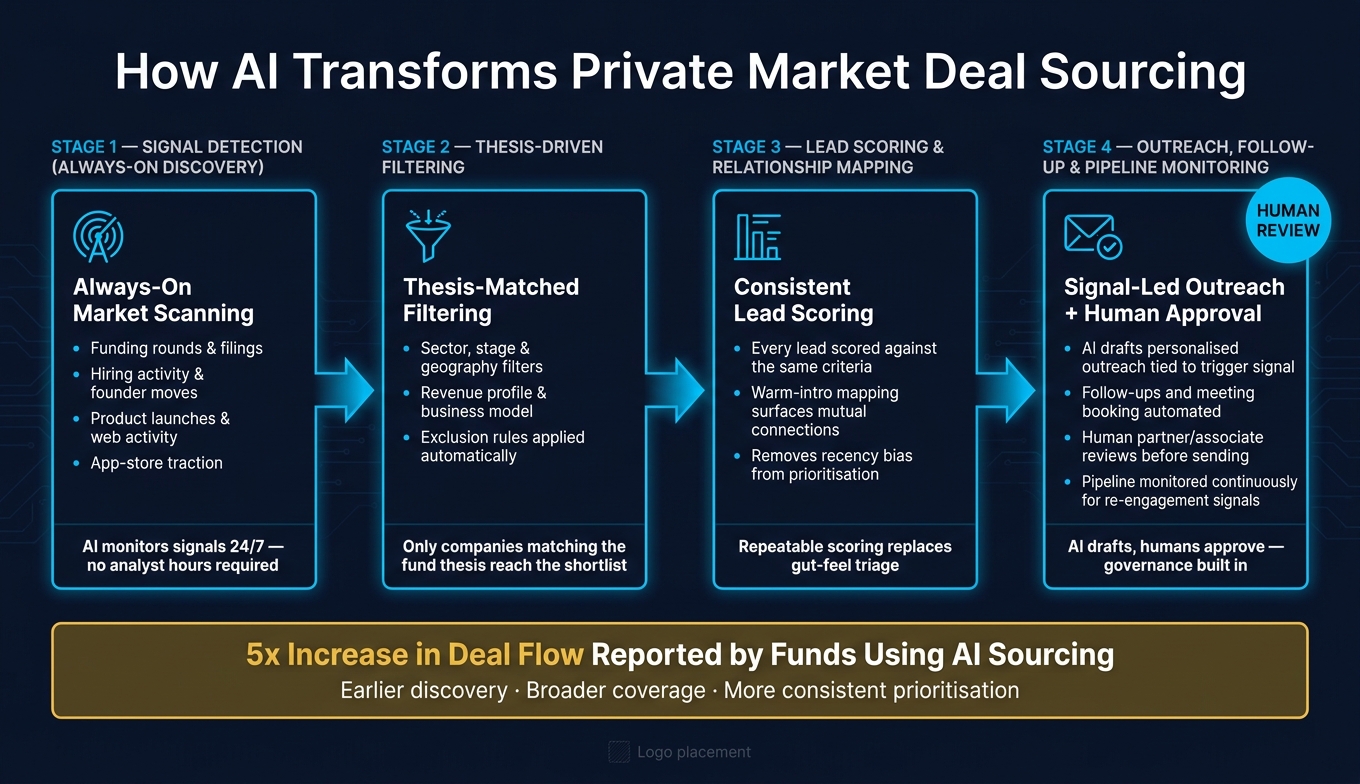
How AI Transforms Private Market Deal Sourcing: End-to-End Workflow
Always-on signal detection and thesis-driven company discovery
The fix is a sourcing workflow that keeps finding, ranking and routing leads all the time. AI keeps sourcing live, so it can surface companies that match the fund's thesis before they ever make it onto a manual shortlist.
It watches funding, hiring, founder moves, launches, web activity, app-store traction and filings. That means relevant companies can show up earlier, not after the market has already noticed them. It also filters by sector, stage, geography, business model, revenue profile and exclusions, so the list stays tight and relevant.
"Finding [the one deal that matters] means reading the entire market, not a shortlist. No human analyst can. They run out of hours. Avyn doesn't." - Avyn
Lead scoring and relationship mapping for consistent prioritisation
Once those signals appear, AI scores every lead using the same logic. That's the key point. Without a set process, teams often drift towards whatever was in the news last or whoever they spoke to most recently.
AI scoring checks each company against the same criteria in the pipeline, including sector fit, stage and revenue profile. That keeps the shortlist repeatable and helps the team spend time on the best-fit opportunities instead of chasing noise.
Warm-intro mapping adds another useful layer. Instead of relying on memory or manual searching, AI can show who in a firm's network already knows a founder or could make an introduction. In plain terms, it helps turn a cold lead into a warmer conversation with less digging.
Personalised outreach and follow-up automation increase throughput
Scoring only matters if it leads to outreach at the right time. AI drafts outreach around the trigger signal, such as hiring, founder moves or launches, so messages feel specific and relevant. They can also be written in the firm's voice rather than sounding like a generic template.
Follow-up is another area where automation helps. AI can manage follow-ups, reply handling and meeting booking automatically, which keeps the pipeline moving without piling more manual work onto the team. There is still human approval in the loop: AI drafts messages and surfaces opportunities, then a partner or associate reviews them before anything is sent. That keeps scoring, outreach and follow-up inside one workflow instead of spreading them across separate tools.
How AI supports pipeline monitoring and operational control
Signal-based pipeline monitoring keeps opportunities active
Once outreach begins, AI keeps an eye on the pipeline and flags changes that can affect priority. It tracks live opportunities on a continuous basis and looks for signals such as founder activity, senior hires and fundraising. When something meaningful shows up, it brings the update to the surface and nudges the team to re-engage or reprioritise the opportunity.
One signal can lead to different next steps. It might prompt a follow-up, a shift in priority, or a pause.
Unified workflows reduce tool switching and improve governance
Monitoring tends to work best when sourcing, notes, outreach and approvals live in one workflow. Split those tasks across different tools, and records can go stale fast. You also lose a clear view of where each opportunity stands.
Avyn brings sourcing, relationship mapping, outreach, pipeline tracking, diligence notes and approvals into one process. It also includes built-in approvals, so AI-generated updates and outreach drafts are checked before they go out. That means the human role moves more towards reviewing exceptions and making the call.
That governance layer gives investment teams a clear audit trail, without forcing every update to be written by hand.
How funds can adopt AI sourcing effectively
Once the workflow is live, the next step is to turn it into a controlled pilot.
Start with a clear thesis, data inputs, and pilot metrics
Before you pick a tool, pin down the fund thesis in plain rules. In practice, that means turning the thesis into filters, exclusions, and scoring rules the system can rank against.
From there, map the data inputs that matter most, including data buried in PDFs and other unstructured documents. Then test the workflow on a small, defined slice of the market. The aim is simple: see whether it brings better opportunities to the surface.
Track a few clear signals during the pilot:
- whether coverage expands
- whether manual triage drops
- whether opportunity quality improves
After the pilot shows it can do the job, attention moves to privacy, approvals, and team adoption.
Build around privacy, approvals, and team adoption
Confidential deal data needs careful handling. That means clear access controls, secure storage, and human review at each stage. If the system drafts outreach or updates, a person should approve them before anything goes out.
The point isn't to replace investor judgement. It's to cut the admin load around it. Work shifts away from producing first drafts and chasing updates, and towards reviewing exceptions and making the call.
If the workflow is repeatable and approved, it's ready to scale.
Conclusion: AI makes sourcing earlier, broader, and more repeatable
Standard sourcing is limited by networks, manual research, and signals that show up too late. AI helps close each of those gaps. Funds using AI analysts for private market sourcing have reported a 5x increase in deal flow. The strongest results have come from thesis-led, approval-driven workflows that bring in more qualified deal flow with less operational drag.
FAQs
How does AI find companies earlier?
AI helps investment teams spot companies earlier by scanning the market all the time, instead of leaning on shortlists built by hand.
That matters because manual sourcing has limits. A team can only track so many sectors, founders, and signals on its own. AI changes that. It can watch companies around the clock, score them against a specific investment thesis, and flag the ones that fit best.
It can also map existing network connections for warm introductions. So rather than starting cold, teams can see who already knows whom and use those links to reach founders in a more natural way.
The end result is simple: teams can surface relevant deals before they become widely known.
What signals should funds track first?
Funds should focus on signals that help them read the whole market instead of leaning on manual shortlists. AI can scan broad market data and rank companies against a fund’s investment thesis, which gives teams a much clearer view of where the best-fit deals may sit.
It also helps to track network signals. That way, teams can see who might open the door to a warm introduction, surface relevant opportunities sooner, and begin outreach earlier than they would with manual prospecting alone.
How can teams pilot AI sourcing safely?
Teams should avoid bolting AI onto old processes and instead take an AI-first approach from the start. That helps them steer clear of weak manual habits and the headache of keeping old systems going.
A safe pilot is to use AI as an intelligent analyst. In practice, that lets teams assess the whole market against a specific investment thesis, rather than leaning on narrow manual shortlists.